U.S. GDP Nowcast Rises to 1.2% as Consumer Sentiment ImprovesU.S. GDP Nowcast Rises to 1.2% as Consumer Sentiment Improves
Date: 2026-11-20Author: GDP Dynamics
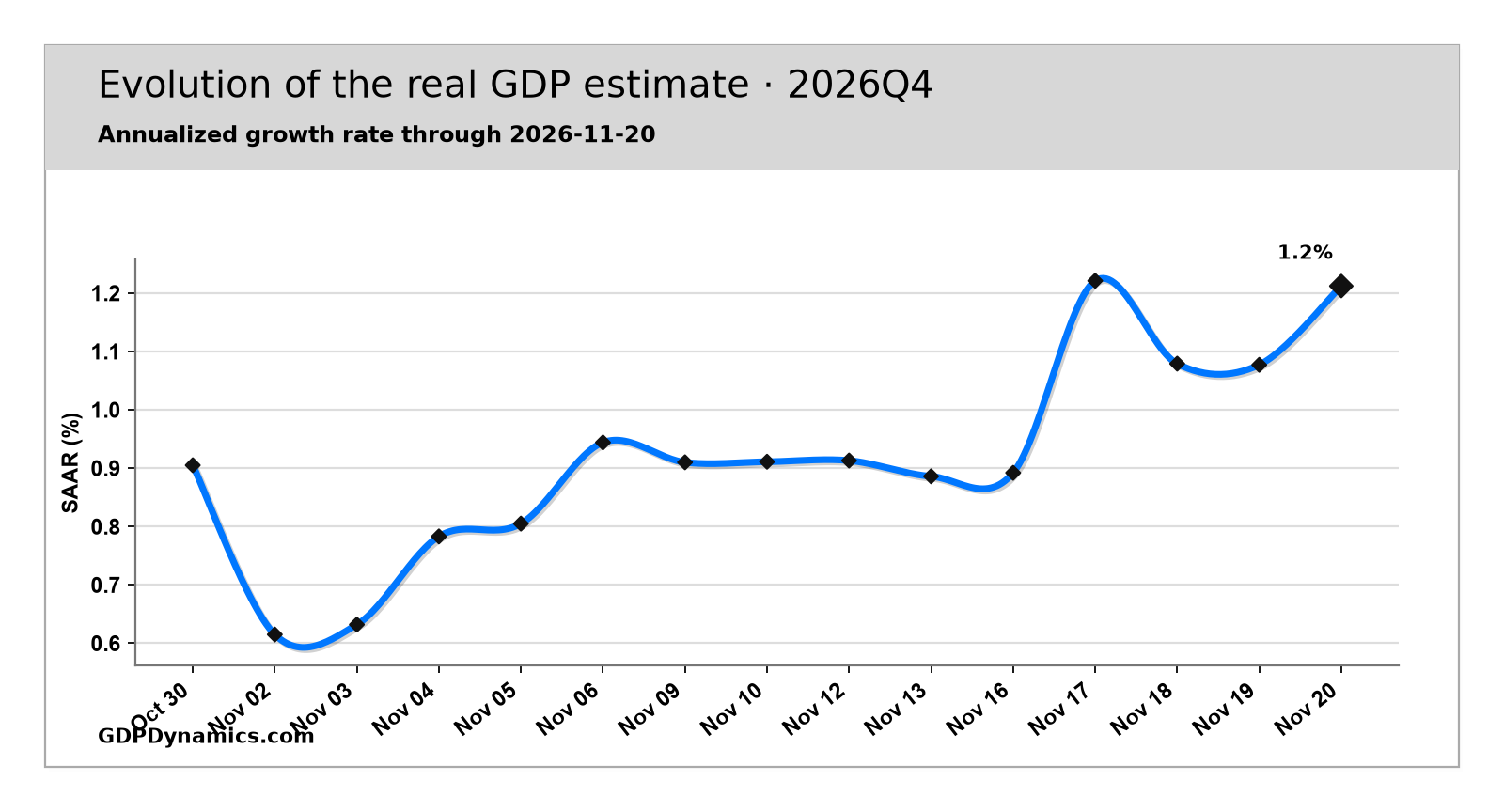
The GDP Dynamics nowcast for fourth-quarter U.S. real GDP growth increased to 1.2% at a seasonally adjusted annual rate (SAAR) on November 20, up 0.1 percentage point from the previous day's estimate of 1.1%. The latest revision reflects an improvement in the model's consumer spending outlook, supported by stronger consumer sentiment and updated financial market data.
The increase is modest, but it comes amid conflicting signals about the health of household demand. Consumer confidence improved in November, even as recent spending figures suggest households remain under pressure from elevated prices and slower real income growth.
Nowcast Path
Consumer Sentiment Improves, but Spending Remains Uneven
The University of Michigan's final November consumer sentiment index increased to 51.5, compared with 48.0 in October and a preliminary November reading of 51.0. All major components improved, with expectations for near-term business conditions showing a particularly strong increase.
According to the survey, lower gasoline prices provided some relief for middle- and lower-wealth households, while expectations surrounding economic policy changes following the midterm elections contributed to the improvement. However, consumer sentiment remains historically weak, reflecting continued concerns over living costs and economic uncertainty.
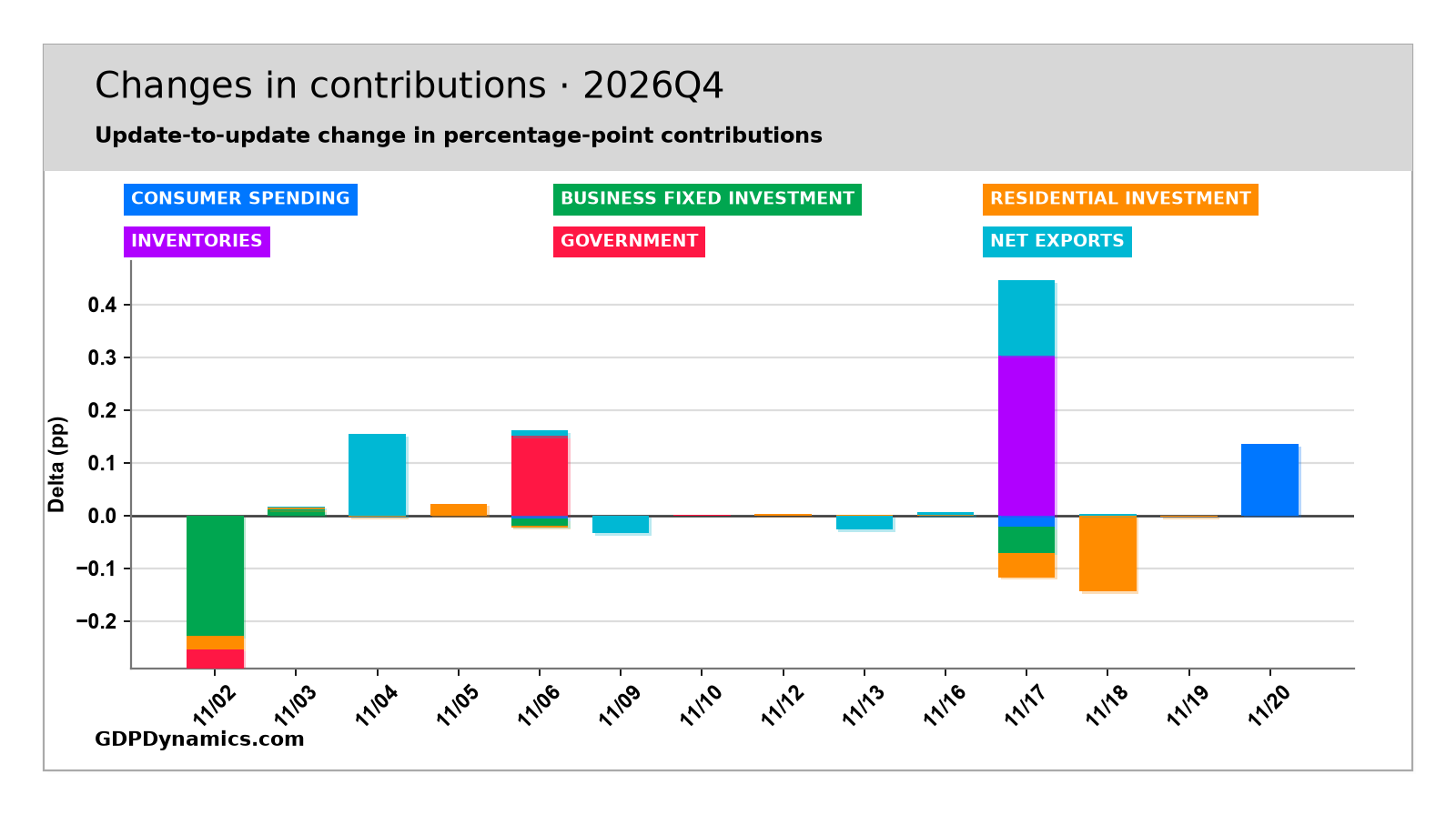
The improvement coincides with a 0.1 percentage point increase in the GDP Dynamics consumer spending contribution, bringing its estimated contribution to fourth-quarter growth to 1.2 percentage points.
Recent spending figures provide a more complicated picture. October retail sales increased just 0.2%, following a stronger 0.8% gain in September. However, the retail sales control group, which more closely tracks the goods component of GDP, increased 0.6%. This suggests underlying spending was firmer than the headline figure alone would indicate.
The latest available personal consumption expenditures report also warrants caution. Real consumer spending was essentially unchanged in September, while real disposable personal income declined 0.3%. Nominal spending continued to increase, but higher prices accounted for much of that growth. Stronger consumer confidence is encouraging, although it does not necessarily translate into an immediate increase in inflation-adjusted household spending.
Housing Data Send Mixed Signals
Residential investment remains a source of weakness in the fourth-quarter outlook, although recent housing construction figures offer some evidence of improvement.
According to the Census Bureau's November 18 release, housing starts increased 9.9% in October to an annualized rate of 1.309 million units. Single-family starts increased 4.0%, indicating some recovery in construction activity following September's weaker figures.
Building permits, however, moved in the opposite direction, declining 7.4% during October. Single-family permits fell 8.7%, raising questions about whether the improvement in housing starts will continue into the coming months.
Financial conditions have also shifted. The 10-year Treasury yield declined from 5.04% on November 19 to 4.92% on November 20. Lower long-term yields can eventually ease mortgage financing costs, although borrowing rates remain elevated and any response in construction activity generally takes time.
GDP Dynamics currently estimates residential investment will subtract 0.4 percentage points from fourth-quarter GDP growth. Its contribution was effectively unchanged in today's update, with the reported adjustment rounding to 0.0 percentage points. The latest figures therefore point to a housing sector that remains weak despite some encouraging construction activity.
Contribution Changes
Breaking Down the Fourth-Quarter Outlook
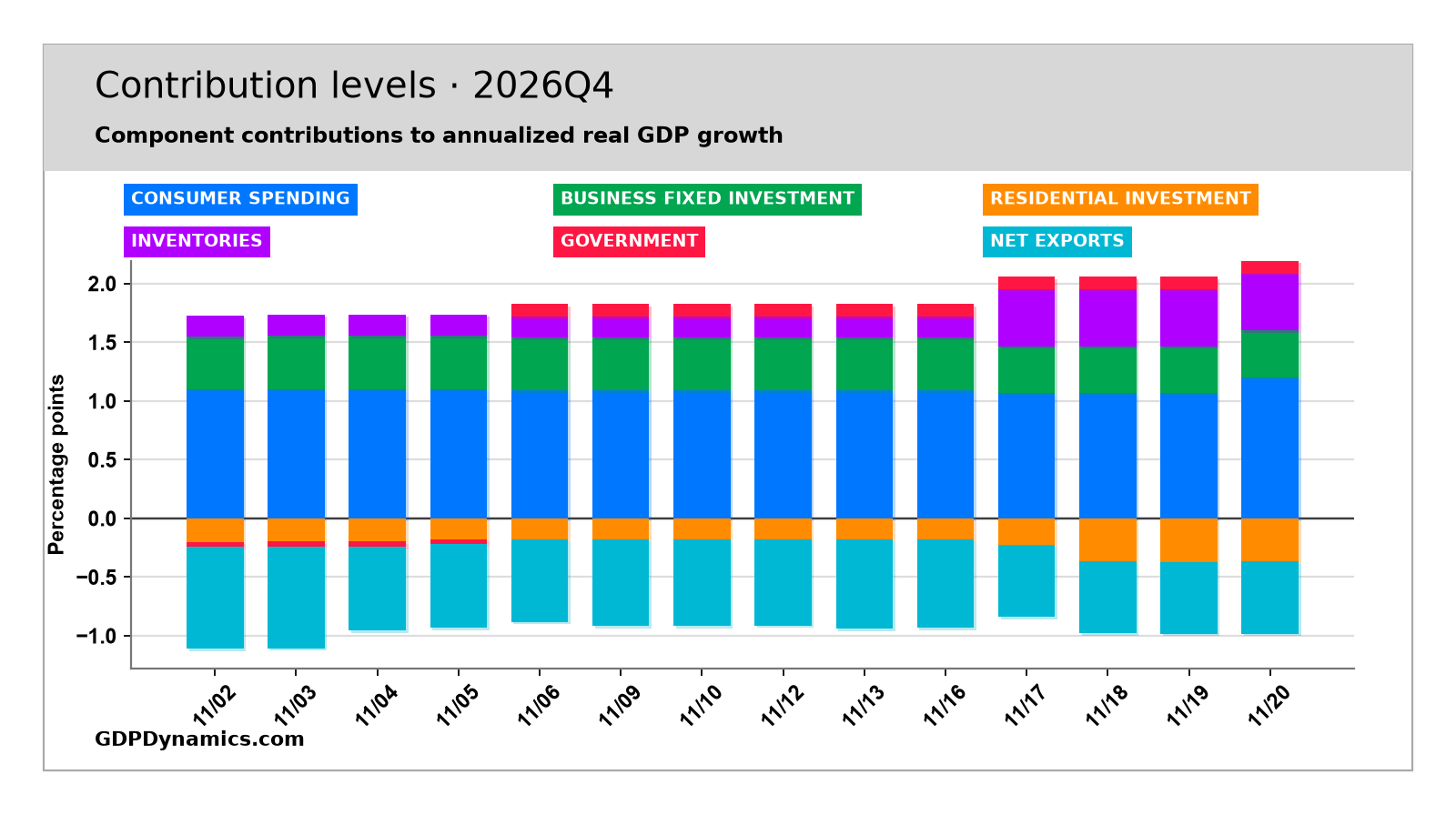
The current estimate continues to reflect substantial differences across the major components of GDP. Consumer spending contributes an estimated 1.2 percentage points to annualized growth, followed by inventory investment at 0.5 percentage points and business fixed investment at 0.4 percentage points.
Government spending contributes another 0.1 percentage point. Offsetting these gains are net exports, which subtract 0.6 percentage points, and residential investment, which subtracts 0.4 percentage points.
These figures illustrate why the overall growth estimate remains relatively subdued. Positive contributions from domestic spending and investment are being partially offset by weakness in the external sector and residential construction. Consumer spending accounts for the entire reported 0.1 percentage point improvement in today's nowcast, rather than merely representing its largest contribution by level.
Contribution Levels
Outlook
The November 20 update brings the GDP Dynamics fourth-quarter nowcast to 1.2%, suggesting that economic growth continues at a relatively modest pace. The improvement in consumer sentiment provides some encouragement, but recent retail sales, real income, and housing figures leave considerable uncertainty about the strength of domestic demand.
Today's model snapshot incorporates the University of Michigan consumer sentiment reading and the 10-year Treasury yield. Other recently released economic statistics provide important context, but they should not be confused with new inputs responsible for today's revision.
The next major consumer spending release arrives November 25, when the Bureau of Economic Analysis publishes October personal income and outlays. That report should provide a clearer indication of whether improving household confidence is being accompanied by stronger real spending.