US GDP Nowcast Holds at 1.1% as Housing Remains a Drag on Fourth-Quarter Growth
Date: 2026-11-19Author: GDP Dynamics
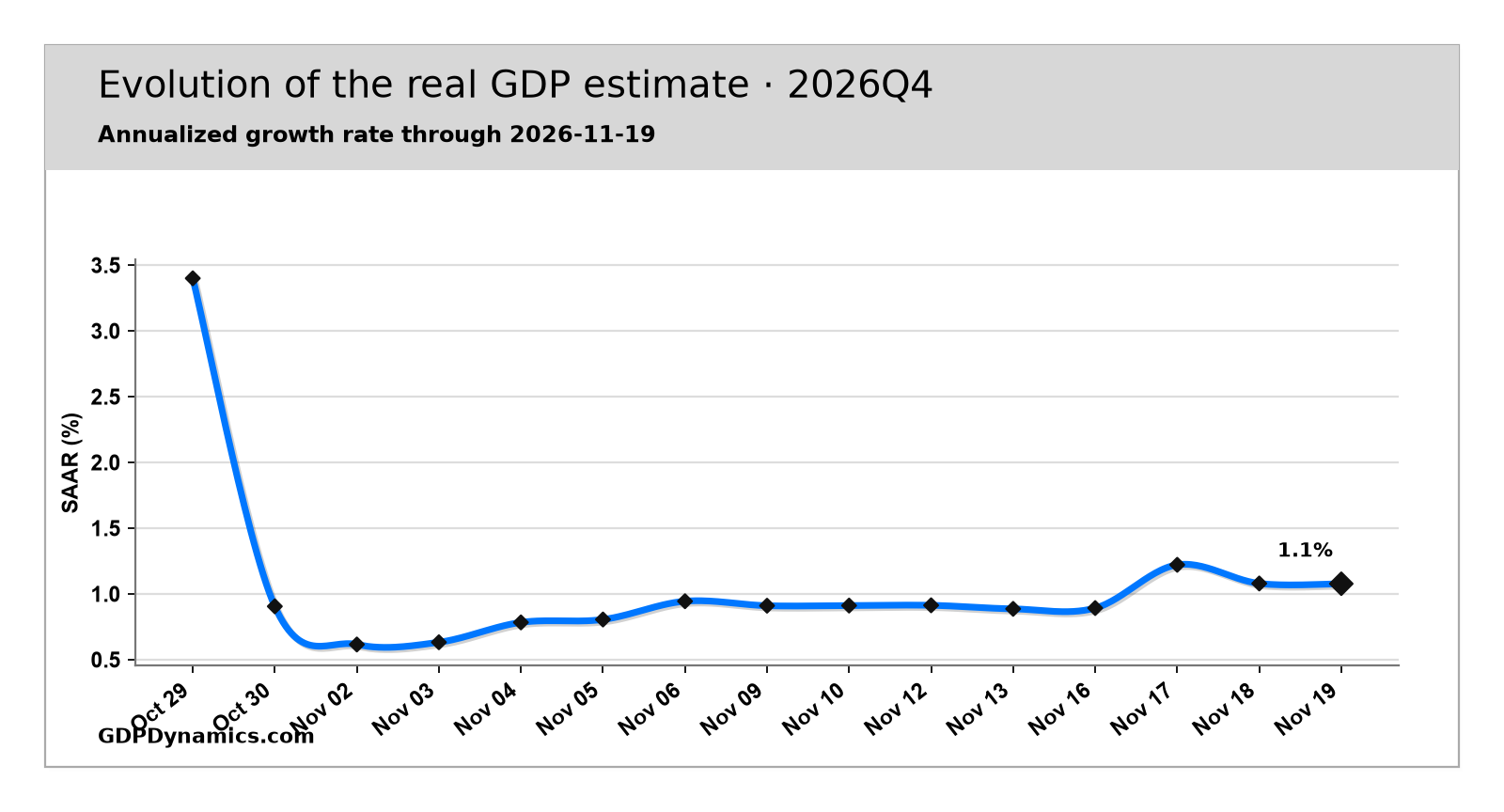
The GDP Dynamics nowcast for fourth-quarter US real GDP growth remained at 1.1% annualized on November 19, with residential investment continuing to weigh on the outlook. The latest update incorporated initial unemployment claims, the 30-year mortgage rate, and the 10-year Treasury yield, producing only a marginal downward revision to the underlying forecast.
Although the published estimate is unchanged at one-decimal precision, the unrounded nowcast slipped from 1.079% to 1.077%, a decline of 0.002 percentage points. The difference is too small to change the headline figure but is reflected in the nowcast's daily trajectory. At the current estimate, fourth-quarter real GDP is projected to expand by approximately 0.3% on a nonannualized quarter-over-quarter basis.
Nowcast Path
Higher Mortgage Rates Keep Pressure on Residential Investment
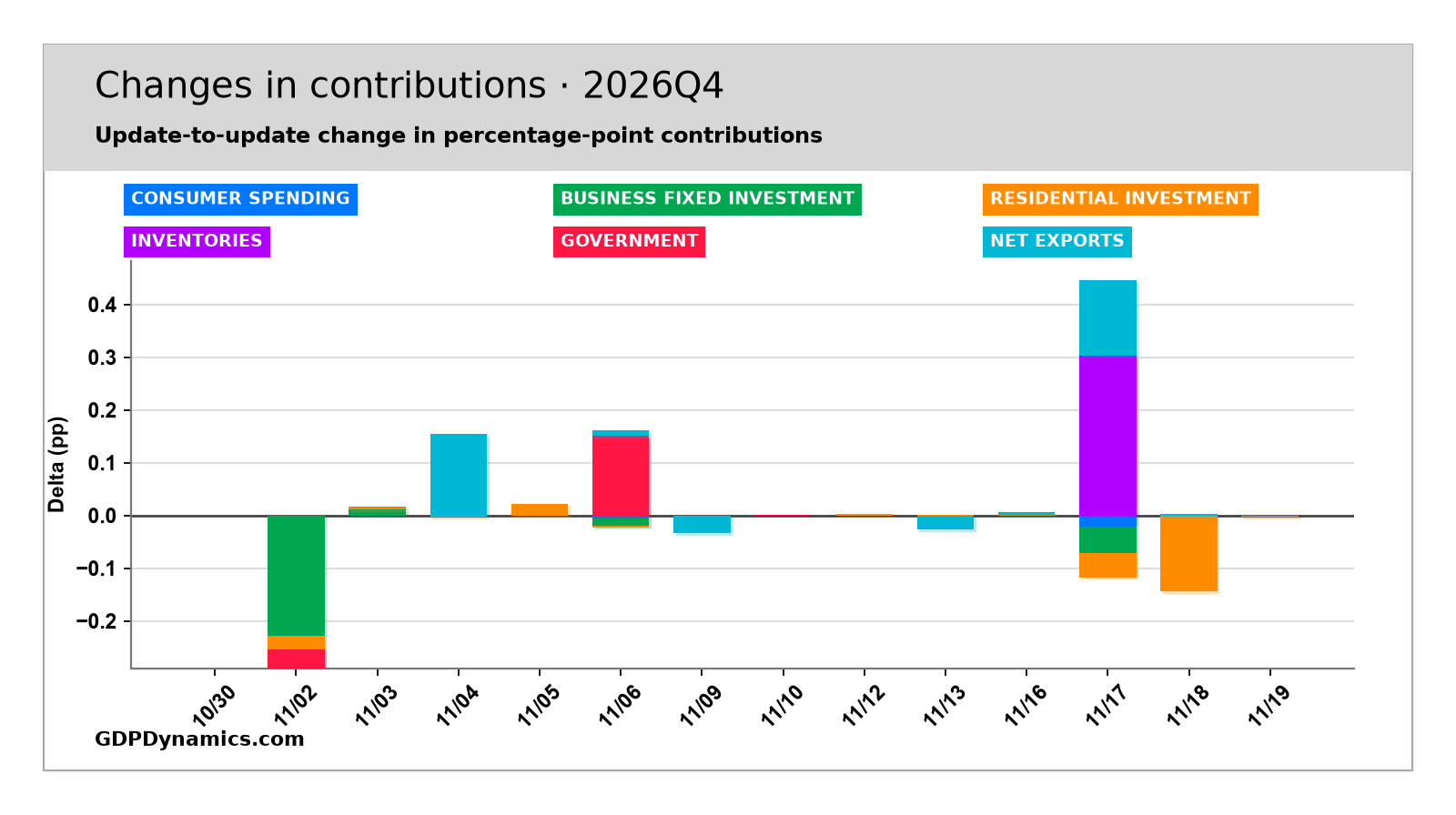
Housing remains one of the weakest components of the fourth-quarter outlook. Residential investment currently subtracts approximately 0.4 percentage points from projected GDP growth and was the only component identified as contributing negatively to the latest daily revision.
Mortgage financing conditions deteriorated further this week. According to Freddie Mac's November 19 survey, the average 30-year fixed mortgage rate increased to 7.28%, up from 7.11% the previous week. Higher mortgage rates reduce purchasing power for prospective homebuyers and can make new residential construction less financially attractive.
The broader construction data present a mixed picture. The Census Bureau's October housing report, released November 18, showed housing starts increasing 9.9% to an annualized 1.309 million units. Single-family starts increased 4.0%. However, building permits declined 7.4% to 1.295 million units, while single-family permits fell 8.7%.
That distinction matters. Housing starts measure construction already getting underway, whereas permits provide information about the pipeline of potential future projects. The increase in starts offers some near-term encouragement, but the contraction in permits suggests builders remain cautious about committing to additional construction.
Earlier construction spending figures reinforce the weakness. September private residential construction spending fell 5.5% from August, according to the Census Bureau.
These figures help explain the housing sector's negative outlook, although the November 18 construction release was not one of the three new inputs listed in today's model snapshot. The exact daily revision should therefore not be attributed to that release alone.
Contribution Changes
Labor Market Claims Show Limited Deterioration
The latest labor market figures offered relatively little evidence of a major shift in employment conditions. Initial unemployment claims increased by just 1,000 to 203,000 for the week ending November 14, while the four-week moving average rose to 197,750.
The modest increase does not indicate a substantial acceleration in layoffs. It also provides little reason, on its own, to expect a sharp deterioration in consumer spending during the fourth quarter.
Longer-term borrowing costs remain another important consideration. The 10-year Treasury yield was approximately 5.1% in the latest available Federal Reserve H.15 figures. Elevated longer-term yields continue to influence financing conditions for households and businesses, particularly in interest-sensitive sectors such as housing.
Where Fourth-Quarter Growth Is Coming From
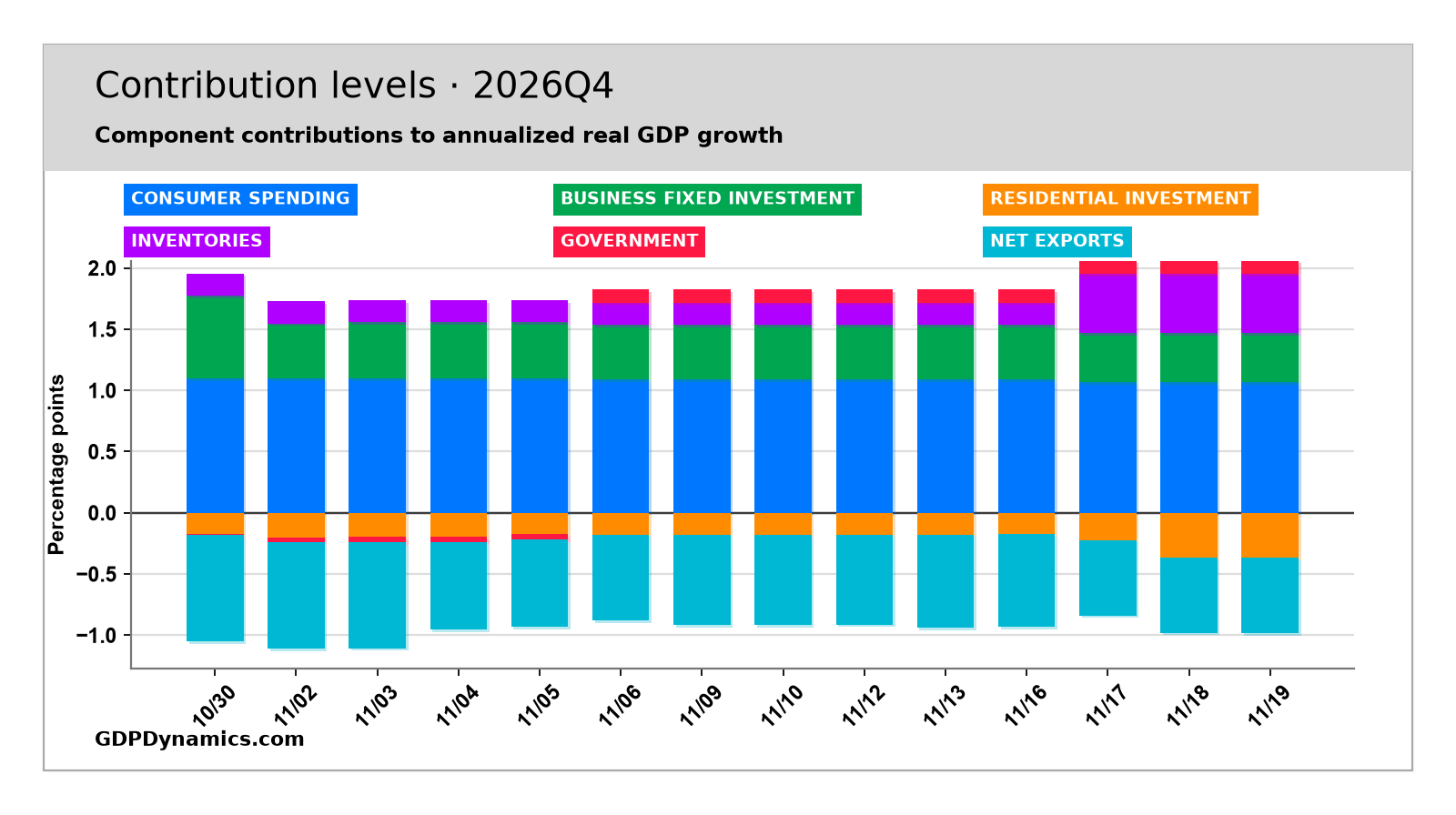
The composition of the nowcast remains uneven. Consumer spending currently contributes approximately 1.1 percentage points to projected GDP growth, while inventory accumulation adds 0.5 percentage points and business fixed investment contributes another 0.4 percentage points. Government spending makes a smaller positive contribution of 0.1 percentage points.
These gains are partially offset by two substantial negative components. Net exports subtract approximately 0.6 percentage points, while residential investment subtracts 0.4 percentage points.
Consumer spending accounts for the largest positive contribution in absolute terms, reflecting its substantial share of economic activity. However, its contribution level should not be confused with evidence of accelerating consumption. Today's update does not identify a meaningful positive change in consumer spending, and the principal downward adjustment remains concentrated in residential investment.
Contribution Levels
Outlook: Modest Growth With Persistent Housing Weakness
The November 19 update leaves the overall picture largely unchanged. The US economy is still projected to expand during the fourth quarter, but the forecast remains modest at 1.1% annualized growth.
Housing continues to face considerable pressure from borrowing costs, weaker permitting activity, and declining residential construction spending. At the same time, unemployment claims have not shown a comparable deterioration, and positive contributions from consumption, inventories, and business investment continue to support the forecast.
The immediate question is whether housing weakness remains concentrated in residential investment or begins to affect other components of demand as the quarter progresses. For now, the latest information supports a small downward adjustment rather than a substantial change in the economic outlook.
The GDP Dynamics nowcast will continue to incorporate incoming economic releases as additional fourth-quarter data become available.