US GDP Nowcast Falls to 1.1% as Housing Permits Signal Further Weakness
Date: 2026-11-18Author: GDP Dynamics
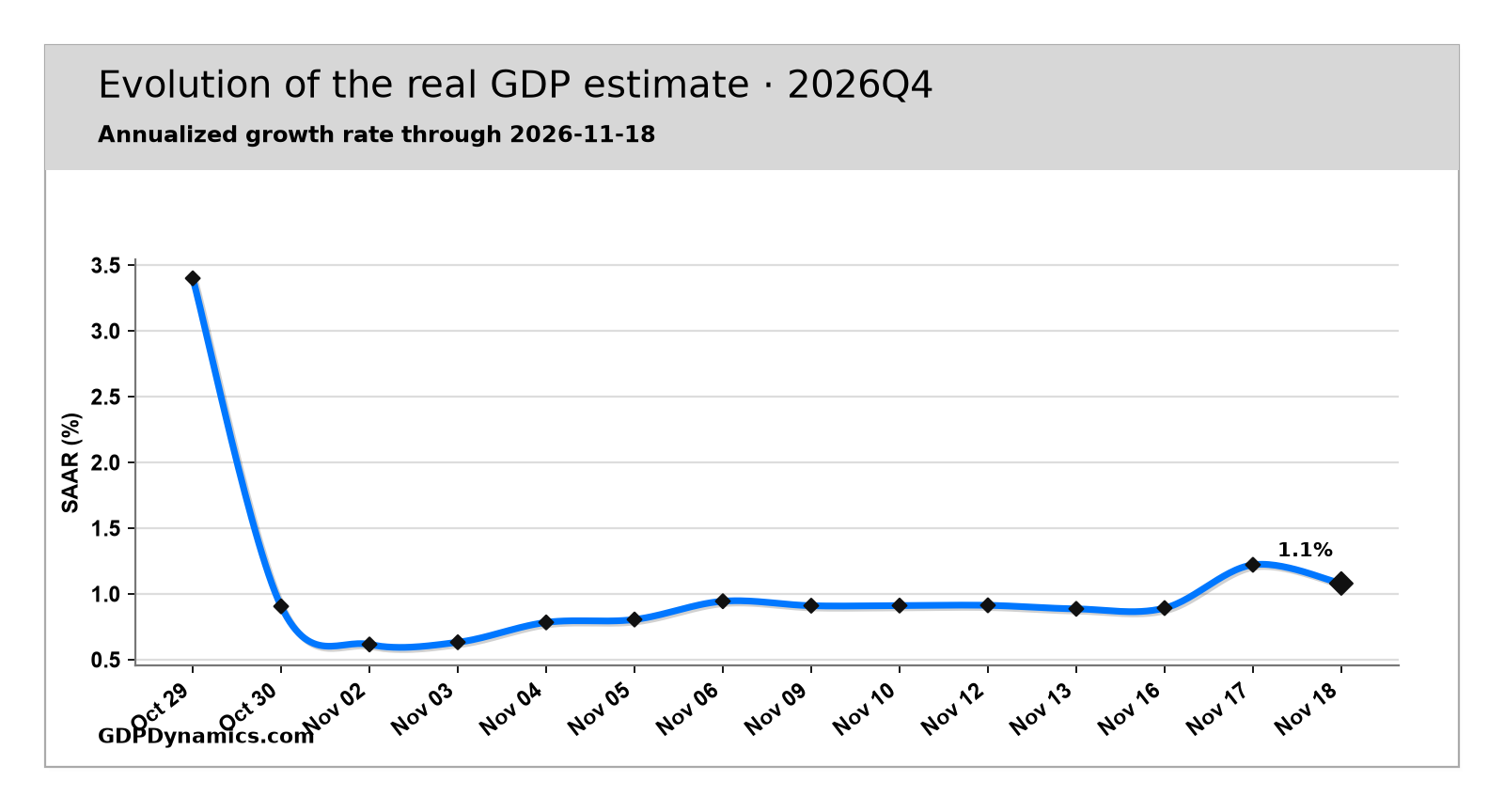
The GDP Dynamics nowcast for the fourth quarter of 2026 slipped to 1.1% annualized growth on November 18, down 0.1 percentage points from yesterday's estimate of 1.2%. That translates to approximately 0.3% growth on a quarter-over-quarter basis. The latest revision was concentrated in residential investment following a mixed report on housing construction.
Nowcast Path
Housing Starts Rebound, but Building Permits Tell a Different Story
The US Census Bureau's October residential construction report delivered conflicting signals about the housing market. Total housing starts increased 9.9% from September to a seasonally adjusted annual rate of 1.309 million units. Single-family starts also improved, rising 4.0% to 864,000 units. On their own, those figures suggest construction activity recovered somewhat after a weak September.
The less encouraging figures came from building permits. Total permits declined 7.4% to an annualized rate of 1.295 million units, while single-family permits fell 8.7% to 772,000 units. The distinction matters because housing starts measure construction getting underway, while permits provide an indication of the projects builders are preparing to undertake. More homes may have entered construction in October, but fewer new projects were authorized.
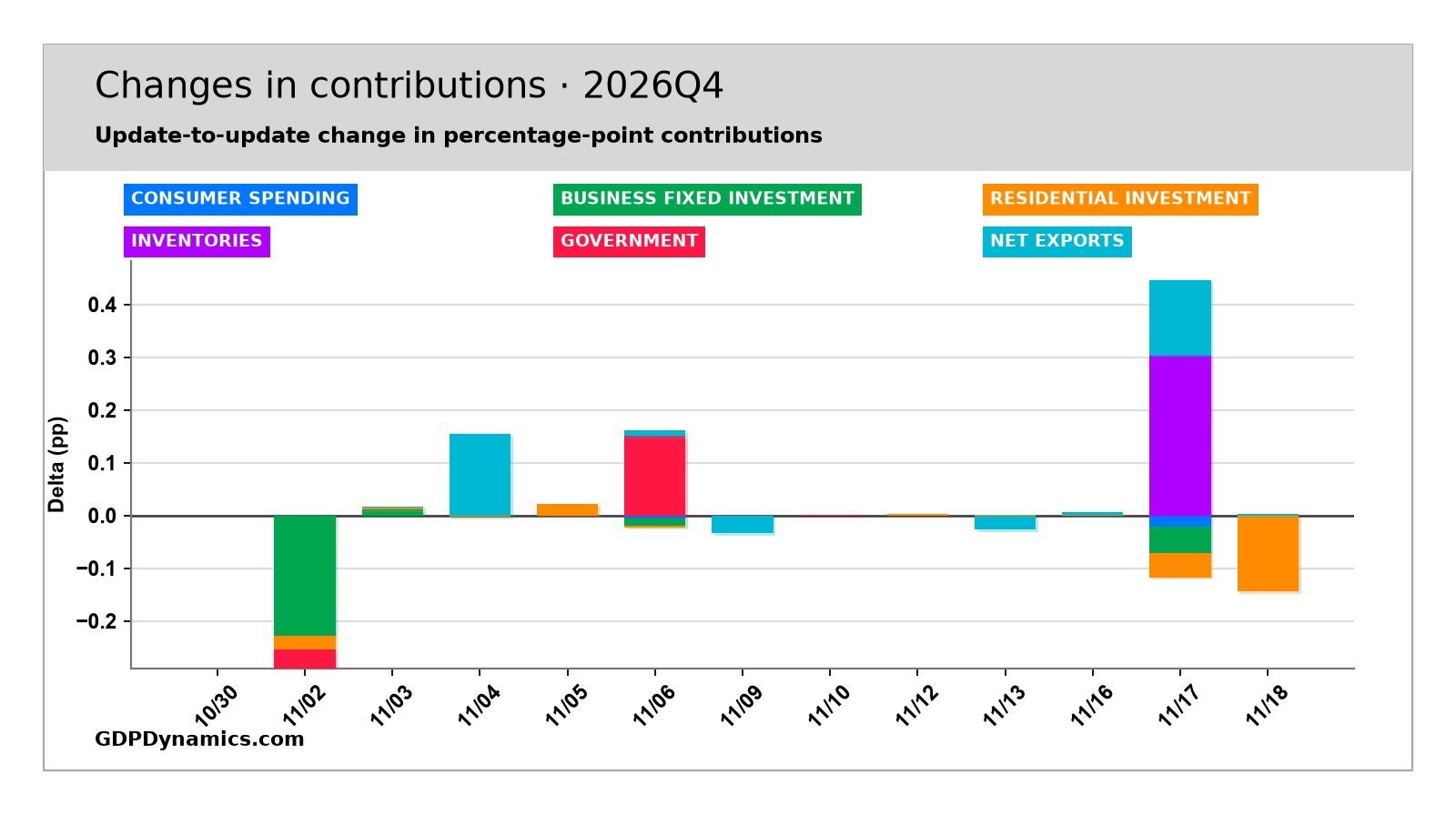
The GDP Dynamics model responded by reducing residential investment's contribution to fourth-quarter GDP growth by 0.1 percentage points. Residential investment is now expected to subtract approximately 0.4 percentage points from annualized GDP growth.
The broader construction picture offers little reassurance. September's construction spending report showed private residential spending falling 5.5% from August. Meanwhile, the National Association of Home Builders reported that builder confidence dropped to 25 in November, its lowest reading since April 2012. Elevated mortgage rates, affordability problems, and construction costs continue to weigh on the sector.
The positive movement in housing starts is worth acknowledging, but it has not yet translated into a convincing recovery in the outlook for residential investment.
Contribution Changes
What the Rest of the Economy Is Contributing
Outside residential investment, the November 18 revision was relatively quiet. Net exports registered a small positive adjustment that rounds to 0.0 percentage points, leaving housing responsible for essentially the entire reported decline in the nowcast.
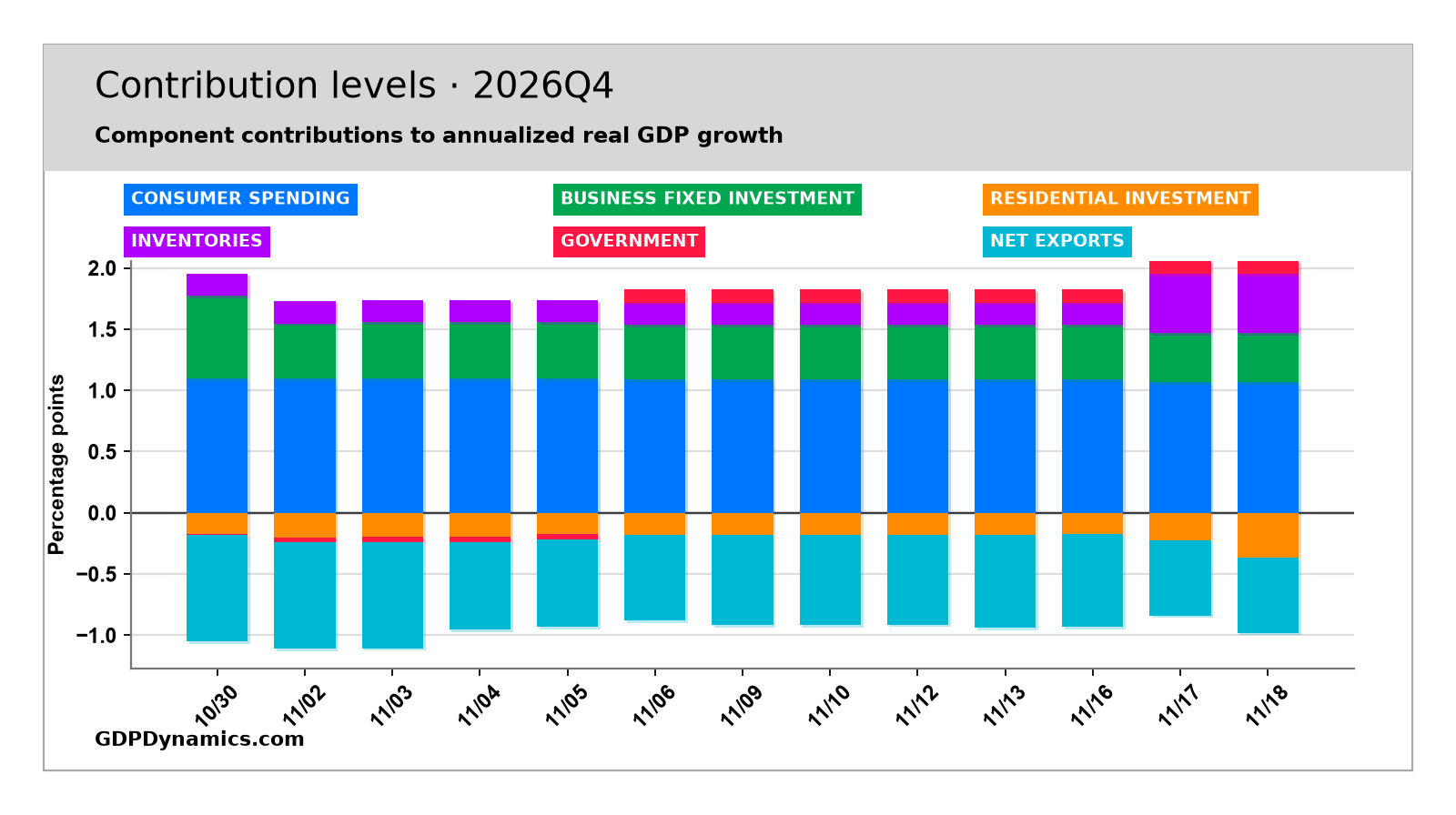
Consumer spending is currently expected to contribute 1.1 percentage points to fourth-quarter growth. Business fixed investment adds another 0.4 percentage points, while changes in inventories contribute approximately 0.5 percentage points. Government spending is expected to add 0.1 percentage points.
These positive contributions are partly offset by residential investment and net exports, which are each expected to subtract 0.4 and 0.6 percentage points, respectively.
The external sector remains a substantial drag on the current estimate, even though its contribution changed very little in today's update. The latest published international trade report, covering September, showed the US trade deficit narrowing slightly from $105.7 billion in August to $105.0 billion. Exports increased by $5.8 billion, compared with a $5.2 billion increase in imports. Those figures provide some context for the external sector, but they were released on November 4 and do not represent new trade data in today's revision.
Contribution Levels
Outlook: Housing Remains the Immediate Concern
The latest GDP Dynamics estimate continues to point toward positive but relatively modest economic growth in the final quarter of 2026. The decline from 1.2% to 1.1% is small, but the underlying housing figures deserve attention.
October's increase in housing starts demonstrates that construction activity has not fallen uniformly. However, the sharp drop in permits suggests that the pipeline of future residential projects is weakening. If builders continue to scale back new projects, residential investment could remain a drag on economic growth into the coming quarters.
For now, the model's central estimate remains at 1.1% annualized growth, with housing accounting for the latest downward revision. Further releases on consumer activity, business investment, trade, and construction will determine whether the fourth quarter settles near this estimate or moves in either direction.