U.S. GDP Nowcast Rises to 1.2% as Inventories Lift Fourth-Quarter Growth Outlook
Date: 2026-11-17Author: GDP Dynamics
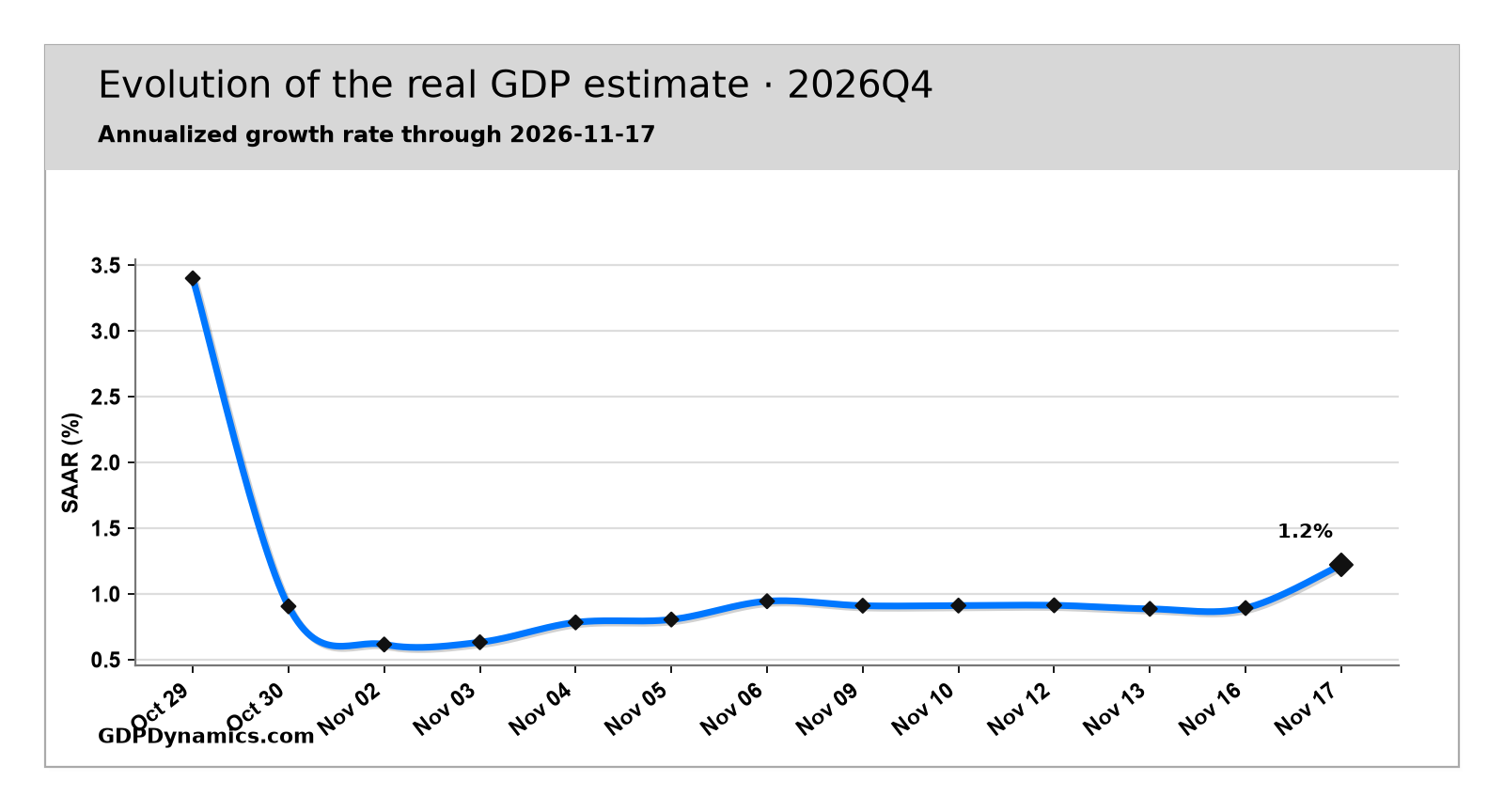
The GDP Dynamics nowcast for U.S. real GDP growth in the fourth quarter of 2026 increased to 1.2% at a seasonally adjusted annual rate (SAAR) on Tuesday, November 17, up 0.3 percentage points from Monday's estimate of 0.9%. That translates to approximately 0.3% growth on a nonannualized quarter-over-quarter basis. Most of today's upward revision came from inventories, with a smaller improvement in net exports. The stronger estimate is encouraging, but the underlying data continue to paint a mixed picture of the U.S. economy, particularly when it comes to consumer spending and industrial production.
Nowcast Path
Inventories Account for Most of Today's Increase
Inventory investment contributed an additional 0.3 percentage points to the GDP nowcast, making it the largest positive revision in today's update. Its estimated contribution to fourth-quarter growth now stands at 0.5 percentage points. The increase coincides with the Census Bureau's latest manufacturing and trade inventories report, released Tuesday, which showed that total business inventories increased 0.5% in September to approximately $2.87 trillion. Retail inventories excluding automobiles were also revised higher, rising 0.5% rather than the previously reported 0.4%.
There is an important distinction in these figures. Business sales increased 1.8% in September, considerably faster than inventories, bringing the inventory-to-sales ratio down from 1.35 to 1.33. That suggests businesses were not simply accumulating unwanted merchandise as sales weakened. Inventories were increasing while sales were expanding even faster. September belongs to the third quarter, so these figures should not be interpreted as a direct addition to fourth-quarter GDP. Instead, they provide updated information about inventory behaviour that the nowcast uses in estimating current-quarter activity. Whether the stronger inventory contribution persists will depend on subsequent releases.
<figure><img src="assets/2026-11-17_u-s-gdp-nowcast-rises-to-1-2-as-inventories-lift-fourth-quarter-growth-outlook/nowcast_daily_contribution_changes.png" alt="Contribution Changes" loading="lazy" /><figcaption>Contribution Changes</figcaption></figure>
Retail Sales Slow While Manufacturing Holds Up
The latest consumer spending data were less encouraging at the headline level. According to the Census Bureau, retail and food services sales increased just 0.2% in October, compared with a 0.8% increase in September. Motor vehicle and parts dealers experienced a 1.6% decline in sales, contributing to the slowdown. However, the retail sales control group, which excludes several volatile categories and is more closely associated with goods consumption in GDP, increased 0.6%. That was slightly stronger than September's revised 0.5% increase.
This distinction matters because the headline retail sales number alone does not tell us how much real household consumption changed. Retail sales are reported in nominal dollars, while real GDP is adjusted for price changes and includes substantial spending on services. In today's GDP Dynamics update, the consumer spending contribution was effectively unchanged after rounding, remaining at 1.1 percentage points. The October figures suggest some moderation in headline spending, but they do not establish a broad contraction in household demand.
Industrial production also delivered a mixed result. The Federal Reserve reported that total industrial output declined 0.4% in October, following a 0.7% increase in September. Much of that decline came from utilities, where output fell 4.3%, while mining declined 0.8%. Manufacturing production actually increased 0.3%, supported by a 4.4% increase in motor vehicle and parts production. Business equipment production also rose 1.0%, suggesting that weakness in aggregate industrial production was not uniform across the industrial sector. The contribution from business fixed investment was essentially unchanged in today's nowcast, remaining at 0.4 percentage points, while residential investment continued to subtract approximately 0.2 percentage points.
Net Exports Improve but Remain a Drag
Net exports added another 0.1 percentage points to today's GDP growth estimate, although their overall contribution remains negative at approximately -0.6 percentage points. The latest official international trade figures, released November 4, showed that the U.S. trade deficit narrowed slightly from $105.7 billion in August to $105.0 billion in September. Exports increased by $5.8 billion, while imports increased by $5.2 billion.
Those trade figures provide some context for the external sector, but they predate today's nowcast revision and cover the third quarter. The improvement in the model's fourth-quarter estimate should therefore not be attributed directly to September's narrowing deficit. More complete October trade data will be needed to determine whether the external sector is genuinely becoming less of a constraint on growth.
Where the Fourth-Quarter Nowcast Stands
The current contribution estimates show consumer spending adding 1.1 percentage points to annualized GDP growth, inventories adding 0.5 percentage points, business fixed investment adding 0.4 percentage points, and government spending adding 0.1 percentage points. Residential investment subtracts 0.2 percentage points, while net exports subtract 0.6 percentage points. These contributions are individually rounded, which accounts for small differences between their sum and the overall nowcast.
<figure><img src="assets/2026-11-17_u-s-gdp-nowcast-rises-to-1-2-as-inventories-lift-fourth-quarter-growth-outlook/nowcast_daily_contributions.png" alt="Contribution Levels" loading="lazy" /><figcaption>Contribution Levels</figcaption></figure>
The most important development in today's update is that the improvement in expected fourth-quarter GDP growth is concentrated in inventories rather than a substantial upward revision to household consumption or business investment. That does not make the increase meaningless, but it does raise an important question about its durability. Inventory investment can contribute to measured GDP growth without necessarily indicating a comparable improvement in final demand, and its contribution can reverse when businesses adjust their stock-building behaviour.
For now, the GDP Dynamics model points to 1.2% annualized real GDP growth in the fourth quarter, a modest improvement from yesterday but still a relatively subdued pace of expansion. The next several releases will help determine whether inventories continue supporting the estimate or whether changes in consumer demand, production, investment and trade begin to shift the outlook in a more substantial direction.