US GDP Nowcast Holds at 0.9% as Dollar Strength and Higher Treasury Yields Shape the Outlook
Date: 2026-11-16Author: GDP Dynamics
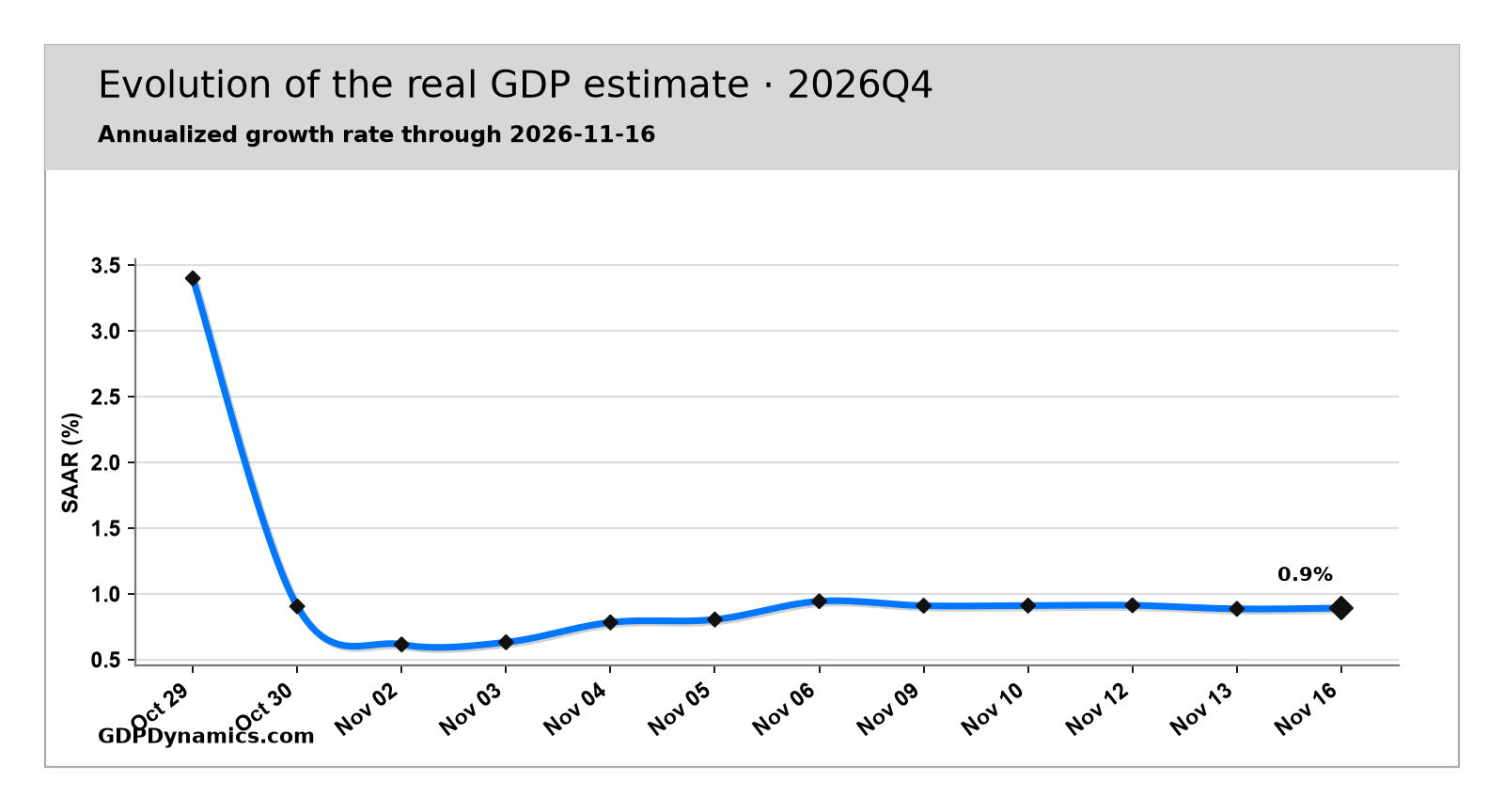
The GDP Dynamics nowcast for the fourth quarter of 2026 remained at 0.9% annualized growth on Monday, November 16, as the latest financial market data produced only a marginal upward revision to the underlying estimate. The model moved from 0.886% on November 13 to 0.892% on November 16, an increase of just 0.006 percentage points. Both estimates round to 0.9%, leaving the published headline unchanged. On a nonannualized basis, the projection represents approximately 0.2% growth for the quarter.
Although the headline remained steady, the latest update offers another look at the competing forces shaping the American economy. Consumer spending and business investment continue to make positive contributions to projected growth, while foreign trade and residential investment remain significant drags. The latest adjustment was too small to change that overall picture, but it occurred against a backdrop of rising Treasury yields and a strengthening US dollar, both of which have implications for economic activity heading into the final weeks of the year.
Nowcast Path
A Stronger Dollar and Higher Borrowing Costs
The November 16 update incorporated two newly released data inputs: the Federal Reserve's Broad Dollar Index and the 10-year Treasury yield. Rather than a new report on consumer spending, housing construction or business equipment orders, this update reflects the latest financial conditions feeding into the model's estimates of fourth-quarter economic activity.
According to the Federal Reserve's H.10 release, published November 16, the nominal broad US dollar index increased from 121.6623 on November 9 to 122.6503 on November 13, a gain of approximately 0.8%. The advance reflects a broader appreciation of the dollar against the currencies of major US trading partners. A stronger dollar generally makes American exports more expensive for foreign buyers while reducing the dollar cost of imported goods, potentially weighing on net exports if trade volumes respond. These effects rarely appear immediately, however, and changes in relative prices do not necessarily translate into equivalent changes in actual shipments or expenditures within the same quarter.
Treasury yields have also moved considerably higher. The US Treasury's daily yield data show the 10-year yield reaching 5.15% on November 13, compared with 5.10% the previous trading session and 4.86% on November 6. That represents an increase of 29 basis points in just one week. Higher long-term yields can raise financing costs for households and businesses, particularly in interest-sensitive areas such as housing construction, commercial investment and durable goods purchases. The consequences depend on how persistent those higher yields become and how quickly borrowing costs transmit into spending decisions.
Taken together, these financial indicators suggest a more restrictive environment for parts of the economy. The small upward revision in the GDP Dynamics nowcast should not be interpreted as evidence that a stronger dollar or rising interest rates are themselves stimulating growth. The model's estimated component contributions have shifted slightly, but the available release snapshot does not establish a direct causal breakdown linking each revision to a specific financial indicator.
Where Fourth-Quarter Growth Is Coming From
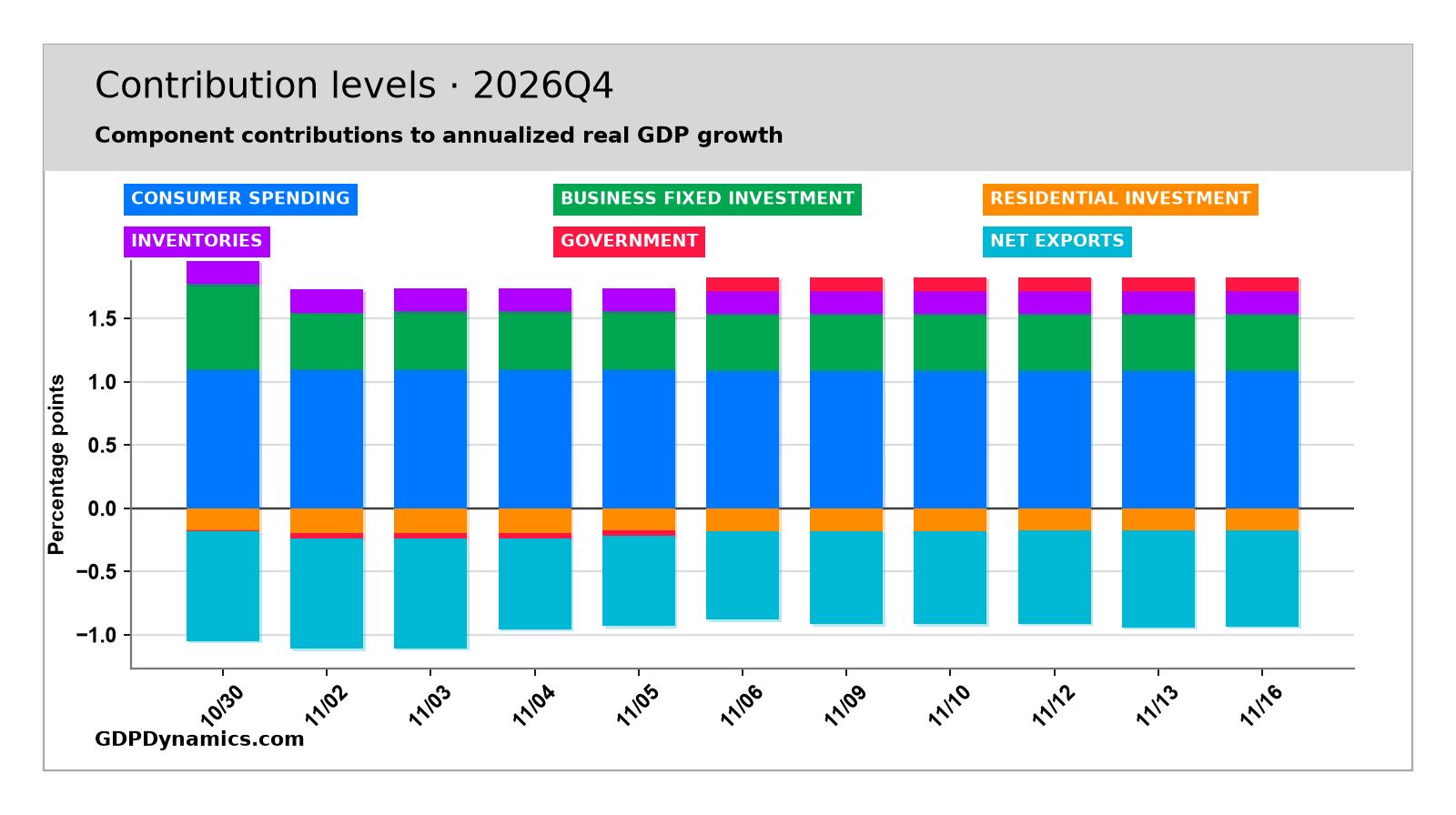
The composition of the GDP Dynamics forecast remains uneven, with positive contributions from domestic consumption and investment offset by weakness in foreign trade and residential construction. Consumer spending is currently projected to contribute 1.1 percentage points to annualized GDP growth, reflecting its substantial weight in total economic activity. Business fixed investment contributes another 0.4 percentage points, while inventory accumulation adds approximately 0.2 percentage points and government expenditure contributes 0.1 percentage points.
These positive contributions are partly offset by net exports, which subtract an estimated 0.8 percentage points from fourth-quarter growth. Residential investment subtracts another 0.2 percentage points, indicating that housing-related activity remains a drag on the projected expansion. The contributions are individually rounded to one decimal place, so their displayed sum need not match the more precisely calculated headline nowcast.
The contrast between business fixed investment and residential investment is particularly important. The model continues to project a positive contribution from business capital spending even as residential construction weighs on growth. This distinction matters when interpreting higher borrowing costs, since investment categories differ in their exposure to financing conditions, spending commitments and adjustment delays. Similarly, a negative net-export contribution does not necessarily mean exports are contracting outright. It means the combined contribution from exports and imports is currently expected to reduce measured GDP growth.
Contribution Levels
Small Improvements Beneath an Unchanged Headline
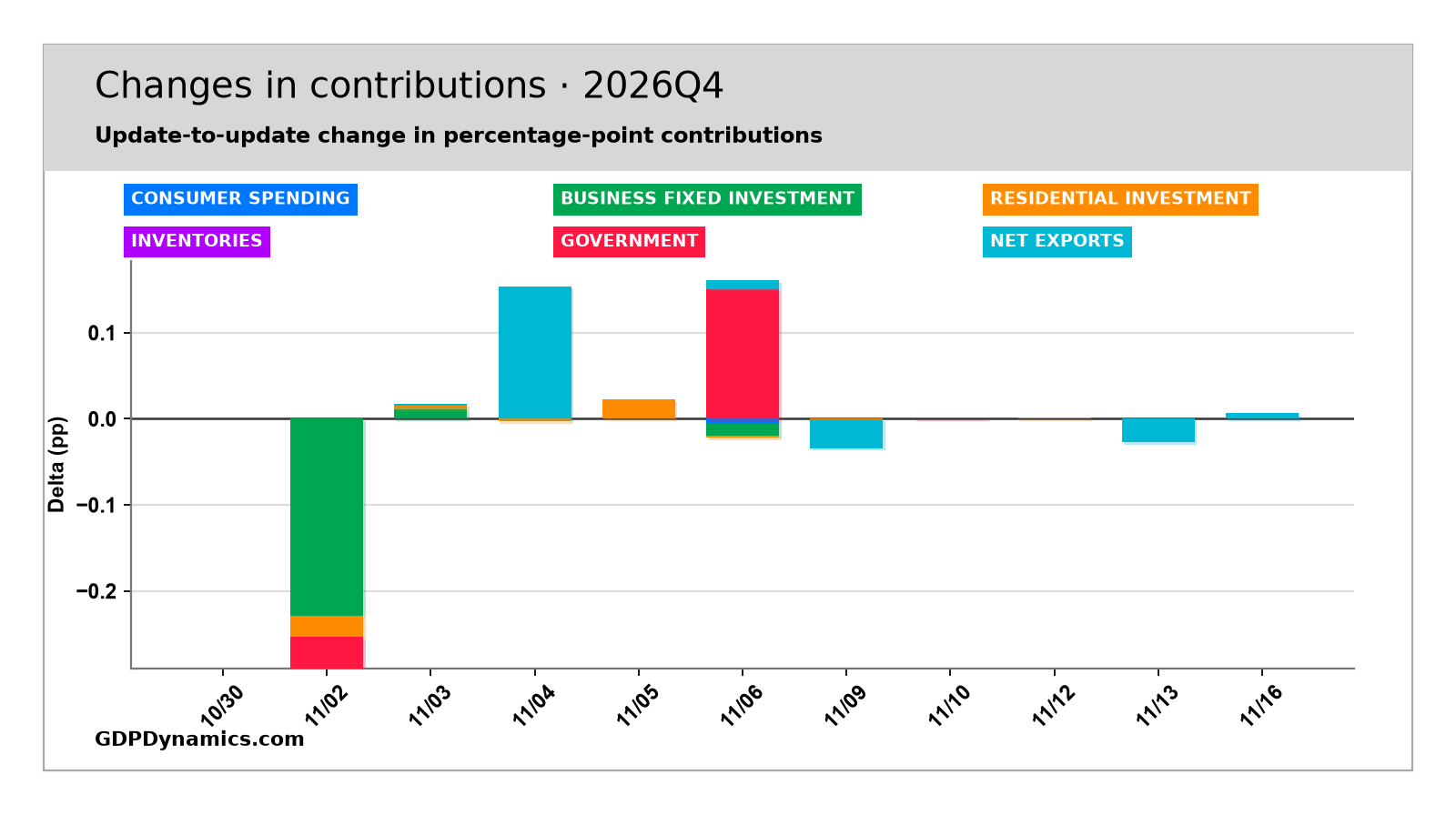
The latest model run identified small positive revisions in net exports, residential investment and business fixed investment. However, each adjustment rounds to 0.0 percentage points at the precision used in the published contribution-change figures. No negative contribution revisions were identified in this update, leaving the combined movement slightly positive but far too small to alter the headline growth estimate.
The distinction between contribution levels and contribution changes is important here. Net exports remain a substantial negative contributor to projected GDP growth despite receiving a slight upward revision, while residential investment continues to subtract from growth even though its estimate improved marginally. Business fixed investment remains positive, with another small upward adjustment to its estimated contribution. These revisions change the model's assessment at the margin without materially changing the economic outlook.
Because the current snapshot contains only two newly released financial indicators, these movements should not be attributed to fresh improvements in the trade balance, housing starts or capital goods orders. Those would require separate release evidence. The current changes are better understood as minor adjustments to the model's projected expenditure components following the incorporation of updated financial data, rather than confirmation of new spending or production trends.
Contribution Changes
The Outlook Remains Subdued
At 0.9% annualized growth, the GDP Dynamics forecast continues to point toward a relatively weak fourth quarter for the US economy. The latest revision is positive, but an increase of 0.006 percentage points offers little reason to change the broader interpretation. Consumption and business fixed investment remain sources of positive growth contributions, while the external sector and residential investment continue to offset part of that expansion.
The more consequential question is whether the recent strengthening of the dollar and increase in long-term interest rates persist long enough to influence actual expenditure decisions. Higher financing costs could place additional pressure on residential and business investment, while a stronger exchange rate could complicate the outlook for exporters. The magnitude and timing of those effects remain uncertain, and subsequent releases covering household spending, industrial activity, trade and construction will provide a clearer picture of how the economy is responding.
For now, the fourth-quarter estimate remains at 0.9% SAAR, with the small upward movement in the underlying model largely invisible at the published level of precision. The next meaningful change in the outlook is more likely to come from new evidence on actual economic activity than from a revision of this size.