GDP Dynamics Q4 Nowcast Holds at 0.9% as Mortgage Rates Ease
Date: 2026-11-12Author: GDP Dynamics
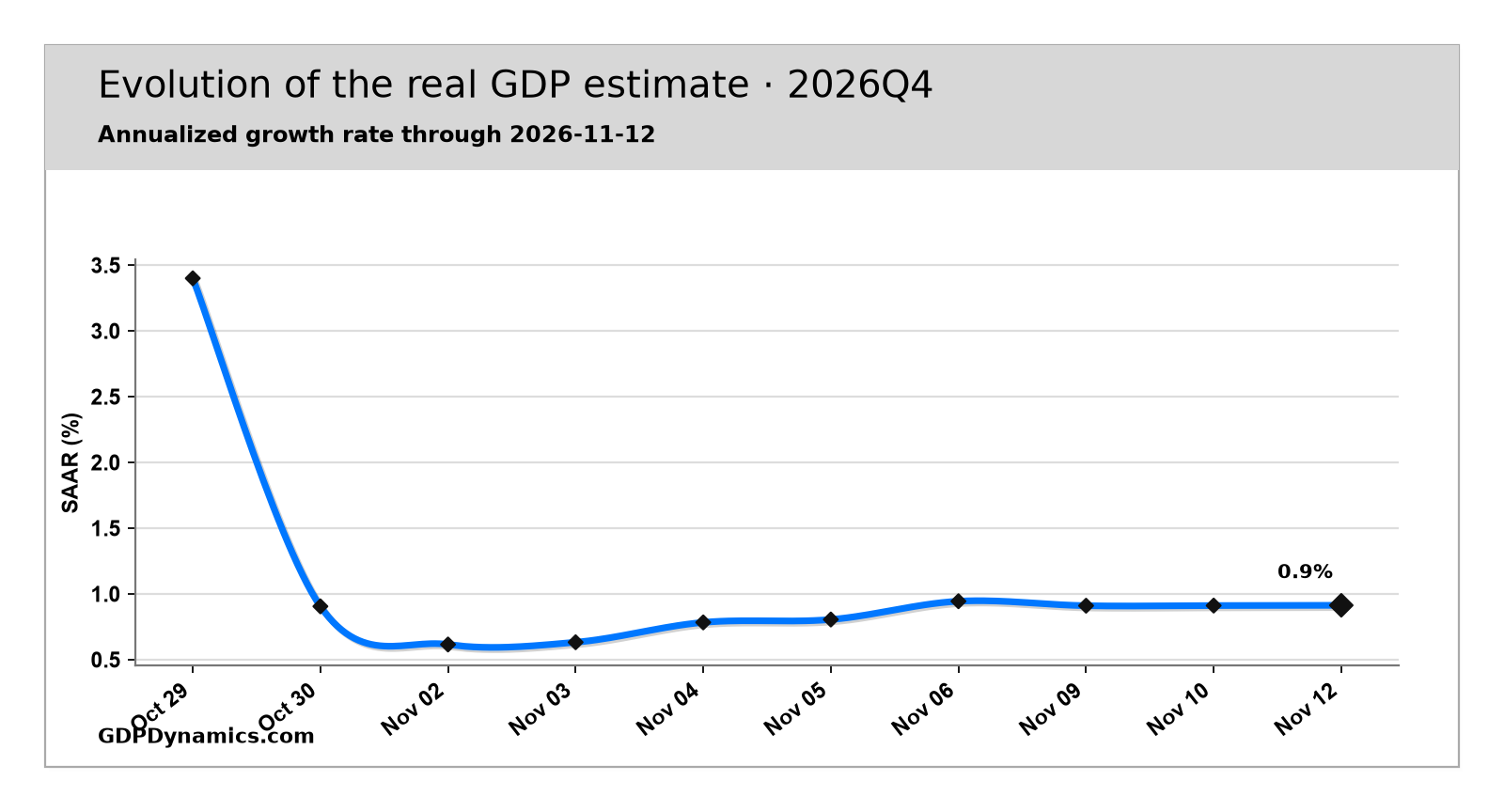
The GDP Dynamics nowcast for U.S. real GDP growth in the fourth quarter of 2026 remained at 0.9% on a seasonally adjusted annualized basis (SAAR) on November 12, equivalent to approximately 0.2% quarter-over-quarter growth.
The underlying estimate edged higher from 0.911% on November 10 to 0.913%, an increase of just 0.002 percentage points. That small revision is visible in the nowcast's daily path, although both estimates round to the same published figure of 0.9%.
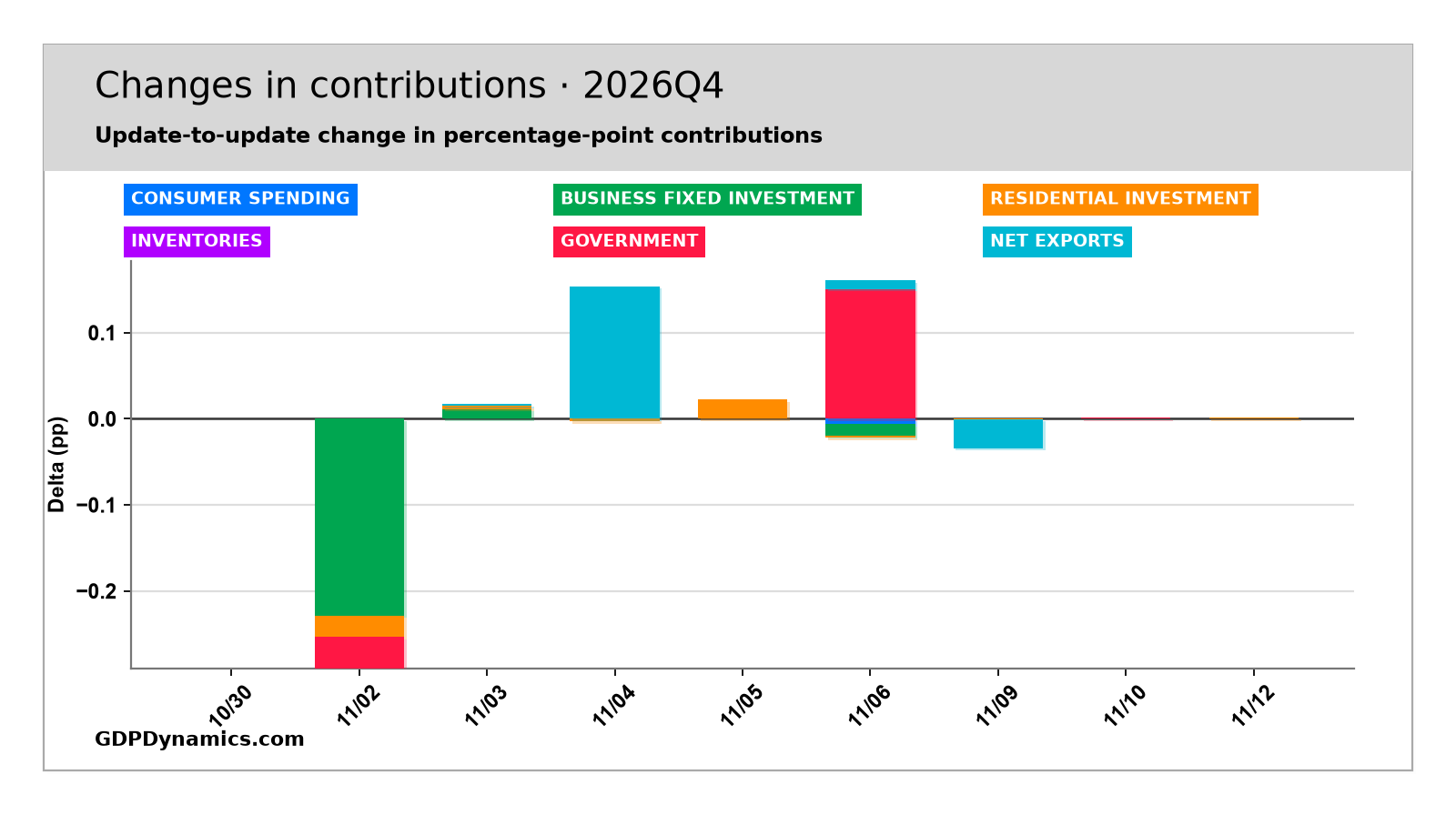
This was a relatively quiet update. Changes in mortgage rates, Treasury yields, and financial conditions produced minor adjustments to the forecast, with a slight improvement in residential investment offset by softer business fixed investment expectations.
Nowcast Path
Lower Mortgage Rates Offer Some Relief to Housing
The most encouraging development in the latest financial data came from mortgage rates.
According to Freddie Mac's November 12 Primary Mortgage Market Survey, the average 30-year fixed mortgage rate declined to 7.11%, down from 7.18% the previous week. This marked the fourth consecutive weekly decline and brought borrowing costs to their lowest level in seven weeks.
That is a modest improvement for a housing market still struggling with elevated financing costs. Lower mortgage rates can improve affordability at the margin, support prospective homebuyers, and eventually encourage additional residential construction. However, the average rate remains considerably higher than the 6.24% recorded a year earlier.
Within the GDP Dynamics model, residential investment received a small positive revision, although the change was too small to register at one-decimal precision in the contribution figures. Lower financing costs provide a plausible source of support for that adjustment, but the available update does not establish how much of the revision came from mortgage rates specifically.
It is also important to distinguish a change in financing conditions from an improvement in actual construction activity. The November 12 snapshot did not incorporate a new housing starts, building permits, or construction spending release. Those indicators will be needed to determine whether improved financing conditions are translating into additional residential investment.
Despite the minor improvement, residential investment is still expected to subtract approximately 0.2 percentage points from fourth-quarter GDP growth.
Treasury Yields and Financial Conditions Tell a Different Story
The broader interest-rate environment is less encouraging.
The U.S. 10-year Treasury yield increased from 4.88% on November 9 to 4.98% on November 10, according to Treasury data. The increase followed a stronger-than-expected October inflation report, which renewed concerns about the possibility of additional Federal Reserve tightening.
Higher Treasury yields matter because they influence financing costs throughout the economy, including corporate borrowing, commercial real estate, and longer-term investment decisions. They can also put renewed upward pressure on mortgage rates, potentially reversing some of the recent improvement in housing finance.
Meanwhile, the Chicago Fed's National Financial Conditions Index moved from -0.465 for the week ending October 30 to -0.462 for the week ending November 6.
The index remains negative, indicating financial conditions are still looser than their historical average. However, the movement toward zero represents a slight tightening compared with the previous week.
These developments help explain why the latest nowcast adjustment was so small. Mortgage financing conditions improved, but the broader financial environment has not moved uniformly in the same direction.
Business fixed investment received a small negative revision in the model, although it continues to make a positive contribution to projected GDP growth. The available release information does not isolate whether that revision originated in equipment, structures, or intellectual property investment, so it would be premature to attribute it to a specific weakness in capital goods orders or manufacturing production.
Contribution Changes
What Is Supporting Fourth-Quarter Growth?
The composition of the GDP Dynamics forecast continues to show an economy growing slowly, with meaningful differences between its major expenditure components.
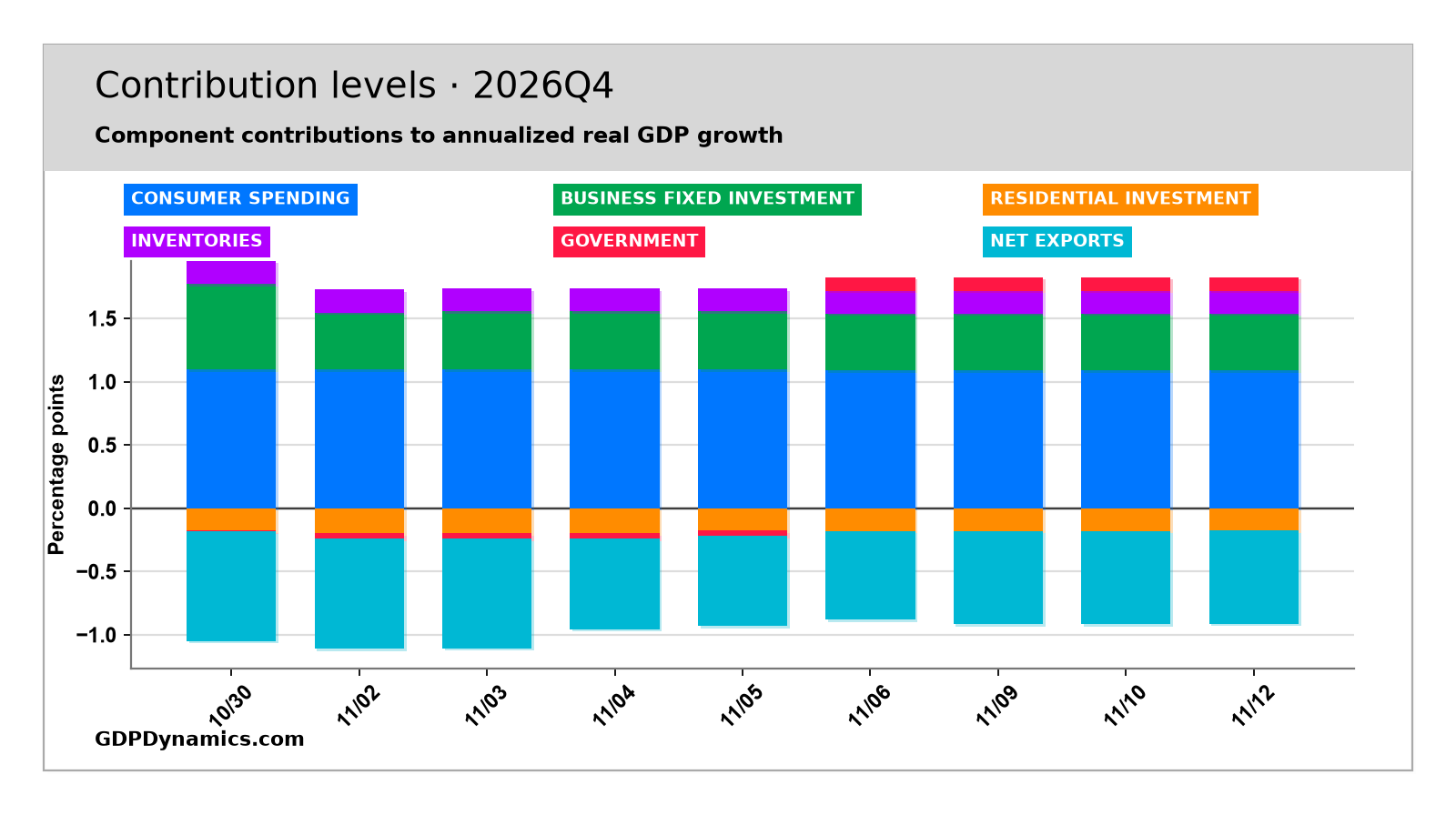
Consumer spending is currently projected to contribute approximately 1.1 percentage points to fourth-quarter GDP growth. This represents the largest contribution in level terms, although it should not be interpreted as evidence that consumption was responsible for the latest upward revision.
Business fixed investment contributes another 0.4 percentage points, while inventories add approximately 0.2 percentage points. Government expenditure is expected to make a smaller positive contribution of 0.1 percentage points.
Against these positive contributions, net exports subtract approximately 0.7 percentage points, making the external sector the largest projected drag on growth. Residential investment subtracts a further 0.2 percentage points despite its marginal improvement in the latest update.
Taken together, the contribution estimates produce a fourth-quarter growth forecast of approximately 0.9% SAAR.
The notable feature of this composition is that domestic demand is providing positive support while external trade and residential investment are reducing the overall growth rate. Even with positive contributions from consumer spending and business investment, the combined offsets leave the economy expanding at a relatively subdued pace.
Contribution Levels
What to Watch in the Coming Releases
The next round of economic data should provide a clearer picture of whether the fourth-quarter economy is maintaining its modest expansion or moving toward a weaker outcome.
October retail sales and industrial production are scheduled for November 17. Retail sales will provide additional information about household spending, while industrial production and manufacturing output will help assess the trajectory of business activity.
Housing starts and building permits follow on November 18. These releases will be particularly important for evaluating whether the recent improvement in mortgage rates is accompanied by any stabilization in residential construction.
The November 25 durable goods orders report will provide further evidence on business investment, including the direction of capital goods demand.
For now, the November 12 update leaves the central outlook essentially unchanged. The underlying forecast has moved slightly higher, but a 0.002 percentage-point adjustment is economically negligible compared with the uncertainty surrounding future expenditure and production data.
GDP Dynamics continues to project U.S. real GDP growth of 0.9% SAAR for the fourth quarter of 2026. The next meaningful change in the outlook will likely depend more on incoming evidence of actual economic activity than on small movements in financial market indicators.