GDP Dynamics Q4 Nowcast Holds at 0.9% as Inflation Pressures Intensify
Date: 2026-11-10Author: GDP Dynamics
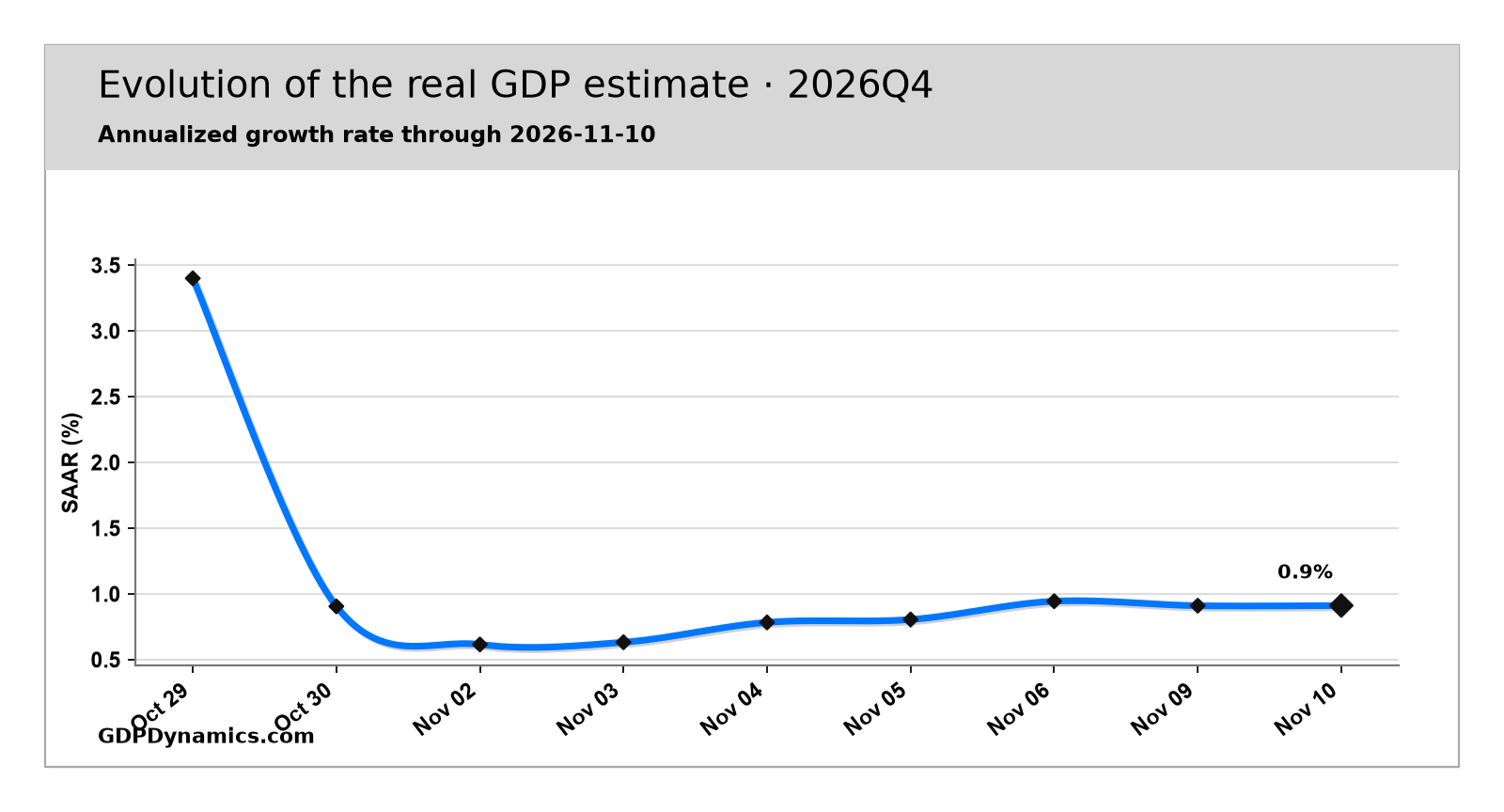
The GDP Dynamics nowcast for fourth-quarter 2026 U.S. real GDP growth remains at 0.9% on a seasonally adjusted annualized basis (SAAR), equivalent to approximately 0.2% quarter-over-quarter growth. Despite today's hotter-than-expected inflation report and a sharp increase in Treasury yields, the model's overall growth outlook has barely changed.
The underlying estimate edged higher from 0.910% on November 9 to 0.911% on November 10, an increase of just 0.001 percentage points. Both estimates round to 0.9% at the published precision. This explains the slight upward movement in the nowcast's daily path without indicating any meaningful acceleration in projected economic activity.
Nowcast Path
October Inflation Comes in Hotter Than Expected
The most significant economic release of the day was the Bureau of Labor Statistics' October Consumer Price Index (CPI) report, which showed consumer prices increasing 0.4% month-over-month, above economists' expectations of 0.3%. Although this was below September's 0.6% increase, it suggests that inflationary pressures remain persistent.
Core CPI, excluding food and energy, increased 0.3% for the third consecutive month. Shelter prices rose 0.3%, accounting for more than 30% of the overall monthly increase, while food prices increased 0.5% and energy prices rose 0.7%.
The report also prompted a substantial response in financial markets. The benchmark 10-year Treasury yield, which stood at 4.88% on November 9, climbed toward 5% following the inflation release as investors reassessed the prospect of additional Federal Reserve tightening.
For the GDP Dynamics model, the CPI and 10-year Treasury yield were the two updated indicators identified in today's data snapshot. Higher consumer prices can affect estimates of real purchasing power, while higher long-term interest rates can influence expectations for interest-sensitive investment.
The distinction matters because the CPI measures prices rather than the volume of goods and services produced. Similarly, an increase in Treasury yields does not immediately establish a reduction in real investment. Both indicators provide information about the economic environment that the model must incorporate into its broader growth projections.
Despite the significance of today's inflation and interest-rate developments, the overall nowcast has remained essentially unchanged.
Small Changes Beneath the Headline
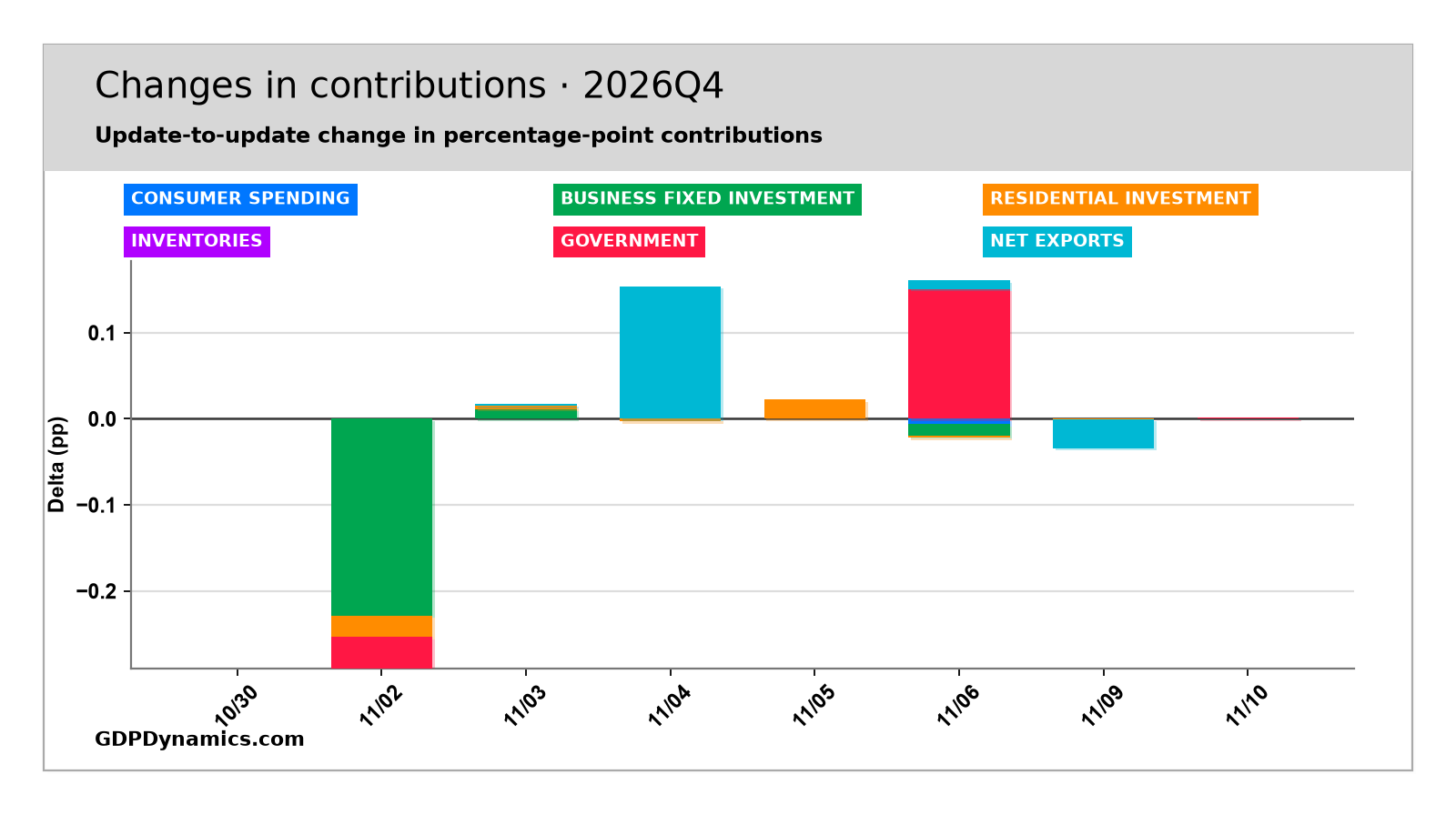
Although the aggregate forecast moved by only 0.001 percentage points, the model registered small, offsetting adjustments across several GDP components.
Government spending received a marginal upward adjustment, providing a small positive contribution to the daily revision. Residential investment moved slightly lower, while business fixed investment also registered a modest negative adjustment.
Each of these component changes rounds to 0.0 percentage points at one-decimal precision. Their importance lies in their direction rather than their immediate magnitude.
Housing and business investment are particularly sensitive to financing conditions. Higher Treasury yields can eventually translate into more expensive mortgages and corporate borrowing, potentially discouraging residential construction and capital expenditure. Today's increase in market yields therefore represents a potential headwind for these components, although the available model snapshot does not establish how much of their individual revisions came directly from interest-rate changes.
Likewise, the small positive government adjustment should not be interpreted as evidence of a new increase in public construction spending or government employment. Neither was identified as a newly released indicator in today's snapshot.
The result is a set of nearly offsetting adjustments that leave the headline GDP projection unchanged.
Contribution Changes
The Composition of Fourth-Quarter Growth
The current forecast continues to show an economy experiencing modest growth, supported by domestic demand but restrained by external-sector weakness and residential investment.
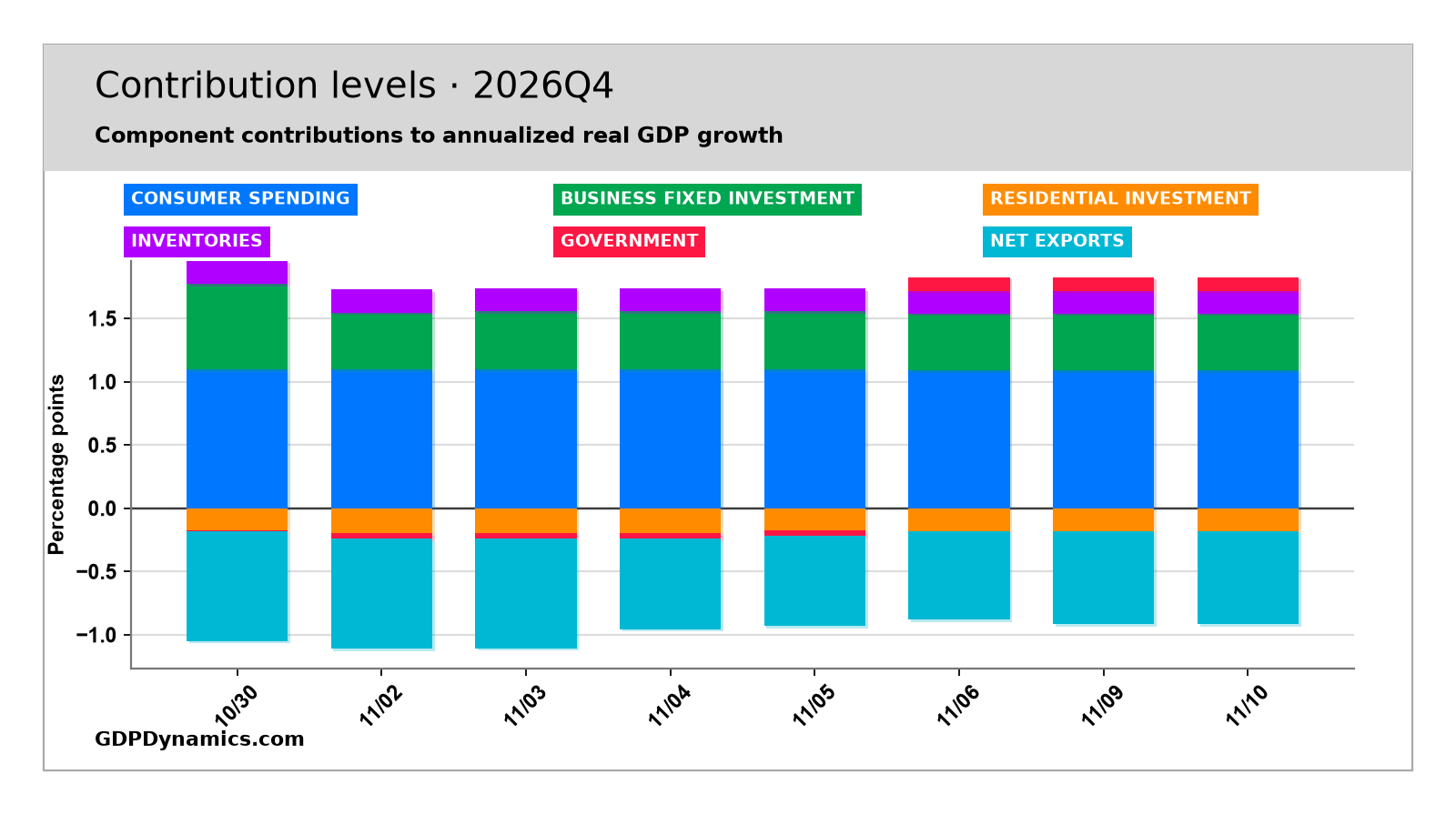
Consumer spending contributes approximately 1.1 percentage points to projected annualized GDP growth. Business fixed investment adds another 0.4 percentage points, followed by inventories at 0.2 percentage points and government spending at 0.1 percentage points.
These positive contributions are partly offset by net exports, which subtract approximately 0.7 percentage points, and residential investment, which subtracts another 0.2 percentage points.
Consumer spending remains the largest positive component in the current estimate, reflecting its considerable weight in the U.S. economy. However, its contribution level should not be confused with evidence that household consumption was responsible for today's marginal upward revision.
The more important structural observation is the combination of positive contributions from consumer and business spending alongside meaningful weakness in net exports and housing.
Residential investment is already subtracting from projected growth, making the recent increase in long-term interest rates worth monitoring. At the same time, the negative contribution from net exports continues to limit the extent to which domestic demand translates into overall GDP growth.
Contribution Levels
Outlook: Inflation and Interest Rates Remain Important
Today's update illustrates how financial conditions can change substantially without producing an equally substantial revision to near-term GDP growth expectations.
The October inflation report was stronger than anticipated, Treasury yields moved sharply higher, and markets reassessed the trajectory of monetary policy. Yet the GDP Dynamics fourth-quarter nowcast remains at 0.9%.
That does not mean higher inflation and borrowing costs are irrelevant to the growth outlook. Their effects can develop gradually as households adjust spending, businesses reconsider investment plans, and housing activity responds to changes in financing costs.
The immediate question is whether these financial pressures begin appearing more clearly in the real economic data. Future releases covering consumer spending, housing construction, factory orders and business investment will help determine whether the current weakness in residential investment broadens into other parts of the economy.
For now, the model continues to project slow but positive fourth-quarter growth, with the latest information producing almost no change in the aggregate estimate.