GDP Dynamics Q4 Nowcast Holds at 0.9% as Stronger Dollar Weighs on Growth Outlook
Date: 2026-11-09Author: GDP Dunamics
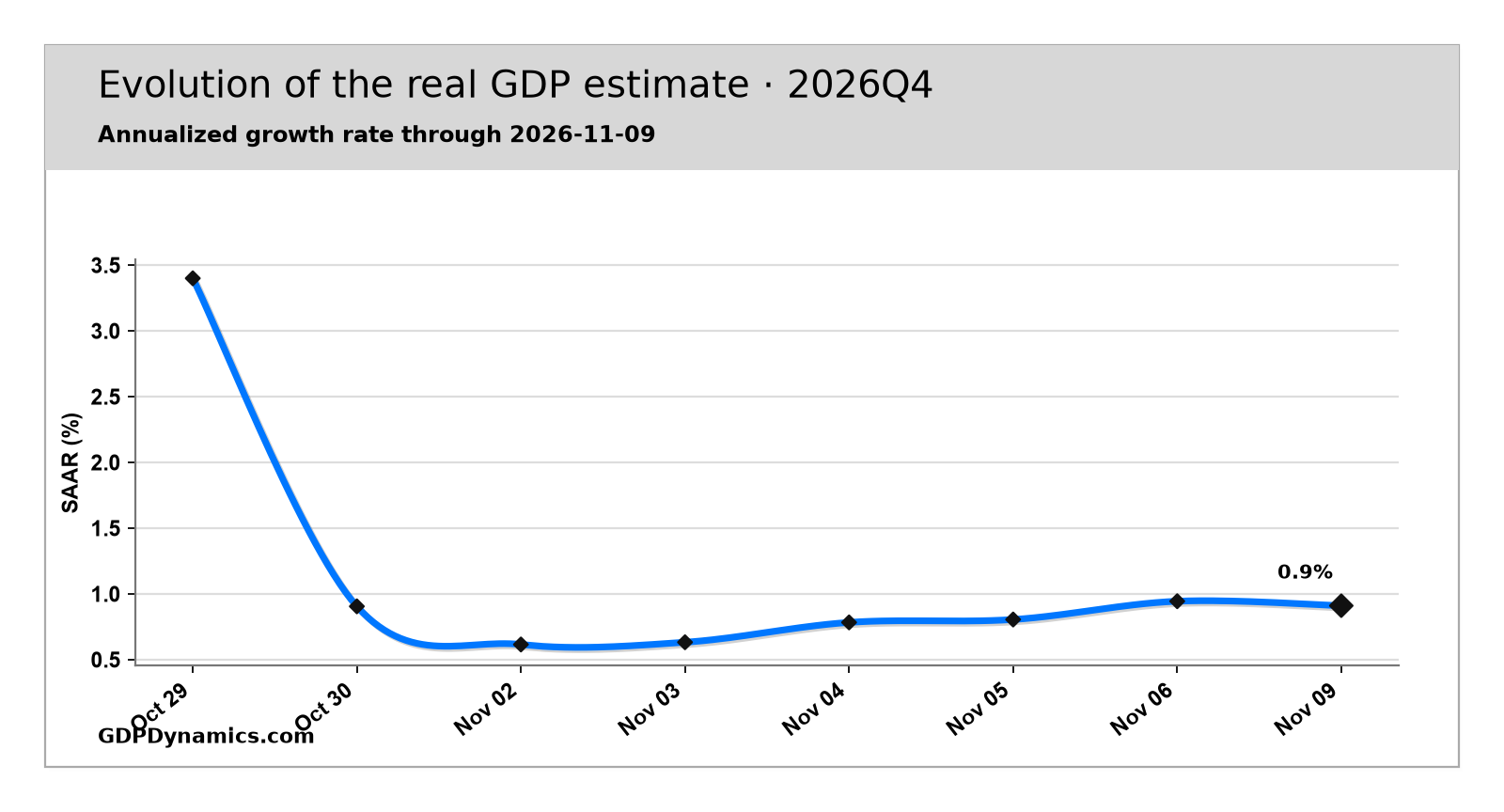
The GDP Dynamics nowcast for U.S. real GDP growth in the fourth quarter of 2026 remains at 0.9% on a seasonally adjusted annualized basis (SAAR), with the latest update showing a slight deterioration in the underlying forecast.
Although the published estimate is unchanged at one decimal place, the unrounded forecast declined from 0.944% on November 6 to 0.910% on November 9, a reduction of 0.034 percentage points. This is a relatively small adjustment, but it reflects a modest weakening in the model's assessment of fourth-quarter economic activity. The latest estimate is equivalent to approximately 0.2% growth on a nonannualized quarter-over-quarter basis.
Nowcast Path
Stronger Dollar and Higher Bond Yields Shape the Latest Update
The November 9 update incorporated two newly available financial indicators: the Federal Reserve's Broad Dollar Index and the yield on the 10-year U.S. Treasury note. These indicators influence the model's assessment of external demand, investment conditions, and the broader outlook for economic activity.
The dollar strengthened following Friday's unexpectedly strong October employment report. U.S. payrolls increased by 165,000 jobs, substantially exceeding market expectations, while the unemployment rate fell to 4.1%. The report reinforced expectations that the Federal Reserve could raise interest rates again in December.
According to the Nominal Broad U.S. Dollar Index, the index increased from 121.5061 on November 5 to 121.8803 on November 6, a gain of approximately 0.31%. The broad measure is particularly relevant because it captures movements in the dollar against a trade-weighted basket of currencies rather than a handful of major trading partners.
A stronger dollar can make American exports more expensive to foreign buyers while reducing the domestic price of imported goods. Both effects can put downward pressure on net exports, although the magnitude and timing depend on trade volumes, pricing arrangements, and the response of businesses and consumers.
Treasury yields also moved higher following the employment report. The benchmark 10-year yield increased from 4.84% on November 5 to 4.86% on November 6, according to the U.S. Treasury. Higher long-term borrowing costs can place additional pressure on interest-sensitive sectors, particularly residential construction and business capital investment.
These financial developments provide useful context for the latest forecast adjustment. However, the small changes in the model's individual GDP contributions should not be interpreted as direct, one-for-one effects of either financial indicator.
Net Exports and Housing Remain the Principal Weaknesses
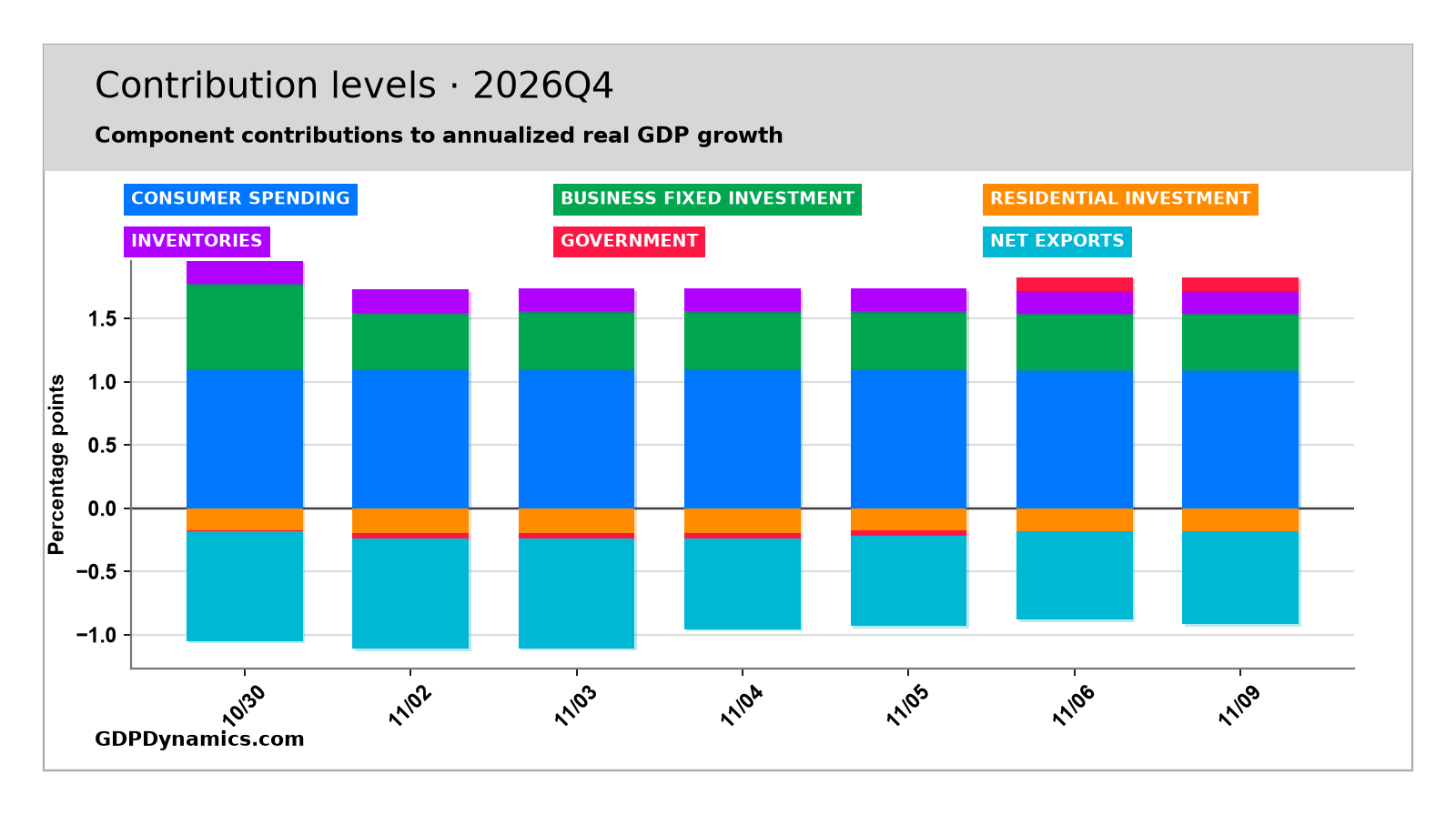
The model continues to identify net exports as the largest negative contribution to fourth-quarter GDP growth, subtracting approximately 0.7 percentage points from the headline estimate.
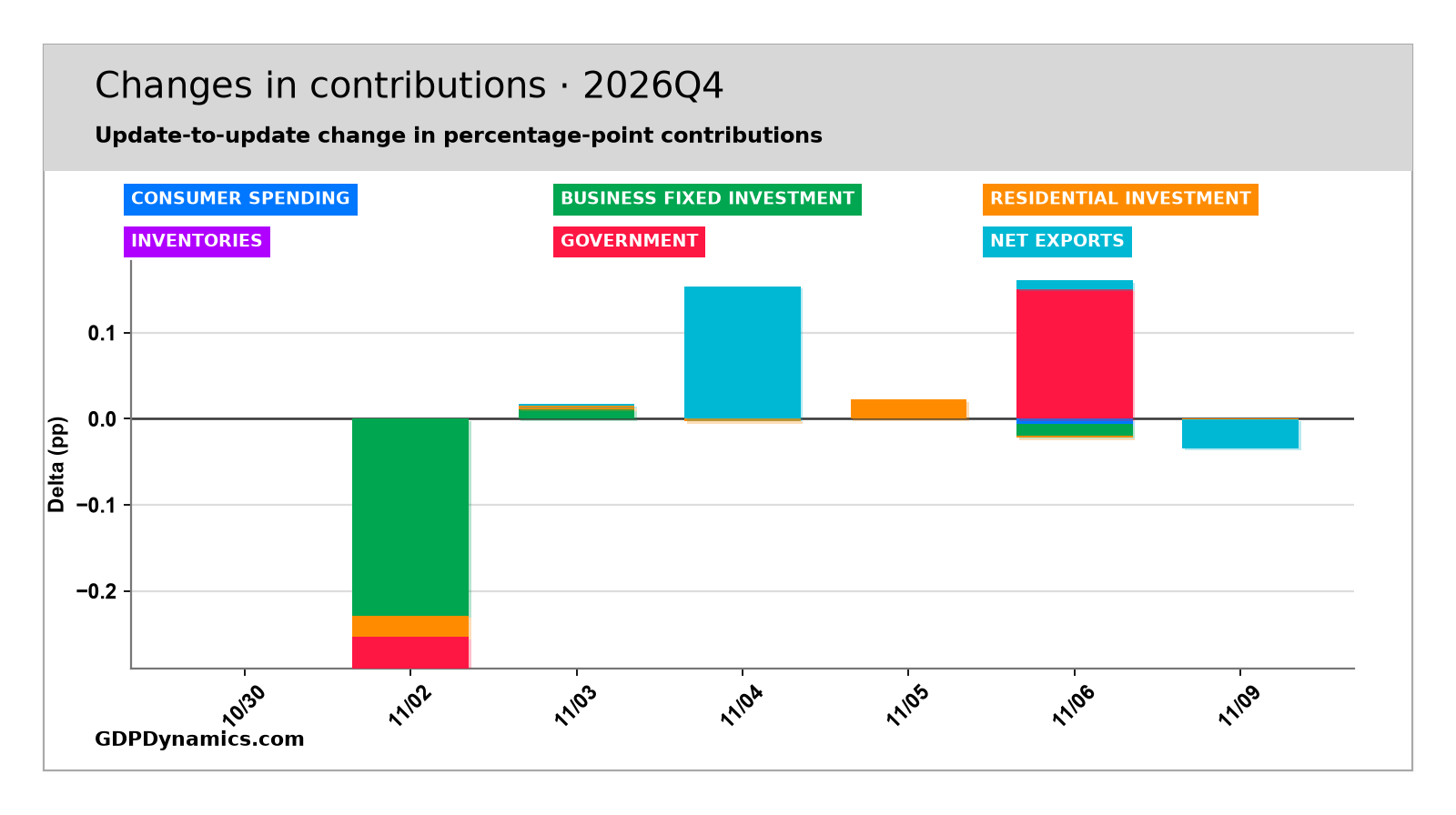
The latest update introduced another small negative adjustment to the external sector, consistent with the unfavorable implications of a stronger dollar. Although the change was too small to register at one decimal place, the direction of the revision suggests slightly weaker expected trade performance.
Residential investment is another source of weakness, currently subtracting 0.2 percentage points from GDP growth. Higher financing costs remain a concern for housing activity, particularly when mortgage borrowing and new construction are sensitive to changes in long-term interest rates.
The model recorded a further marginal downward adjustment to residential investment in the November 9 update. This should not be confused with a new deterioration in housing starts or building permits reported today. Neither series was included among the newly available indicators in this snapshot.
Business fixed investment provided a small positive offset to these revisions. Its contribution increased marginally, although the change was less than 0.05 percentage points and therefore rounds to zero at the published precision.
Contribution Levels
Consumer Spending Continues to Support Growth
Despite the latest downward adjustment, the overall composition of the fourth-quarter forecast remains relatively stable.
Consumer spending is projected to contribute approximately 1.1 percentage points to real GDP growth. This represents a substantial positive contribution, although its size partly reflects the large structural weight of household consumption in the American economy. The latest update does not provide evidence of a similarly large new improvement in consumer demand.
Business fixed investment contributes another 0.4 percentage points, while inventory accumulation contributes approximately 0.2 percentage points. Government spending adds 0.1 percentage points.
Together, these positive contributions are substantially offset by the external sector's negative 0.7 percentage points and the 0.2 percentage-point subtraction from residential investment.
The resulting forecast of 0.9% annualized growth describes an economy still expanding, but at a relatively subdued pace. Domestic demand remains sufficient to support positive output growth, while weakness in trade and housing limits the overall expansion.
Contribution Changes
What Comes Next?
The latest GDP Dynamics estimate arrives as financial markets reassess the likely direction of Federal Reserve policy following the stronger-than-expected employment report.
The next important release is the October Consumer Price Index, scheduled for November 10. Inflation data will help clarify whether the recent strengthening in employment is likely to be accompanied by additional monetary tightening.
The near-term outlook will also depend on incoming evidence from retail spending, industrial production, business investment, housing activity, and international trade. These releases will provide a more direct assessment of economic activity than the financial indicators responsible for the latest update.
For now, the fourth-quarter forecast remains at 0.9%, with the underlying estimate edging slightly lower. The November 9 revision is not large enough to suggest a meaningful change in the economic outlook by itself, but it reinforces the importance of monitoring the external sector and interest-sensitive investment.
The central question for the remainder of the quarter is whether domestic demand can continue offsetting the negative contributions from trade and residential construction.
GDP Dynamics publishes independent U.S. GDP nowcasts and macroeconomic analysis at GDPDynamics.com. Forecasts are model estimates and are subject to revision as new economic data become available.