GDP Dynamics Q4 Nowcast Falls to 0.6% as Construction Spending Weakens
Date: 2026-11-02Author: GDP Dynamics
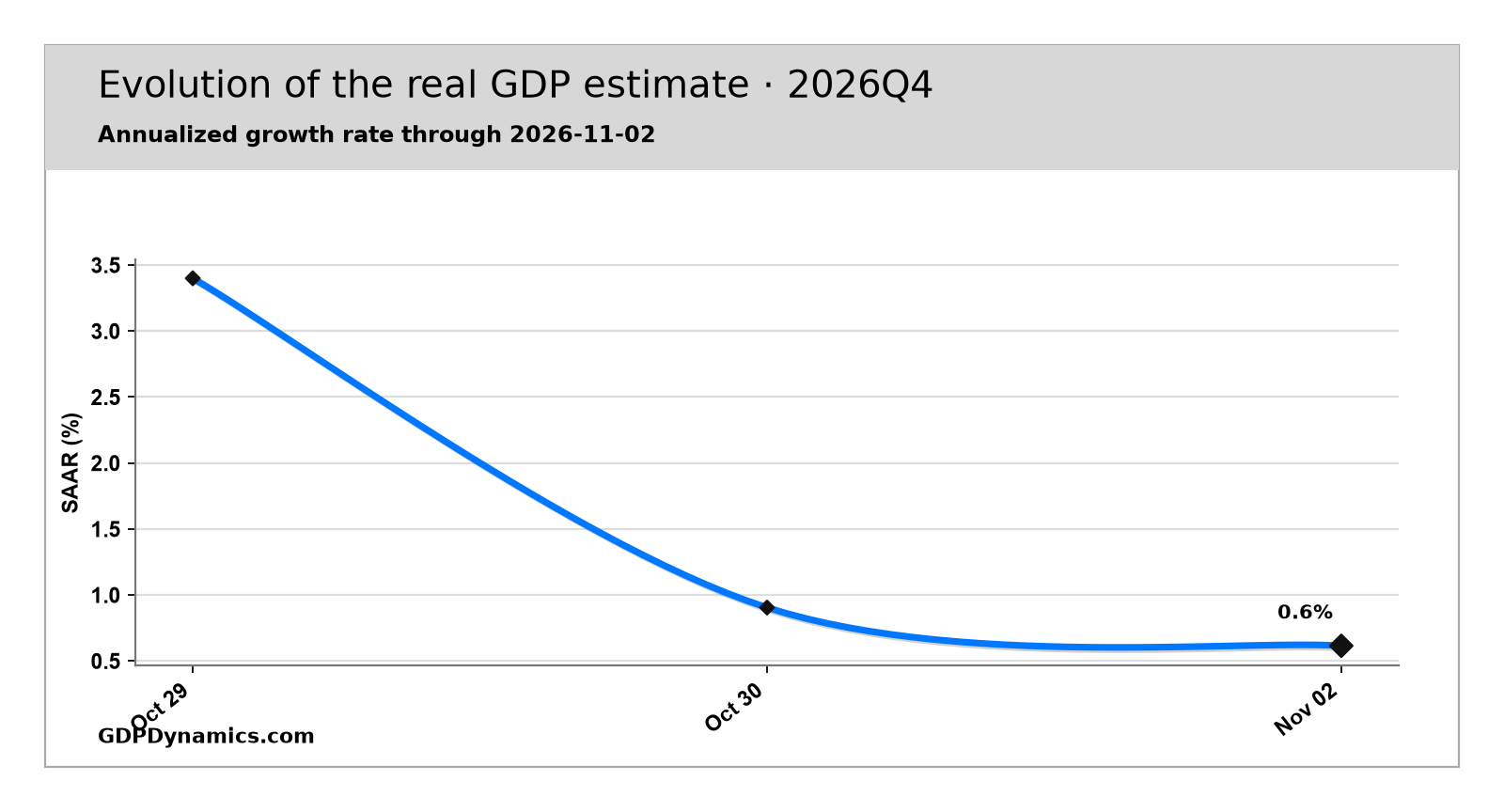
The GDP Dynamics nowcast for fourth-quarter U.S. real GDP growth has fallen to 0.6% at a seasonally adjusted annual rate (SAAR), down 0.3 percentage points from the previous estimate of 0.9% on October 30. The latest reading is equivalent to approximately 0.2% quarter-over-quarter growth.
Nowcast Path
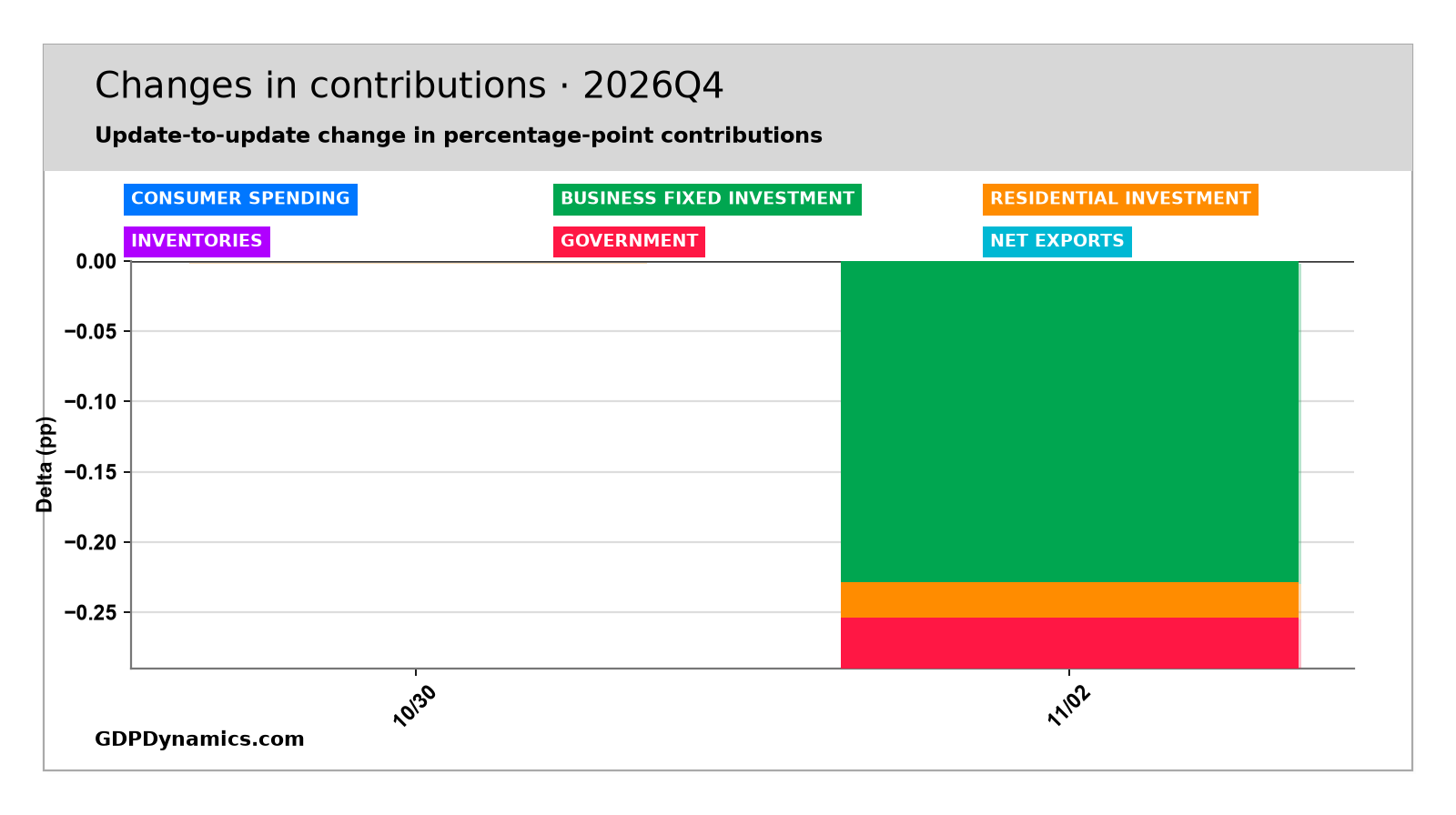
The revision comes alongside a disappointing construction spending report, with residential activity showing particular weakness. Business fixed investment accounts for the largest identified reduction in the model's GDP contribution estimates, while government spending and residential investment registered smaller changes.
Although the fourth quarter is still in its early stages, the latest estimate points to considerably weaker growth than the 3.4% annualized expansion reported for the third quarter.
Business Investment Accounts for the Largest Revision
Business fixed investment recorded the largest identified deterioration in the latest GDP Dynamics update, with its estimated contribution to quarterly growth declining by 0.2 percentage points. Despite this reduction, the component is still expected to contribute approximately 0.5 percentage points to real GDP growth.
Contribution Changes
The latest construction spending figures offer some context, although the investment revision should not be attributed entirely to construction activity.
According to the U.S. Census Bureau's November 2 release, total construction spending fell 1.9% in September to an annualized $2.186 trillion, following an upwardly revised 2.0% increase in August. The decline was substantially worse than economists' expectations for a 0.3% increase.
There is an important distinction within those figures. Private nonresidential construction spending actually increased 1.1% in September, while residential construction spending fell sharply. The overall construction decline therefore does not indicate a uniform contraction across business investment.
Earlier releases also presented a more favourable picture of industrial activity. September industrial production increased 0.7%, including a 0.3% increase in manufacturing output. Durable goods orders rose 1.8% during the month.
The reduction in the GDP Dynamics investment contribution is consequently better understood as a change in the model's broader investment outlook rather than evidence of an outright collapse in capital spending.
Housing Construction Remains Under Pressure
Residential construction produced the most pronounced weakness in the September spending report.
Private residential construction spending declined 5.5% from August, reversing much of the previous month's increase. The weakness was concentrated in residential building activity outside new single-family and multifamily construction, consistent with softer spending on improvements and renovations.
The latest figures reinforce concerns already apparent in September's housing starts and permits data. Housing starts declined 5.2% to an annualized 1.221 million units, while building permits slipped 0.2% to 1.400 million units. Single-family permits registered a larger 4.0% decline.
These figures suggest that residential construction entered the fourth quarter with limited momentum.
The GDP Dynamics model currently estimates that residential investment will subtract approximately 0.2 percentage points from fourth-quarter growth. Its contribution changed only marginally in the November 2 update, indicating that housing weakness was already reflected in the previous estimate.
Government Spending Offers Little Support
Public construction spending declined 0.1% in September, compared with August. State and local government construction spending fell 0.3%, while federal construction outlays increased 2.5%.
The GDP Dynamics government contribution remains close to zero, with only a negligible negative adjustment in the latest update.
Public construction is only one part of government expenditure in GDP, but the latest report offers little evidence of stronger construction activity providing additional support to the growth outlook.
Current Fourth-Quarter GDP Contributions
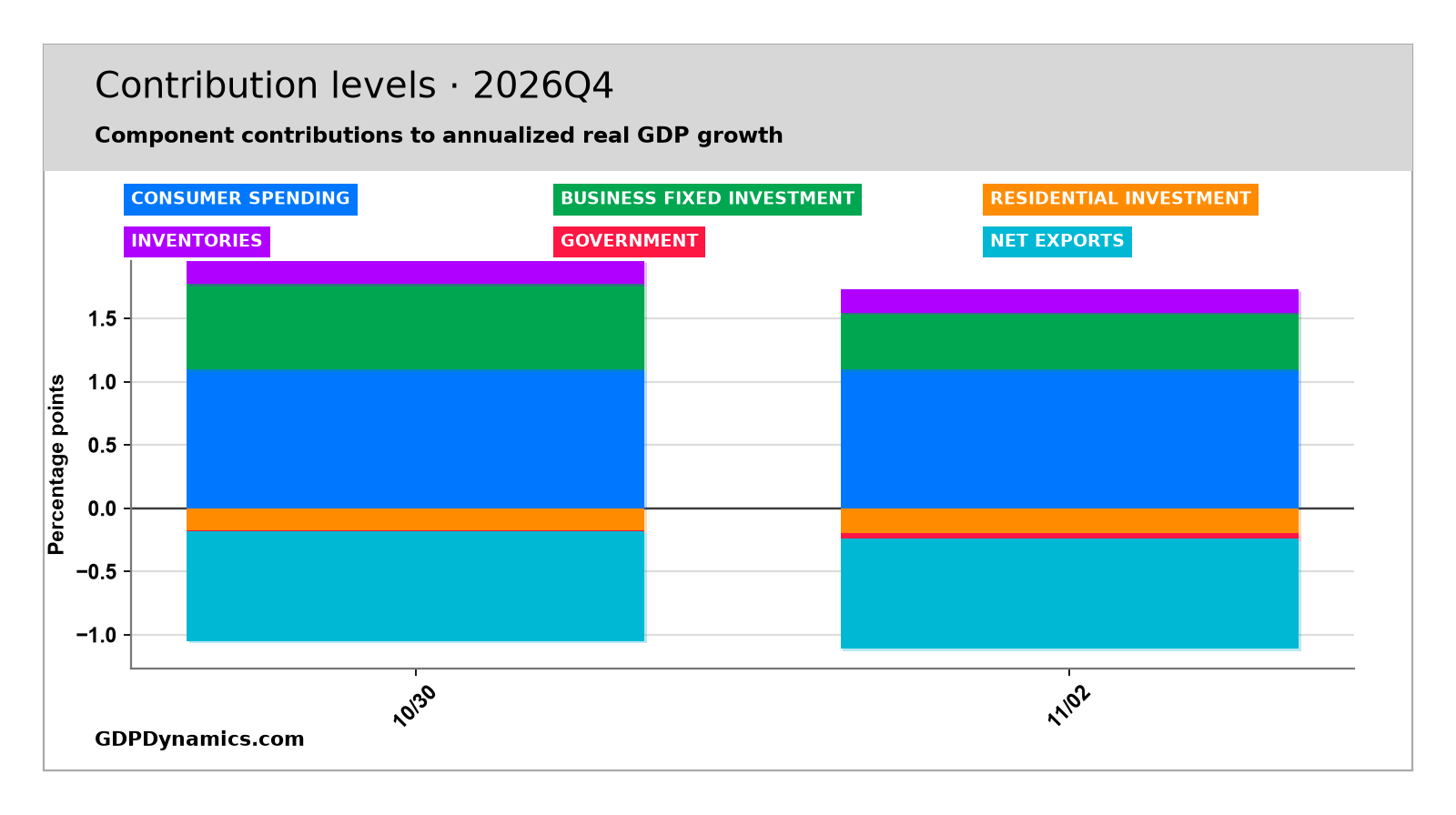
The latest model estimates show consumer spending contributing approximately 1.1 percentage points to real GDP growth. This remains a substantial positive contribution, although the November 2 update provides no evidence of a meaningful change in the consumption outlook.
Contribution Levels
Net exports remain a significant drag, subtracting an estimated 0.9 percentage points. Business fixed investment contributes 0.5 percentage points, while inventory investment adds another 0.2 percentage points. Residential investment subtracts 0.2 percentage points, and government spending contributes approximately zero.
The distinction between contribution levels and contribution changes is particularly important in this update. Consumer spending has the largest positive contribution because of its substantial weight in the economy, but it was not responsible for the latest revision. Business fixed investment experienced the largest identified downward adjustment.
The published component estimates are rounded separately, so their sum may differ slightly from the headline growth estimate.
Manufacturing Strength Complicates the Outlook
Not all recent economic releases support a weaker growth outlook.
The Institute for Supply Management reported that its manufacturing PMI increased from 54.5 in September to 55.5 in October. Manufacturing production strengthened, new orders continued expanding, and the inventories index moved back into expansion territory.
These results suggest that industrial activity maintained momentum entering the fourth quarter, even as residential construction weakened.
The latest manufacturing survey is useful context rather than an identified driver of the November 2 GDP Dynamics revision, which incorporated a narrower set of model inputs.
The Federal Reserve also maintained its target federal funds rate at 3.75% to 4.00% at its October 28 meeting. Financing conditions remain relevant to both business investment and housing, although the unchanged policy rate does not by itself explain the latest decline in the nowcast.
What to Watch Next
The next several economic releases will help determine whether the investment downgrade persists.
September factory orders, scheduled for November 3, will provide additional information about capital goods demand and business investment. Subsequent trade figures will help refine the net export contribution, while incoming employment and spending indicators will offer a clearer picture of domestic demand.
The current 0.6% estimate suggests that the U.S. economy could experience a considerable slowdown in the fourth quarter following its stronger third-quarter performance. However, much of the incoming information still relates to September, the final month of the previous quarter.
For now, the latest GDP Dynamics revision reflects weaker investment expectations against a backdrop of mixed economic evidence. Construction spending is deteriorating, particularly in housing, while manufacturing indicators remain comparatively resilient.