GDP Dynamics Opens Q4 2026 With a 0.9% Real GDP Nowcast
Date: 2026-10-30Author: GDP Dynamics
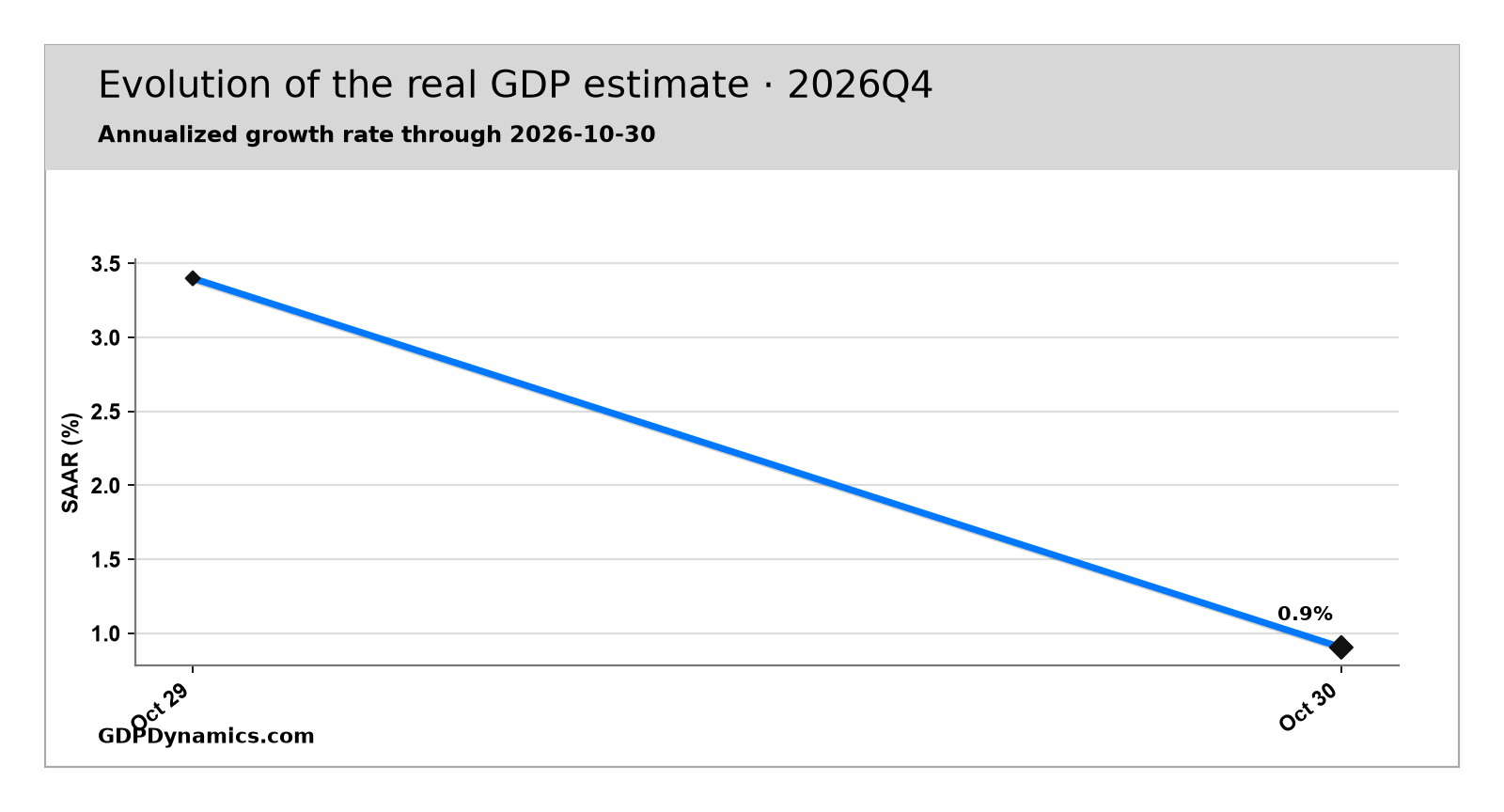
The GDP Dynamics model has produced its first in-quarter nowcast for the fourth quarter of 2026, estimating real GDP growth of 0.9% at a seasonally adjusted annual rate (SAAR), equivalent to approximately 0.2% quarter-over-quarter growth.
Nowcast Path
This represents a substantial slowdown from the official third-quarter GDP growth rate of 3.4%, a difference of 2.5 percentage points. While the initial estimate suggests considerably weaker economic momentum entering the final quarter of the year, it remains preliminary, with most of the quarter's economic data still to be released.
Early Signs of Slower Economic Growth
The initial Q4 estimate points toward a slower pace of economic expansion following the stronger performance recorded in Q3. The model currently projects positive contributions from consumer spending, business fixed investment, and inventories, offset by weakness in net exports and residential investment.
Consumer spending is estimated to contribute 1.1 percentage points to annualized real GDP growth, while business fixed investment adds another 0.7 percentage points. Inventory investment contributes approximately 0.2 percentage points.
Net exports represent the largest negative contribution in the current estimate, subtracting 0.9 percentage points from growth. Residential investment subtracts a further 0.2 percentage points, while the government sector makes a roughly neutral contribution.
These estimates describe the model's current composition of projected GDP growth. They should not yet be interpreted as evidence of confirmed changes in spending, investment, or trade during Q4, particularly given the limited amount of new economic information available.
What Changed in Today's Update?
The October 30 update incorporates the latest available 10-year Treasury yield observation. This is the first true in-quarter release-day update, establishing an initial Q4 estimate against the official Q3 GDP growth anchor of 3.4%.
Long-term Treasury yields provide useful information about financial conditions, borrowing costs, and the broader interest-rate environment facing households and businesses. These conditions can influence residential construction, business investment, and interest-sensitive spending.
However, the current release does not establish how much of the difference between the Q3 anchor and the Q4 nowcast can be attributed specifically to the Treasury yield observation. Much of the initial estimate reflects the model's starting assessment of the new quarter rather than a broad collection of newly released Q4 economic data.
The 2.5-percentage-point difference should therefore be understood as a comparison between the official prior-quarter growth rate and the model's initial projection for the current quarter, rather than a measured deterioration caused by today's release alone.
What to Watch Next
The next several weeks will provide a much clearer picture of economic activity during Q4.
Employment and wage data will help establish whether household income growth remains sufficient to support consumption. Retail sales and personal consumption expenditures will provide more direct evidence of consumer demand, while industrial production, manufacturing orders, and construction spending will help refine estimates of business investment.
International trade releases will be particularly important given the current negative contribution from net exports. Changes in export and import volumes could materially alter the model's estimate of overall growth.
Residential construction indicators will also be worth monitoring, particularly as the housing sector remains sensitive to financing conditions.
As these observations become available, the model will incorporate the new information and revise its estimates of individual GDP components and overall quarterly growth.
Outlook
The first GDP Dynamics nowcast for Q4 2026 suggests that the US economy may be entering the final quarter of the year with substantially less growth momentum than was recorded in Q3.
At 0.9% annualized growth, the initial projection remains positive, but it is considerably below the preceding quarter's official 3.4% expansion.
The principal limitation is the scarcity of new quarter-specific observations. With only one tracked release incorporated into this first update, considerable uncertainty remains around the trajectory of consumption, investment, trade, and inventories.
The coming releases will determine whether the initial slowdown persists, deepens, or is revised upward as the economic picture becomes clearer.