GDP Dynamics Q3 Nowcast Rises to 3.4% as Business and Residential Investment Improve
Date: 2026-10-27Author: GDP Dynamics
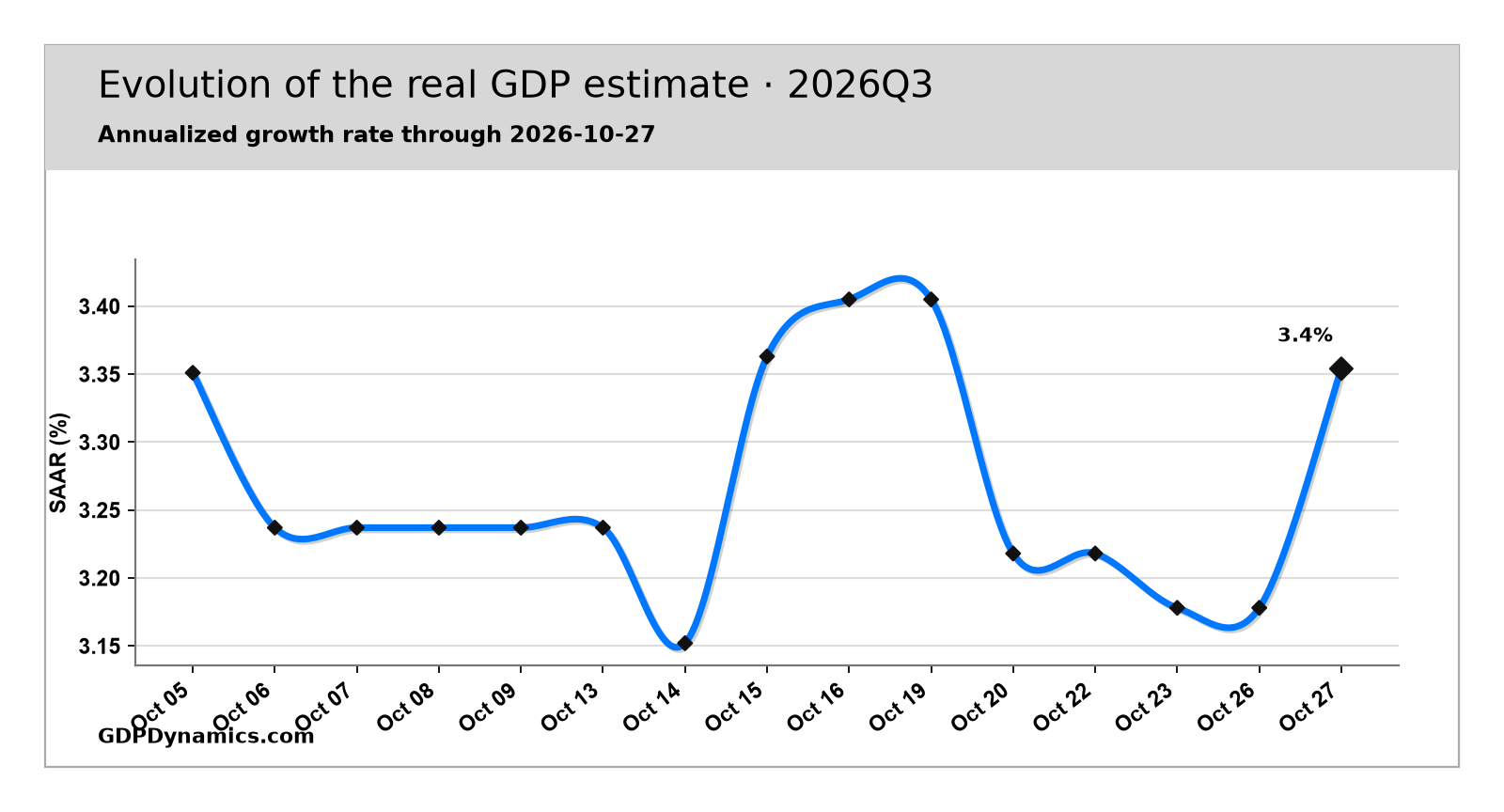
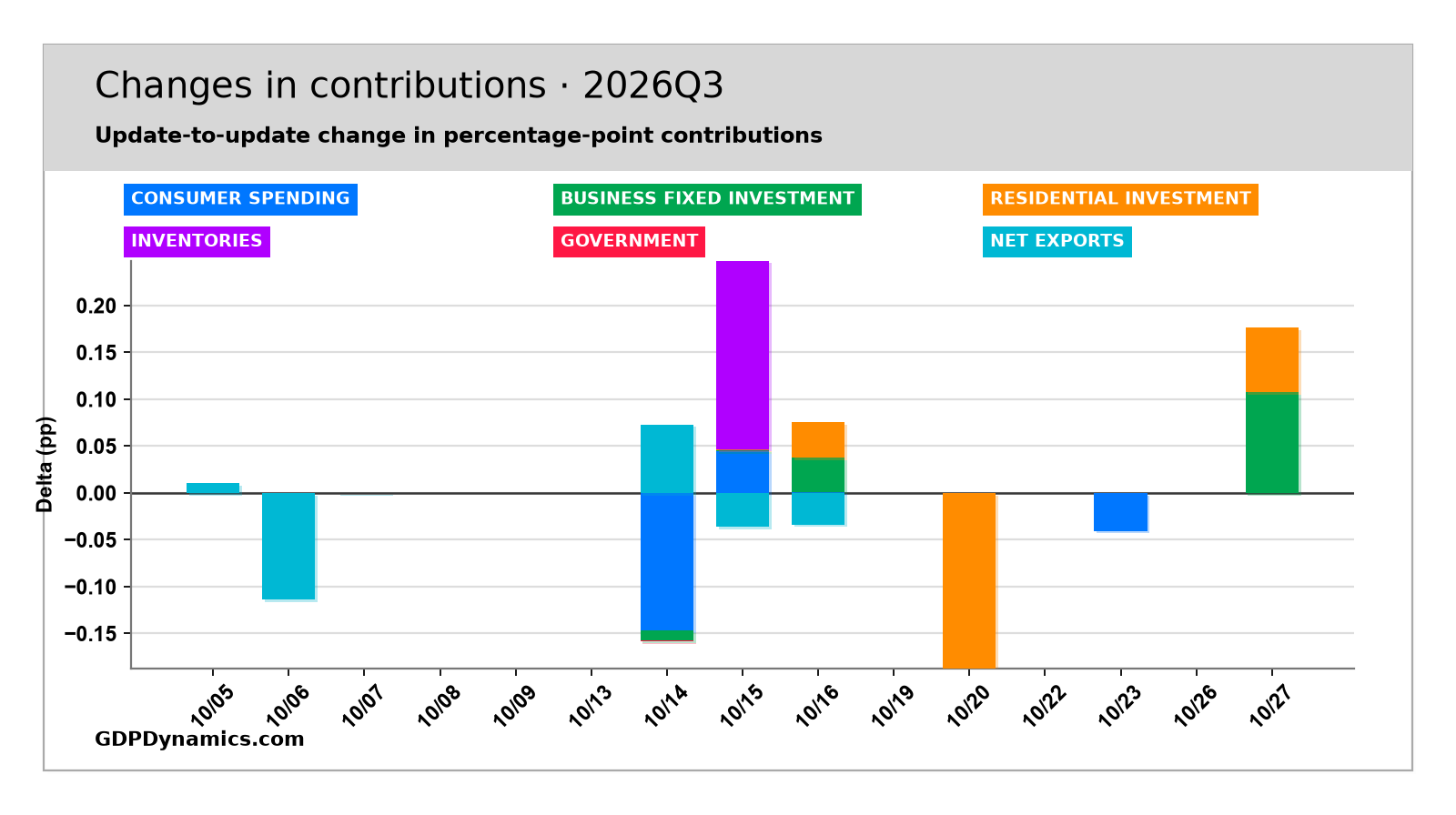
The GDP Dynamics nowcast for the third quarter of 2026 has increased to 3.4% annualized real GDP growth, up 0.2 percentage points from yesterday's estimate of 3.2%. The latest revision reflects improvements in business fixed investment and residential investment, with each contributing an additional 0.1 percentage points to the overall forecast.
The revision comes as the model incorporates information from capital goods orders, durable goods orders, factory orders, and building permits. These indicators provide insight into business capital spending and housing construction, two areas that can materially influence quarterly GDP growth.
The latest estimate corresponds to approximately 0.8% quarter-over-quarter growth before annualization. While the overall revision is relatively modest, its composition is worth examining because both investment categories moved in a positive direction.
Nowcast Path
Business Fixed Investment Adds 0.1 Percentage Points
Business fixed investment accounted for half of today's upward revision, adding 0.1 percentage points to the nowcast. Its estimated contribution to third-quarter GDP growth now stands at 1.2 percentage points.
The relevant indicators include core capital goods orders, durable goods orders, and factory orders. Core capital goods orders, which exclude aircraft and defense equipment, are particularly useful for evaluating business equipment investment intentions. However, orders are not equivalent to completed investment expenditures, and their effect on GDP depends partly on subsequent shipments and the timing of production.
The positive revision suggests that the model's current assessment of business investment has strengthened. The available snapshot does not identify which individual release accounted for the increase or provide the underlying monthly growth rates, so it would be premature to attribute the entire improvement to a particular manufacturing report.
Nevertheless, the change is economically meaningful. Business fixed investment contributes to current aggregate demand through spending on equipment, structures, and intellectual property products. Sustained investment can also expand productive capacity, although that longer-term effect should not be confused with its immediate contribution to quarterly GDP.
Residential Investment Also Improves
Residential investment contributed the remaining 0.1 percentage points to today's upward revision. Its estimated contribution to GDP growth is now approximately zero, suggesting that the sector is no longer making a material positive or negative contribution in the current model snapshot.
The latest available indicators include total building permits and single-family permits. Permits provide an early indication of planned construction activity, but they do not necessarily translate into immediate residential investment. Construction starts, spending on work put in place, and the pace at which projects progress are important for determining the eventual GDP contribution.
The upward adjustment is therefore encouraging, but it should not be interpreted as evidence of a broad housing recovery. The model is indicating a better residential investment outlook relative to yesterday's estimate, rather than a large positive contribution from housing activity itself.
Residential investment can improve substantially at the margin while remaining weak in absolute terms. In this case, the sector's contribution has improved, but its estimated level remains close to zero.
Contribution Changes
September Manufacturing Data Supports the Investment Outlook
The September durable goods report provides additional context for the improvement in business investment. According to the U.S. Census Bureau, new orders for manufactured durable goods increased 1.8% in September, reaching $345.4 billion. This followed a 0.1% increase in August. Orders excluding transportation rose 0.5%, while transportation equipment orders increased 4.6%.
More relevant to the investment outlook, nondefense capital goods orders excluding aircraft increased 0.5% in September, following a 1.6% increase in August. Shipments of these goods also rose 1.2%, providing more direct evidence of equipment spending during the quarter.
Although the increase in core capital goods orders was below economists' expectations of 0.7%, the combination of rising orders and shipments is consistent with continued business equipment investment. This supports the direction of the GDP Dynamics revision, although the model snapshot does not provide enough information to isolate the exact contribution of the September release.
Current Composition of Third-Quarter GDP Growth
The latest estimate continues to show substantial differences across the major components of GDP.
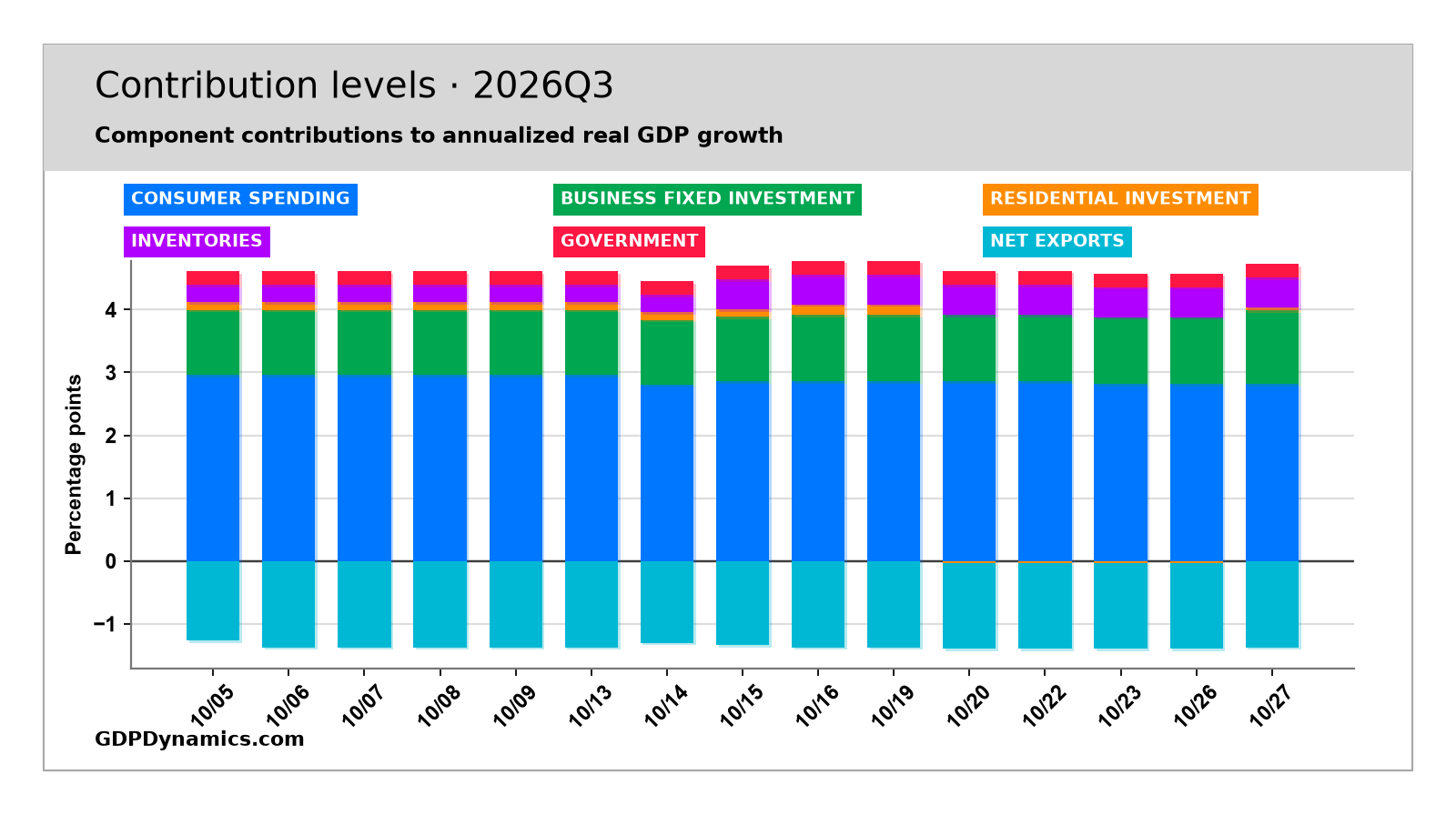
Consumer spending contributes an estimated 2.8 percentage points to third-quarter growth. However, its contribution was not identified as having increased in today's update. The upward revision came from investment rather than a new improvement in household consumption.
Business fixed investment contributes another 1.2 percentage points, while inventory accumulation adds an estimated 0.5 percentage points. Government spending contributes approximately 0.2 percentage points, and residential investment remains close to neutral.
Net exports continue to represent the largest negative contribution, subtracting approximately 1.4 percentage points from estimated growth. This reflects the model's current assessment of the trade balance's effect on GDP, although the latest snapshot does not establish whether imports, exports, or both are responsible for the negative contribution.
Taken together, the current estimates suggest that domestic demand is providing considerable support to third-quarter growth, while the external sector is offsetting part of that expansion. The positive contribution from inventories also warrants attention, since changes in inventory accumulation can have a substantial effect on quarterly GDP growth without necessarily indicating a comparable change in final demand.
Contribution Levels
What Comes Next?
The GDP Dynamics estimate of 3.4% comes just two days before the Bureau of Economic Analysis is scheduled to publish its advance estimate of third-quarter GDP on Thursday, October 29.
Before that release, additional information on international trade and wholesale inventories is scheduled for October 28. These reports may help clarify two components that remain important to the model's current estimate, particularly the negative contribution from net exports and the positive contribution from inventories.
The advance GDP report will provide the first official benchmark against which the GDP Dynamics estimate can be evaluated. As with any nowcast, revisions remain possible as additional data become available and previously published estimates are updated.
For October 27, the model's estimate has strengthened from 3.2% to 3.4%, with the entire identified upward revision coming from business fixed investment and residential investment. The manufacturing data provide supporting evidence for the business investment outlook, while the housing contribution remains comparatively modest despite its improvement.