GDP Dynamics Q3 Nowcast Holds at 3.2% as the Quarter's Final Estimate Approaches
Date: 2026-10-26Author: GDP Dynamics
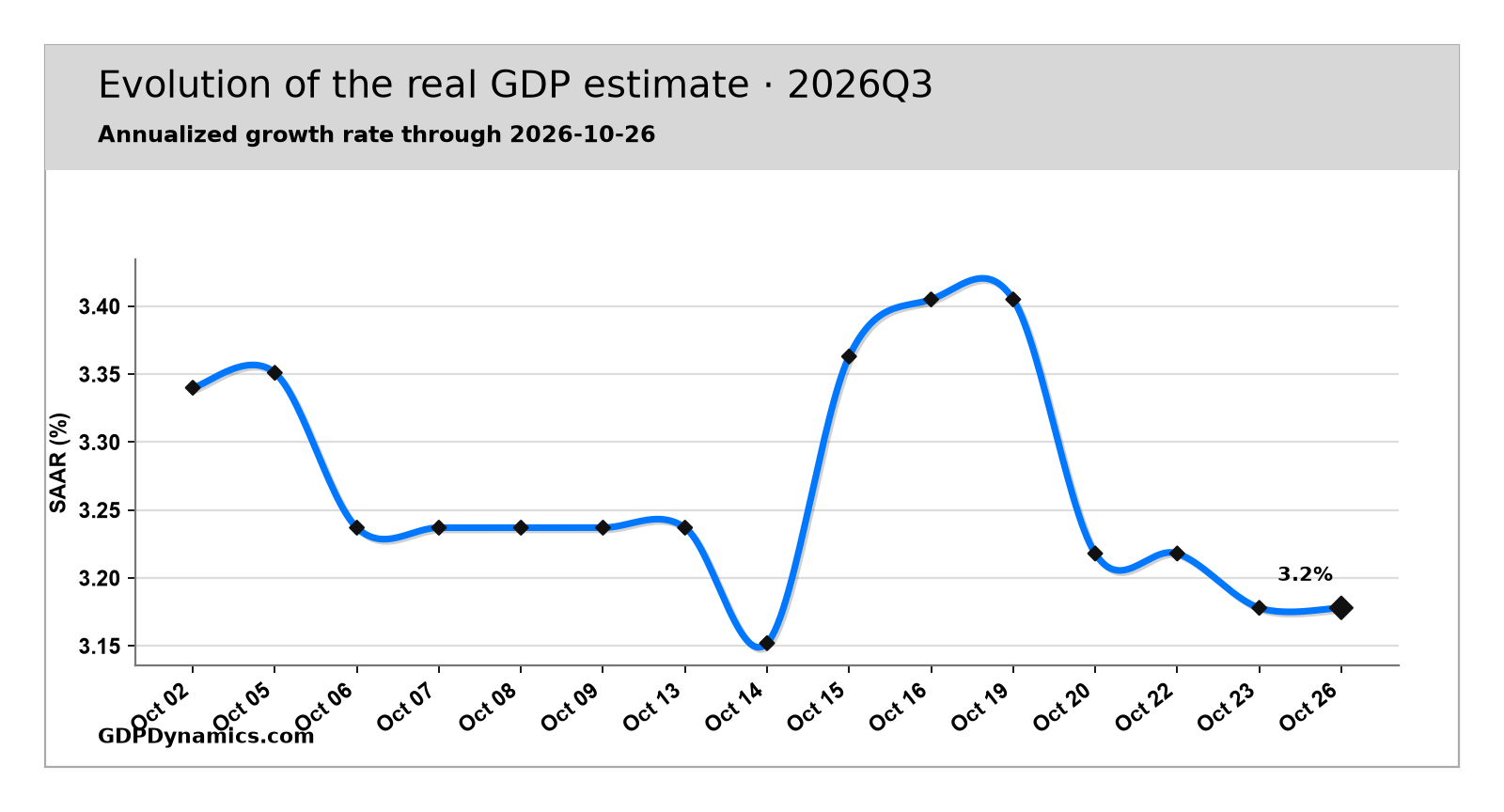
The GDP Dynamics nowcast for the third quarter of 2026 remains unchanged at 3.2% annualized as of October 26, equivalent to approximately 0.8% quarter-over-quarter growth. The estimate is identical to the October 23 reading, with no upward or downward revisions to the individual GDP contributions in today's update.
With the quarter already behind us, attention is increasingly turning from forecasting economic activity to assessing how accurately the available data have captured what happened between July and September. The current estimate points toward continued economic expansion, although the composition of that growth remains uneven.
No Change in the Headline Estimate
Today's update produced no change in the headline nowcast, which continues to indicate real GDP growth of 3.2% at a seasonally adjusted annual rate.
The latest model snapshot includes three available indicators: the broad dollar index, initial jobless claims, and the 10-year Treasury yield. These provide information about exchange-rate conditions, the labour market, and interest rates, respectively.
However, the October 26 snapshot does not identify any changes in their contributions relative to October 23. Consequently, there is no evidence in this update of a new release pushing the GDP forecast either higher or lower.
That is worth emphasizing. An unchanged nowcast is not necessarily evidence that economic conditions have stopped changing. It simply means the latest information incorporated into this model snapshot has not altered its estimate of third-quarter output.
Nowcast Path
Consumer Spending and Business Investment Continue to Support Growth
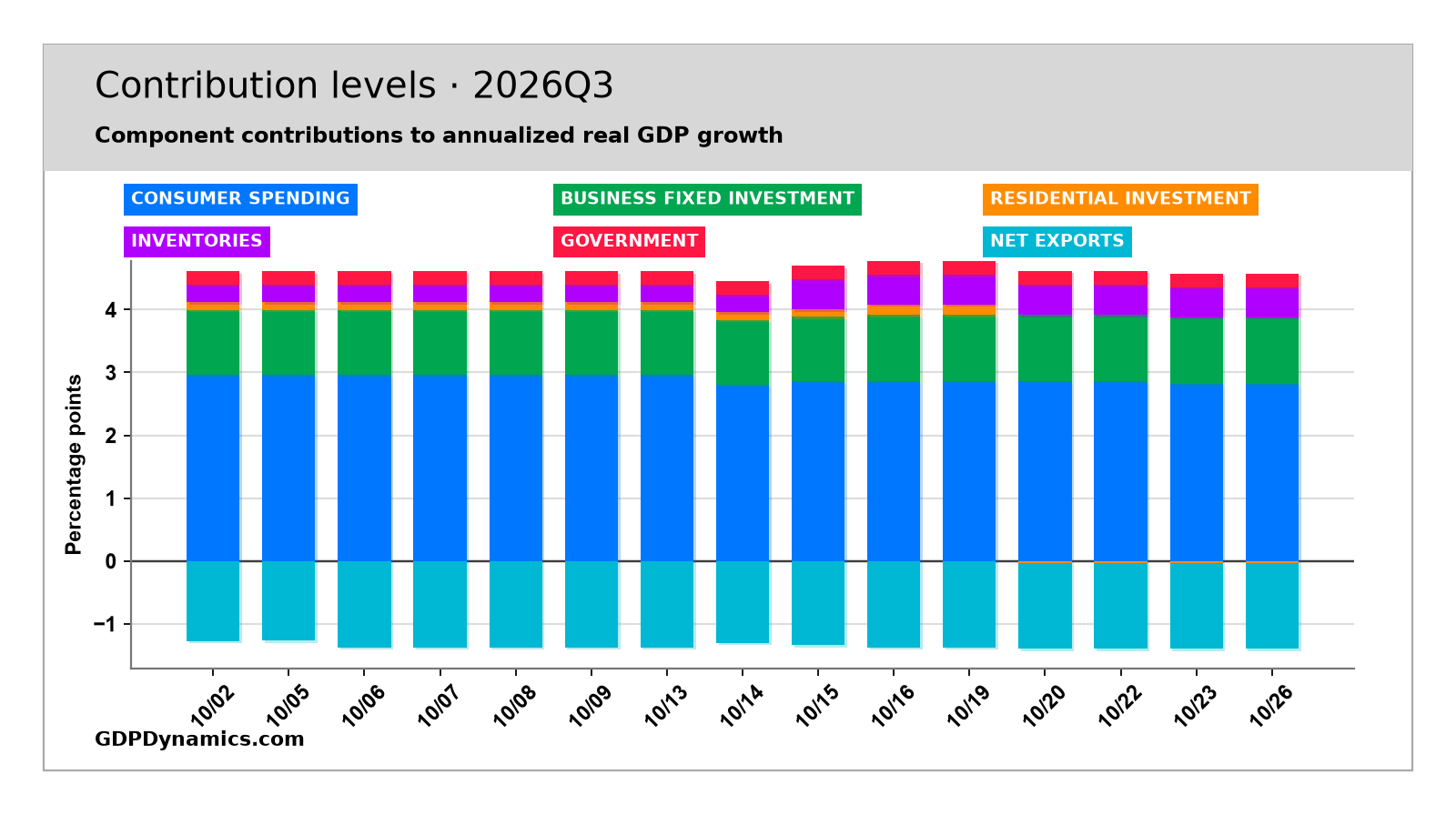
Consumer spending is currently estimated to contribute 2.8 percentage points to third-quarter real GDP growth. That is a substantial contribution, although its size must be interpreted in the context of consumption's large share of the American economy.
The more useful question is whether consumer spending has strengthened or weakened relative to previous estimates. Today's update offers no new movement in that contribution, leaving the existing assessment unchanged.
Business fixed investment is estimated to contribute another 1.1 percentage points, making it an important source of growth in the current forecast. This is particularly relevant because business investment reflects spending on productive assets, including equipment, structures, and intellectual property.
Inventories are also estimated to add 0.5 percentage points to GDP growth. Inventory accumulation can make a meaningful contribution to quarterly GDP, although its interpretation depends on whether businesses are deliberately rebuilding stocks or accumulating goods because sales have fallen short of expectations.
Government spending contributes a further 0.2 percentage points, while residential investment is approximately neutral in the current estimate.
Taken together, the domestic expenditure components remain consistent with positive economic growth, even as the external sector offsets part of their contribution.
Net Exports Remain the Largest Drag
Net exports are currently estimated to subtract 1.4 percentage points from third-quarter GDP growth.
This is a significant offset to domestic expenditure. However, a negative contribution from net exports does not, by itself, establish that exports are contracting. It can also occur when imports grow faster than exports, with imported goods and services subtracted in the GDP expenditure calculation.
The current snapshot does not provide separate revisions for exports and imports, so it would be premature to attribute this drag to a particular trade release or change in foreign demand.
Nevertheless, the negative external contribution remains one of the most important features of the forecast. Without it, the combined contribution of domestic expenditure would imply a considerably stronger headline growth rate.
Contribution Levels
What Changed Since October 23?
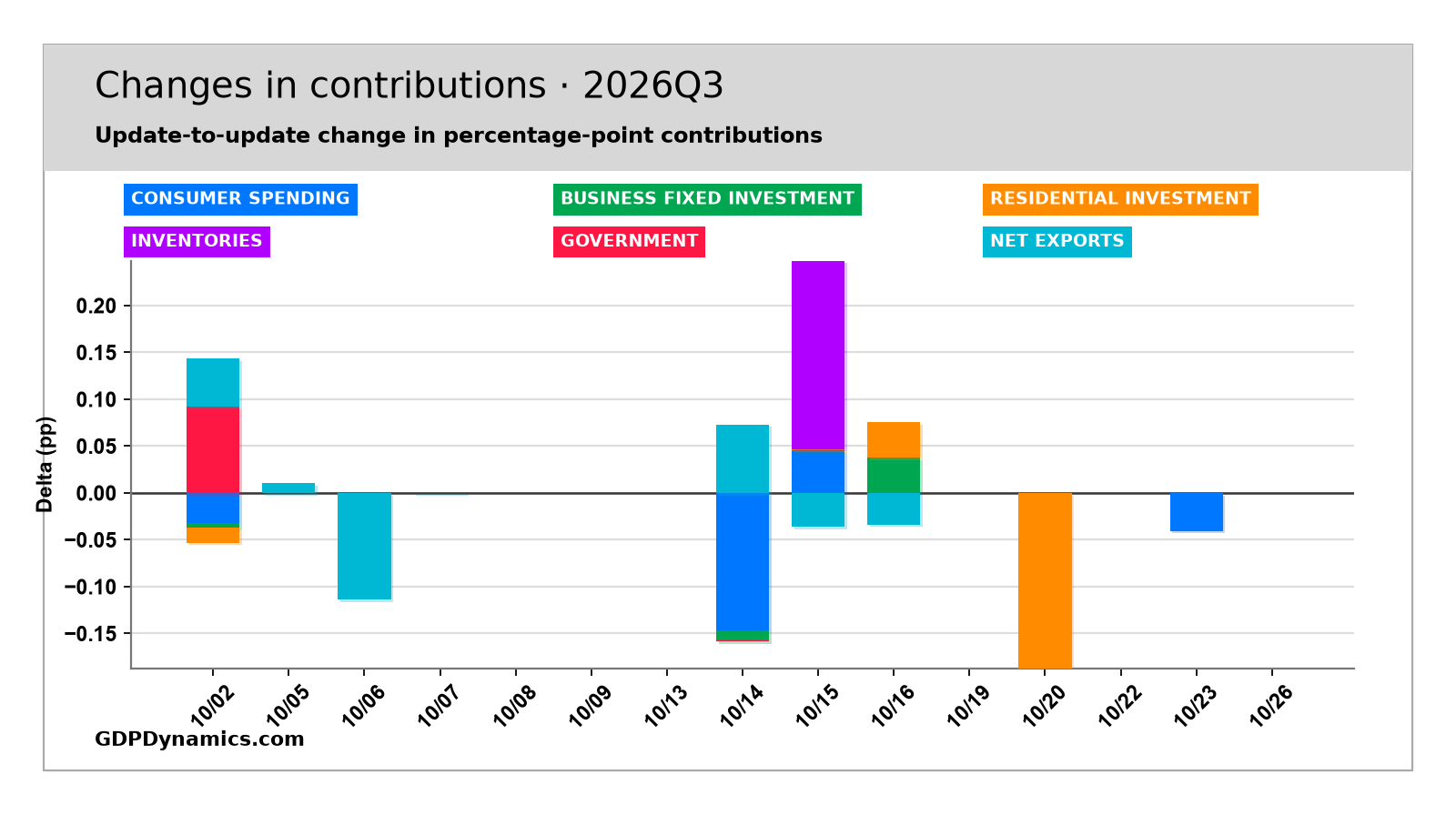
In numerical terms, nothing changed in the model's reported GDP contributions.
The headline nowcast remains at 3.2%, and no individual component registered a positive or negative revision between the October 23 and October 26 updates.
This makes today's release primarily a confirmation of the previous estimate rather than a reassessment of the quarter's economic performance.
The absence of revisions also means there is little justification for constructing a new narrative around accelerating consumption, weakening investment, or improving trade conditions. Those claims would require additional evidence that is not present in the current snapshot.
For now, the model continues to describe an economy expanding at a relatively solid annualized pace, supported by domestic expenditure and partly offset by net exports.
Contribution Changes
Looking Ahead
As the advance GDP release approaches, the central question is whether the official estimate will confirm the 3.2% growth rate currently projected by GDP Dynamics.
The contribution estimates suggest positive growth across several domestic expenditure categories, with net exports providing the largest offset. Today's update offers no new reason to materially revise that assessment.
The eventual GDP release will also provide an opportunity to evaluate the accuracy of the nowcasting model, not merely in terms of the headline growth rate but also in how closely its individual expenditure contributions correspond to the official figures.
For now, the GDP Dynamics third-quarter nowcast remains at 3.2% annualized, unchanged from October 23.