GDP Dynamics Q3 Nowcast Holds at 3.2% as Consumer Spending Estimate Edges Lower
Date: 2026-10-23Author: GDP Dynamics
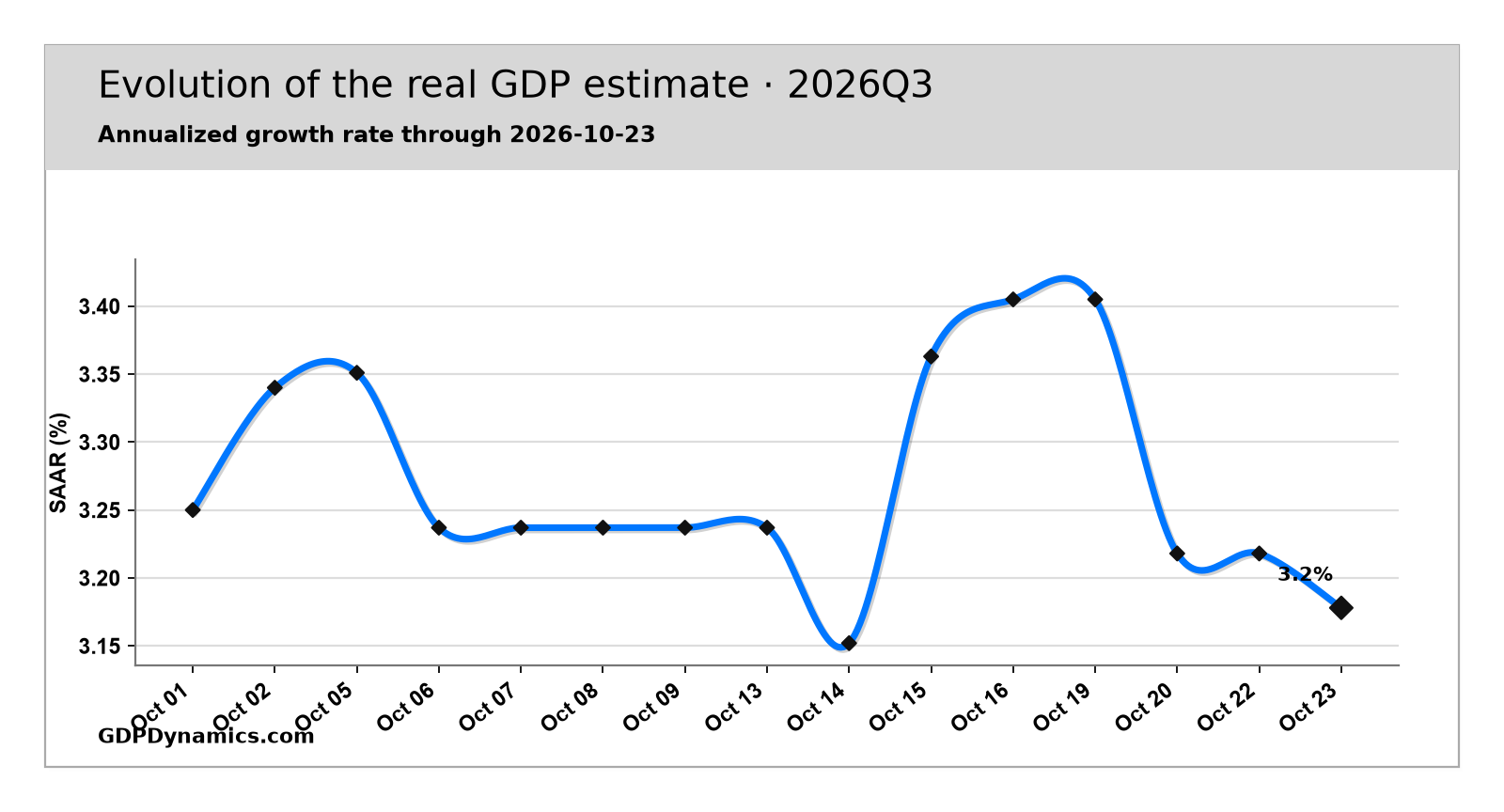
The GDP Dynamics nowcast for third-quarter U.S. real GDP growth remains at 3.2% on October 23, although the underlying estimate has moved slightly lower following the latest update to the model.
Nowcast Path
Yesterday's estimate stood at 3.218%, compared with today's 3.178%, a decline of 0.040 percentage points. Both figures round to 3.2% at the published precision, explaining why the headline remains unchanged even as the nowcast's historical path shows a small downward movement.
At a nonannualized quarterly rate, the forecast implies approximately 0.8% real GDP growth.
The revision is modest, but it comes against a backdrop of weak consumer confidence, relatively low layoffs, and continuing uncertainty about the strength of household demand.
Consumer Spending Accounts for the Small Downward Revision
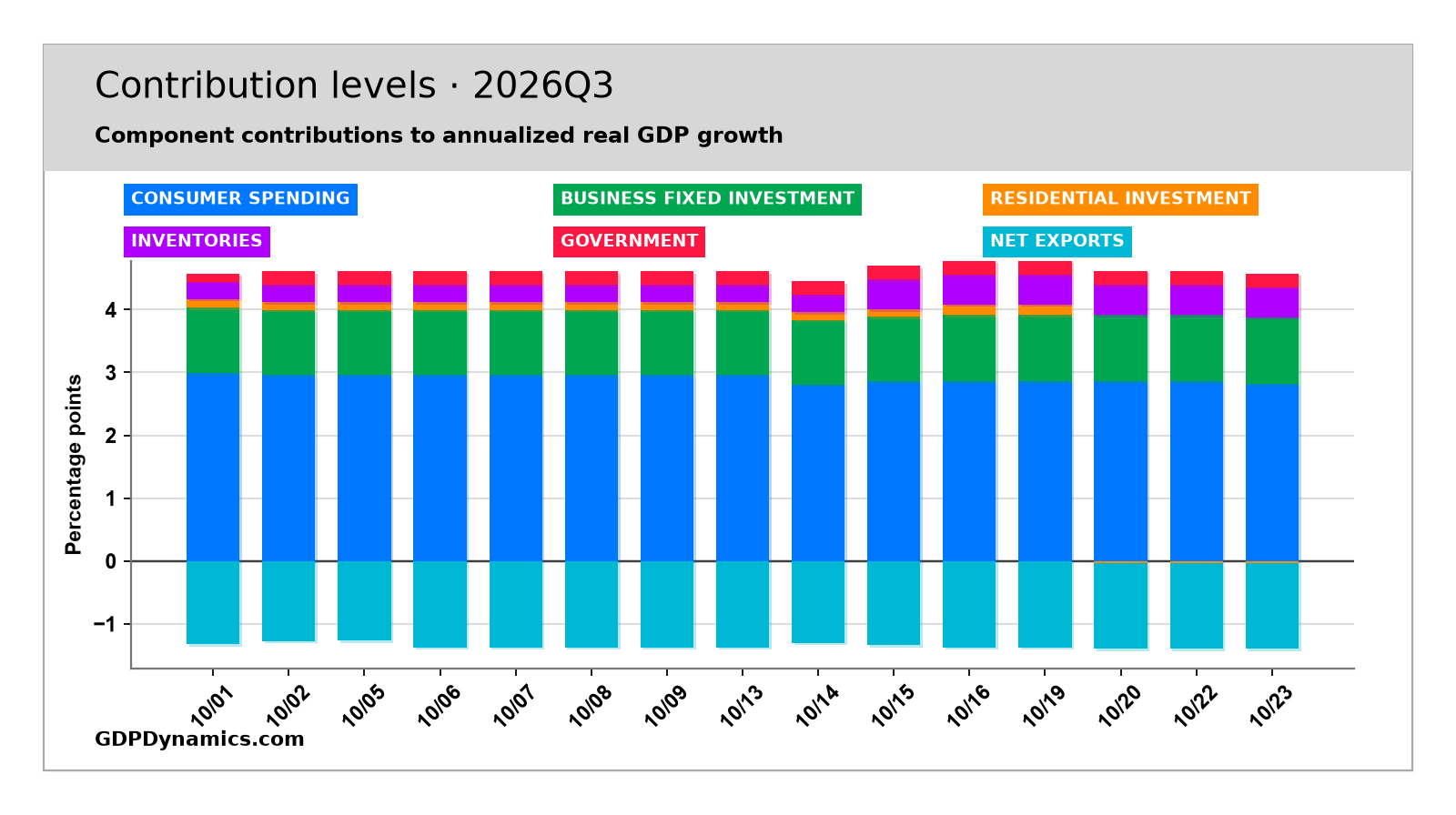
Consumer spending remains the largest positive contribution to the current GDP forecast, adding approximately 2.8 percentage points to annualized growth. That is not particularly surprising given the size of household consumption in the American economy.
What matters for today's update, however, is the change in that contribution rather than its absolute size.
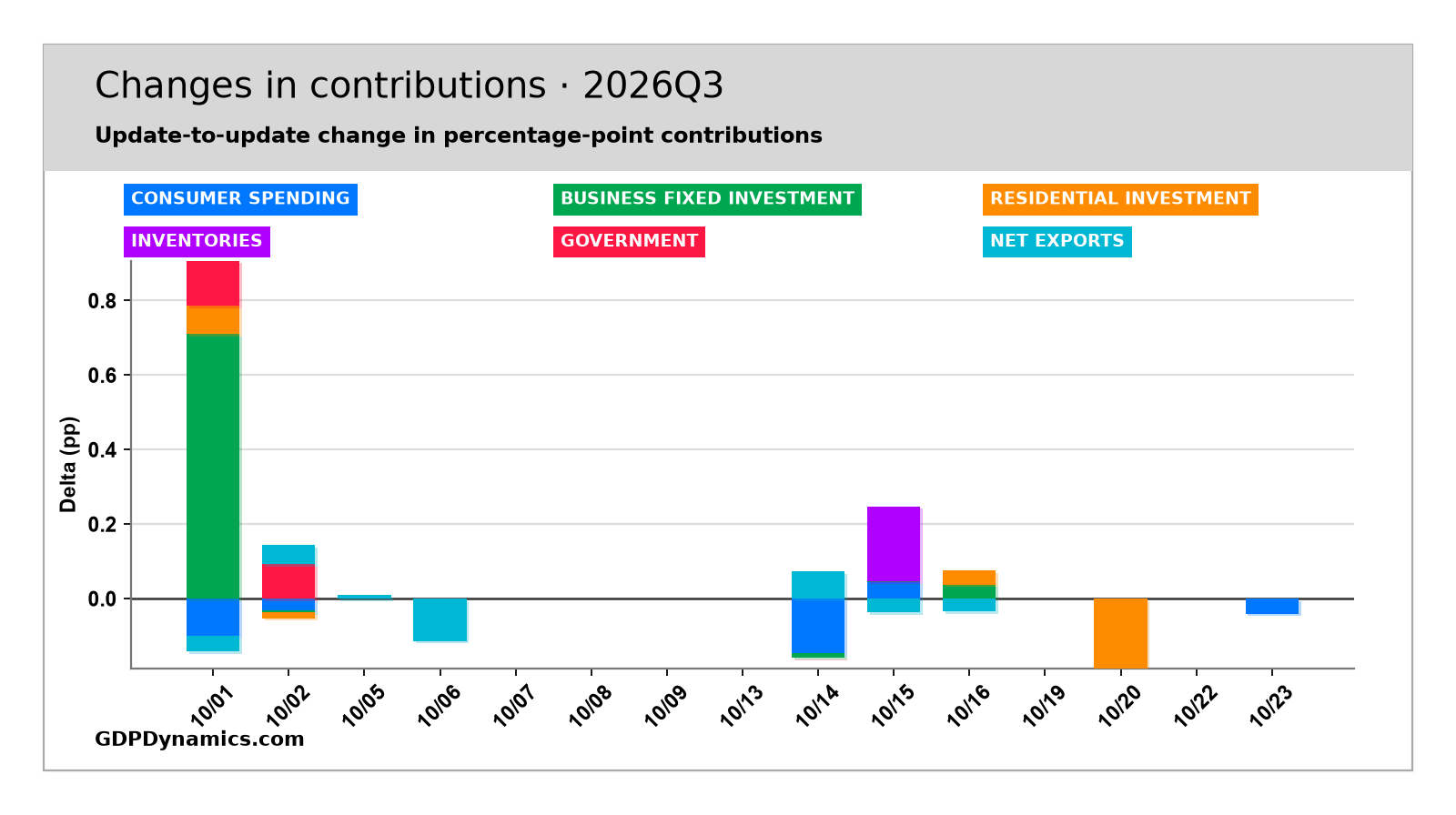
The model identifies consumer spending as the source of the slight downward revision, with no positive contribution changes identified elsewhere in the latest snapshot.
The decline is small enough to disappear when individual contributions are rounded to one decimal place. Nevertheless, the unrounded estimate shows that the model has become marginally less optimistic about third-quarter growth.
There is an important distinction here: the update identifies where the downward adjustment occurred, but the available model snapshot does not establish precisely which observation caused it.
Consumer Confidence Remains Weak
The latest University of Michigan consumer sentiment figures provide useful context for the model's softer household-demand outlook.
The final October consumer sentiment index registered 48.0, compared with 48.1 in September. While this was an improvement over October's preliminary reading of 46.3, confidence remains exceptionally weak.
The underlying details reveal a somewhat divided picture.
The current economic conditions index declined from 50.9 in September to 46.7 in October, suggesting that households have become considerably less satisfied with their present financial and economic circumstances.
Meanwhile, the consumer expectations index improved from 46.3 to 48.8, indicating that expectations for the future have improved somewhat even as assessments of current conditions deteriorated.
Inflation expectations remain another concern. Consumers anticipate price increases of 4.7% over the next year, compared with 4.6% in September. Longer-term inflation expectations have also increased to 3.5%.
These readings suggest that households remain under considerable pressure from prices and borrowing costs.
However, consumer sentiment and actual consumer expenditure are not interchangeable. Households can report considerable pessimism while continuing to spend, and weak survey results do not automatically translate into declining real consumption.
For that reason, the GDP Dynamics model's modest downward revision should not be interpreted as evidence of a broad collapse in consumer demand.
Contribution Changes
It is a small adjustment to an otherwise relatively strong quarterly growth estimate.
Investment Continues to Support the Forecast
Outside household consumption, business fixed investment remains an important source of growth, contributing approximately 1.1 percentage points to the current forecast.
Inventory investment adds another 0.5 percentage points, while government expenditure contributes approximately 0.2 percentage points.
Residential investment is essentially neutral, with a slightly negative contribution that rounds to zero at the displayed precision.
The distinction between fixed investment and inventories is worth emphasizing.
Business fixed investment represents spending on productive assets such as equipment, structures, and intellectual property. Inventory investment, by contrast, measures changes in the accumulation of goods that have been produced but not yet sold.
Both enter the expenditure calculation of GDP, but their economic implications can differ considerably.
An increase in fixed investment can indicate expanding productive capacity, while an increase in inventories may reflect either anticipated future sales or production exceeding current demand.
The present contribution estimates do not, by themselves, establish which interpretation is appropriate.
Net Exports Remain a Significant Drag
Net exports continue to subtract approximately 1.4 percentage points from the third-quarter growth forecast.
Contribution Levels
This represents the largest negative contribution among the model's expenditure components.
A negative net-export contribution indicates that the combined effect of exports and imports is reducing measured GDP growth. It does not necessarily imply that exports themselves are declining.
For example, imports may increase because domestic households and businesses are purchasing more foreign-produced goods, even while exports continue to expand.
The negative contribution therefore needs to be interpreted alongside domestic demand rather than treated as an independent measure of economic weakness.
Importantly, the latest snapshot does not identify a new change in the net-export contribution. The external-sector drag remains part of the overall forecast, but it is not the reported source of today's downward revision.
Labor Market Data Provide a More Stable Signal
The latest initial unemployment claims figures suggest that layoffs remain relatively contained.
Initial claims totaled 194,000 for the week ending October 17, down from the previous week's revised 200,000.
This is consistent with a labor market in which employers are generally reluctant to undertake large-scale layoffs.
However, low initial claims alone do not establish that hiring is accelerating. An economy can experience both relatively few layoffs and weak employment growth when businesses are reluctant to expand their payrolls.
For consumer spending, that distinction matters.
Continued employment supports household income and expenditure, but slower hiring can gradually weaken income growth even without a substantial increase in unemployment claims.
The latest claims data therefore provide a relatively stable labor-market backdrop rather than a decisive signal of stronger third-quarter consumption.
What the Latest Nowcast Tells Us
The October 23 update leaves the central GDP Dynamics forecast unchanged at 3.2% annualized growth.
The underlying estimate has declined slightly, but there is little justification for treating a four-hundredths-of-a-percentage-point revision as a meaningful change in the overall economic outlook.
Consumer spending remains a substantial positive contributor, business investment continues to support growth, and inventories provide an additional boost. Net exports remain the largest offsetting drag.
The latest consumer sentiment figures also illustrate why economic forecasting requires more than simply interpreting individual releases as good or bad news.
Consumer confidence remains weak, yet the model continues to anticipate positive real GDP growth. Initial jobless claims remain relatively low, but that does not necessarily imply a particularly strong hiring environment.
These observations describe different aspects of an interconnected economy, and their implications depend on how they interact.
For now, the model continues to anticipate solid third-quarter growth, with a marginally softer estimate of household consumption than yesterday.
The next meaningful development will be whether incoming expenditure, income, investment, and trade data reinforce that outlook or produce a more substantial revision.
The GDP Dynamics nowcast will continue to incorporate new information as it becomes available.