GDP Dynamics Q3 Nowcast Holds at 3.2% as Investment Offsets Trade Weakness
Date: 2026-10-22Author: GDP Dynamics
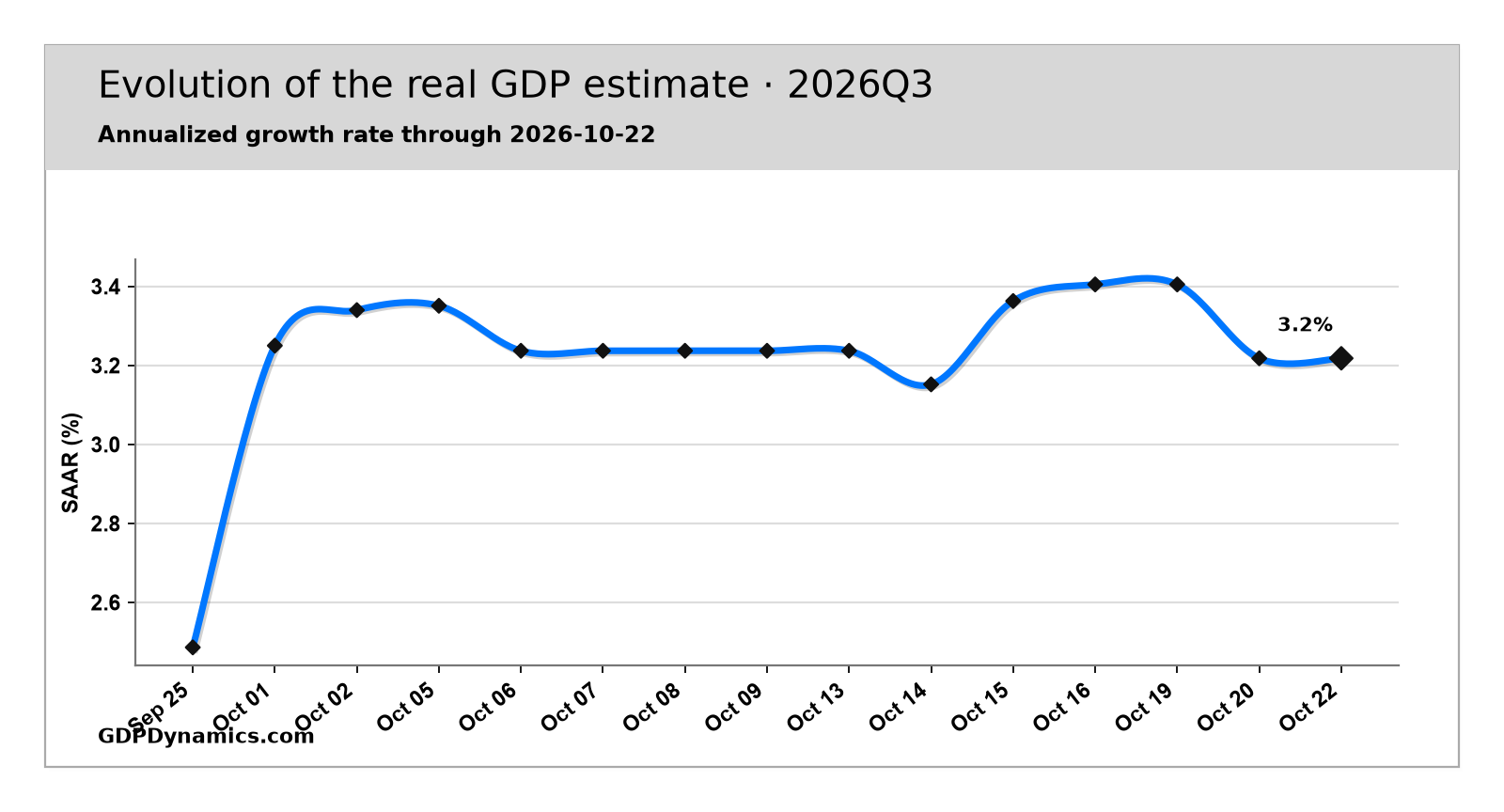
The GDP Dynamics nowcast for third-quarter U.S. real GDP growth remains unchanged at 3.2% annualized as of October 22, holding steady from its previous update on October 20.
Nowcast Path
The estimate translates to approximately 0.8% quarter-over-quarter growth. While the headline forecast has not moved, the underlying contributions continue to show an economy with positive domestic demand and a substantial drag from international trade.
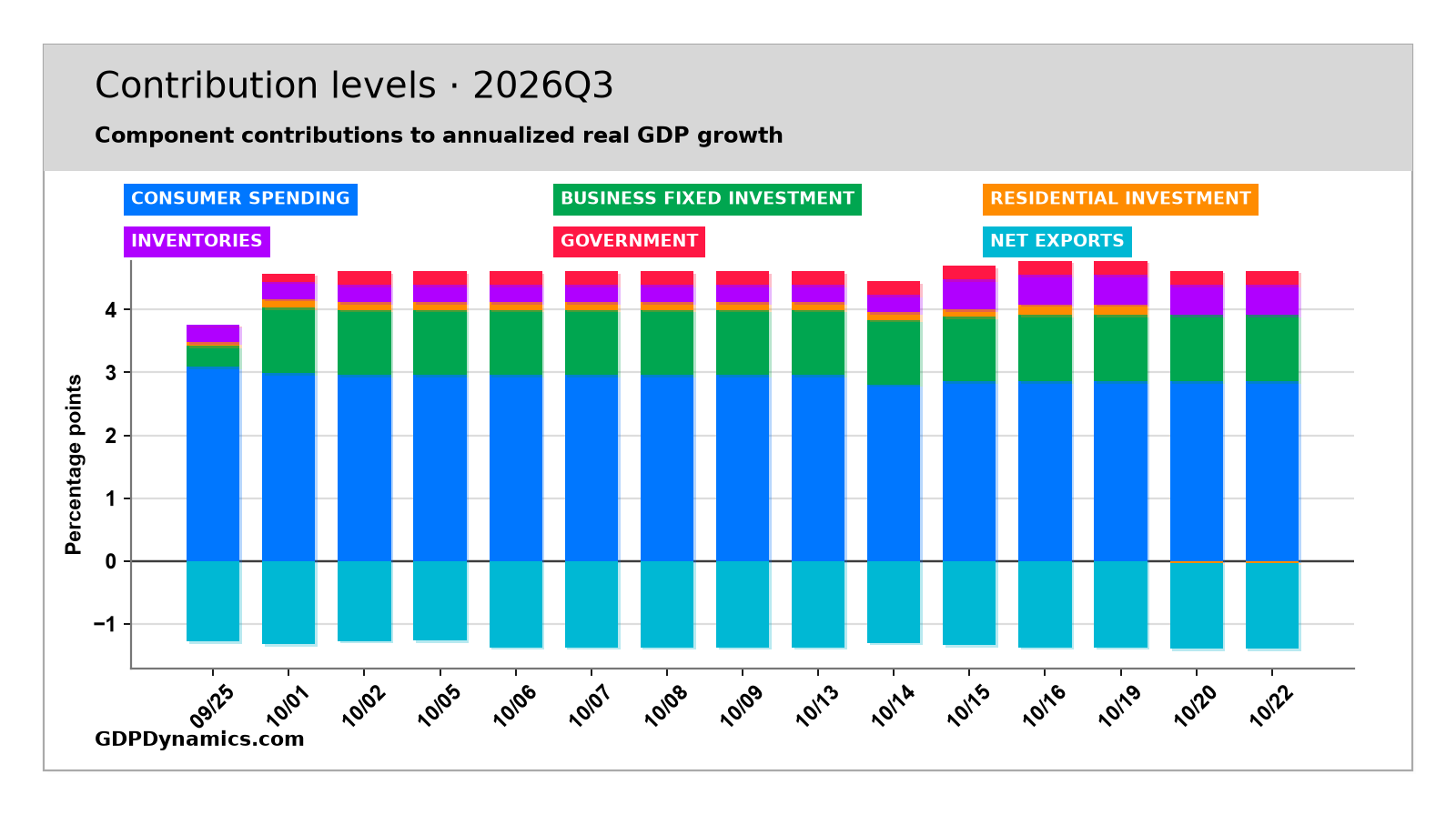
Consumer spending is currently contributing 2.9 percentage points to annualized GDP growth, while business fixed investment adds another 1.1 percentage points. Inventory investment contributes 0.5 percentage points, and government spending adds 0.2 percentage points. Net exports remain the largest negative contribution, subtracting 1.4 percentage points.
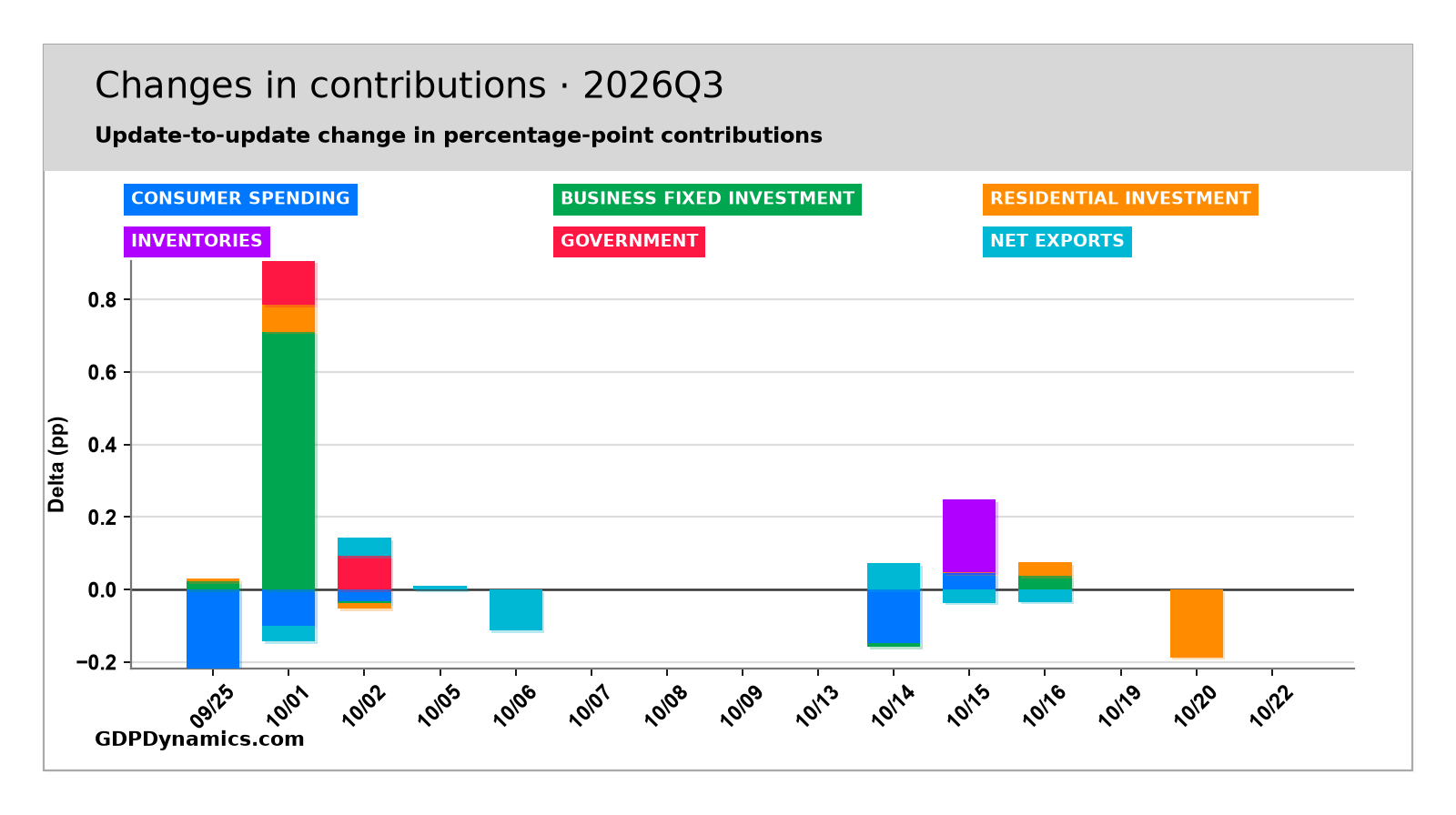
The important development in today's update is the absence of a revision. None of the estimated component contributions changed between October 20 and October 22.
An Unchanged Forecast, Not an Unchanging Economy
A nowcast is an evolving estimate of economic activity based on the information available at a particular point in time. As new data arrive, the model incorporates those observations into its estimate of quarterly GDP growth.
Not every update produces a revision.
The October 22 snapshot contains six available indicators: initial unemployment claims, the 30-year mortgage rate, the 10-year Treasury yield, the Financial Conditions Index, and Brent and WTI crude oil prices.
These indicators provide information about labor market conditions, borrowing costs, financial conditions, and energy prices. However, the current snapshot does not identify any positive or negative changes in GDP component contributions.
Consequently, there is no basis for attributing a change in the headline nowcast to any one of these indicators.
The 3.2% estimate is therefore best understood as a continuation of the October 20 forecast, rather than evidence of a fresh acceleration in economic growth.
Consumer Spending and Business Investment
Consumer spending currently contributes 2.9 percentage points to the forecast.
That is a substantial contribution, although its size should be considered in the context of consumption's large share of total U.S. economic activity. A large contribution to GDP growth does not necessarily mean that consumer spending has recently accelerated.
Contribution Levels
Indeed, the October 22 update provides no evidence of an increase or decrease in the estimated consumption contribution relative to October 20.
Business fixed investment is currently adding 1.1 percentage points to annualized growth.
This is an important part of the forecast because investment represents a smaller share of GDP than household consumption, yet its contribution remains substantial.
Investment spending is also particularly relevant when examining the dynamics of the business cycle. Changes in expected profitability, financing conditions, and business confidence can alter investment decisions, with subsequent effects on production, employment, and household income.
The current forecast suggests that business fixed investment is making a meaningful positive contribution to third-quarter growth. It does not, however, establish whether those underlying investment conditions have strengthened since the previous update.
Inventory investment adds another 0.5 percentage points.
Inventory accumulation can support measured GDP growth, although its economic interpretation depends on whether businesses are deliberately increasing their stocks or experiencing an unexpected difference between production and sales.
The available snapshot does not distinguish between these possibilities.
Net Exports Continue to Weigh on Growth
Net exports currently subtract 1.4 percentage points from the Q3 growth estimate.
Contribution Changes
This represents a significant offset to the positive contributions from domestic spending and investment.
A negative net export contribution can reflect stronger import growth, weaker export growth, or some combination of the two. Imports are subtracted in the expenditure accounting identity because imported goods and services are not part of domestic production.
However, an increase in imports is not necessarily evidence of weakening domestic economic conditions. Imports can rise alongside household consumption and business investment, particularly when domestic demand increases purchases of foreign-produced goods and services.
The October 22 snapshot does not provide the separate export and import movements needed to determine which side of the trade balance is responsible for the negative contribution.
Government expenditure contributes a further 0.2 percentage points, while residential investment is approximately neutral, with its contribution rounded to negative zero.
Taken together, the estimates suggest that positive contributions from consumption, business investment, inventories, and government expenditure are being partially offset by net exports.
What to Watch Next
With the nowcast holding at 3.2%, the next meaningful revision will depend on incoming economic information and how that information changes the model's estimated expenditure components.
Consumer spending will remain important, particularly whether subsequent releases reinforce or weaken the existing consumption estimate.
Business fixed investment also deserves attention. Its current positive contribution is meaningful, but future investment data will help determine whether the estimated strength is sustained.
International trade remains another important source of uncertainty. With net exports currently subtracting 1.4 percentage points, revisions to export or import estimates could materially alter the headline growth forecast.
For now, the model continues to indicate positive third-quarter economic growth, with no change in its estimate since October 20.
The next update will be more informative if new releases produce identifiable revisions to the underlying components, rather than simply leaving the headline estimate unchanged.