GDP Nowcast Falls to 3.2% as Housing Construction Weakens
Date: 2026-10-20Author: GDP Dynamics
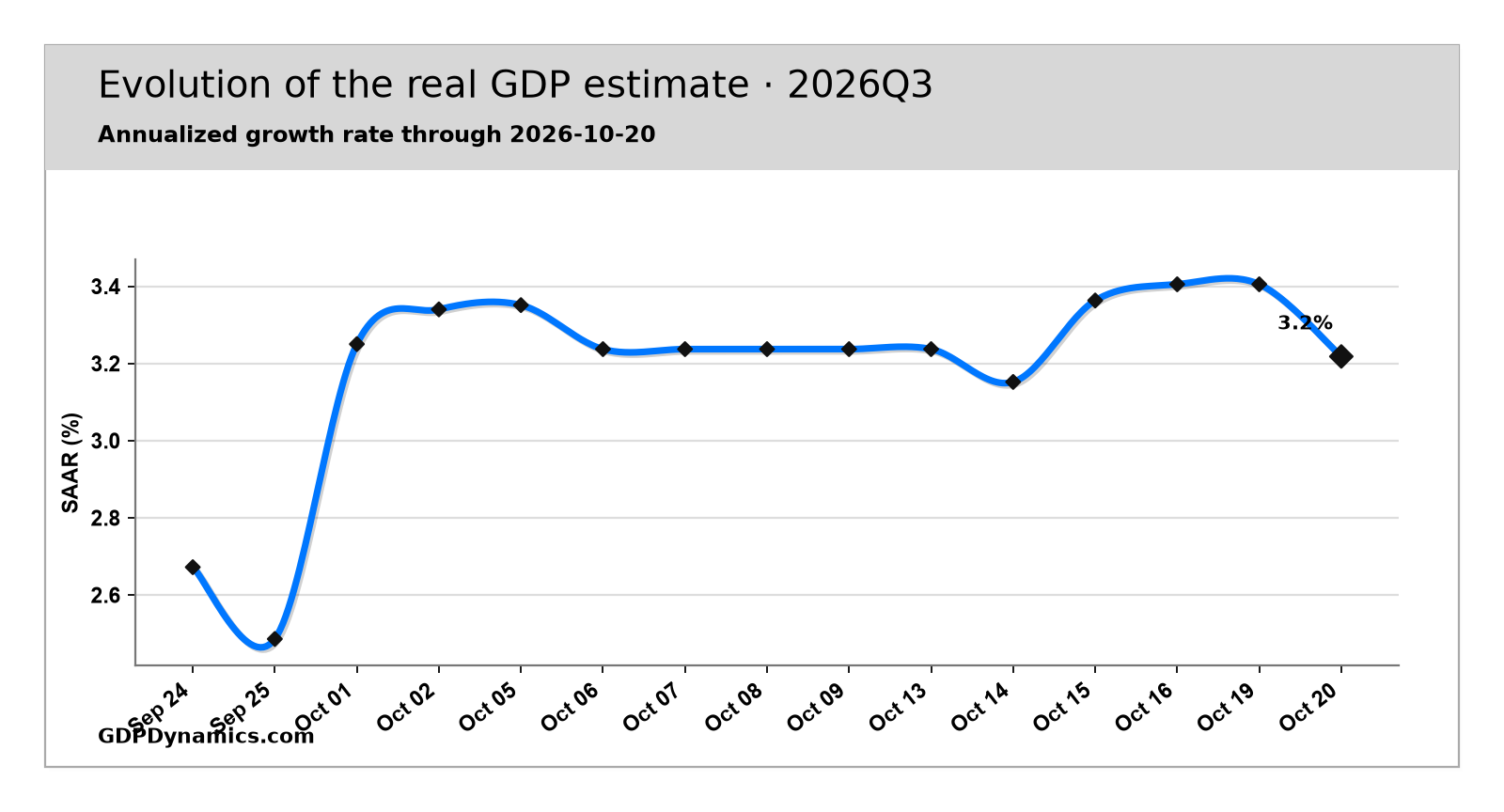
The GDP Dynamics nowcast for third-quarter US real GDP growth declined to 3.2% today, down 0.2 percentage points from yesterday's estimate of 3.4%. The latest revision follows September housing construction data showing a sharper-than-expected slowdown in residential building activity.
The model now estimates real GDP growth of 3.2% at a seasonally adjusted annual rate (SAAR), equivalent to approximately 0.8% quarter-over-quarter.
Nowcast Path
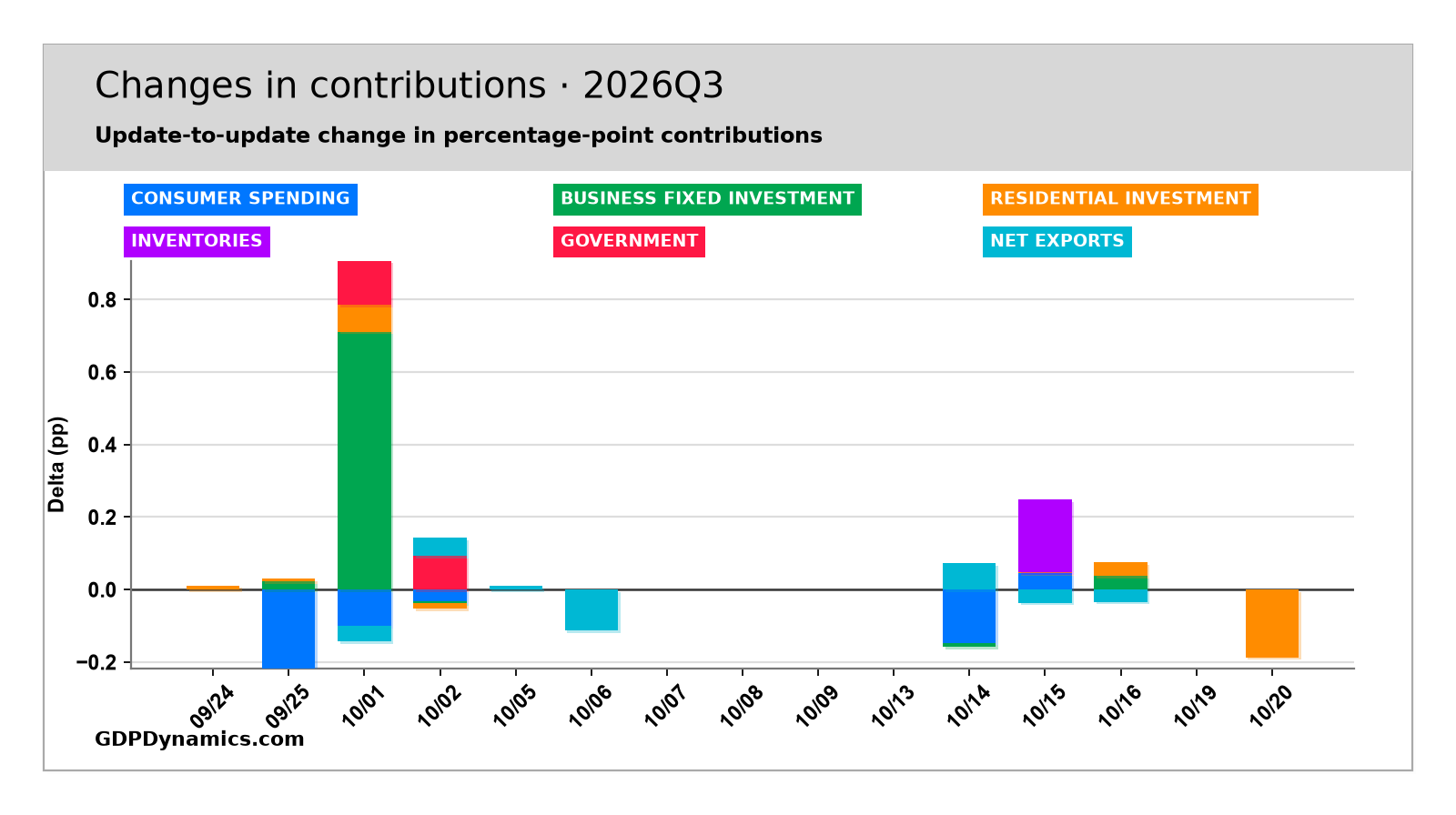
Residential investment accounted for the entire downward revision in today's update. No other expenditure component registered a positive or negative contribution change.
While the overall growth estimate remains above 3%, the housing figures provide further evidence that elevated borrowing costs are weighing on one of the economy's most interest-rate-sensitive sectors.
Housing Construction Drives the Downward Revision
The US Census Bureau reported that housing starts fell 5.2% in September to a seasonally adjusted annual rate of 1.221 million units, down from a revised 1.288 million in August.
The decline was considerably larger than economists had anticipated. The consensus forecast called for approximately 1.305 million housing starts, making the actual release a meaningful disappointment.
Single-family construction was particularly weak.
Single-family housing starts declined 4.6% to an annualized rate of 859,000 units, compared with 900,000 in August. Building permits for single-family homes also fell 4.0%, reaching an annualized rate of 845,000 units.
Total building permits declined by a more modest 0.2% to 1.400 million units. However, this relatively small decline conceals a more substantial deterioration in single-family construction intentions.
The distinction matters because housing starts measure construction activity beginning today, while permits provide an indication of the projects builders intend to undertake in the coming months.
Both measures are pointing toward weaker single-family construction.
The GDP Dynamics model incorporated the latest housing information by reducing residential investment's contribution to third-quarter growth by 0.2 percentage points. This brought the overall GDP nowcast down from 3.4% to 3.2%.
Source: US Census Bureau, September 2026 New Residential Construction, released October 20, 2026.
Contribution Changes
Higher Borrowing Costs Continue to Weigh on Housing
The weakness in residential construction is consistent with the broader deterioration in housing affordability.
According to Freddie Mac data reported by Reuters, the average 30-year fixed mortgage rate reached 7.40% last week, its highest level in nearly three years.
Higher mortgage rates increase the monthly payments required to purchase a home, reducing the number of households able or willing to enter the market at prevailing prices.
For homebuilders, this creates a difficult investment environment.
Slower sales and elevated inventories of unsold new homes reduce the incentive to begin additional projects. Builders must also contend with higher financing costs, expensive construction materials, and labor shortages.
The National Association of Home Builders reported similar concerns in its October assessment of residential construction.
From a macroeconomic perspective, the relationship between interest rates and residential investment is particularly important.
Residential construction involves substantial upfront expenditures and depends heavily on credit conditions. Changes in financing costs can therefore affect investment decisions well before the consequences become visible in completed construction.
The September data suggest that this adjustment is continuing.
There is also an important distinction between housing construction and housing sales. The purchase of an existing home does not directly add the home's value to current GDP, whereas new residential construction represents current production and investment.
A slowdown in new construction consequently has a more direct effect on measured economic output.
The Broader GDP Outlook Remains Positive
Contribution Levels
Despite today's downward revision, the GDP Dynamics model continues to estimate relatively strong third-quarter economic growth.
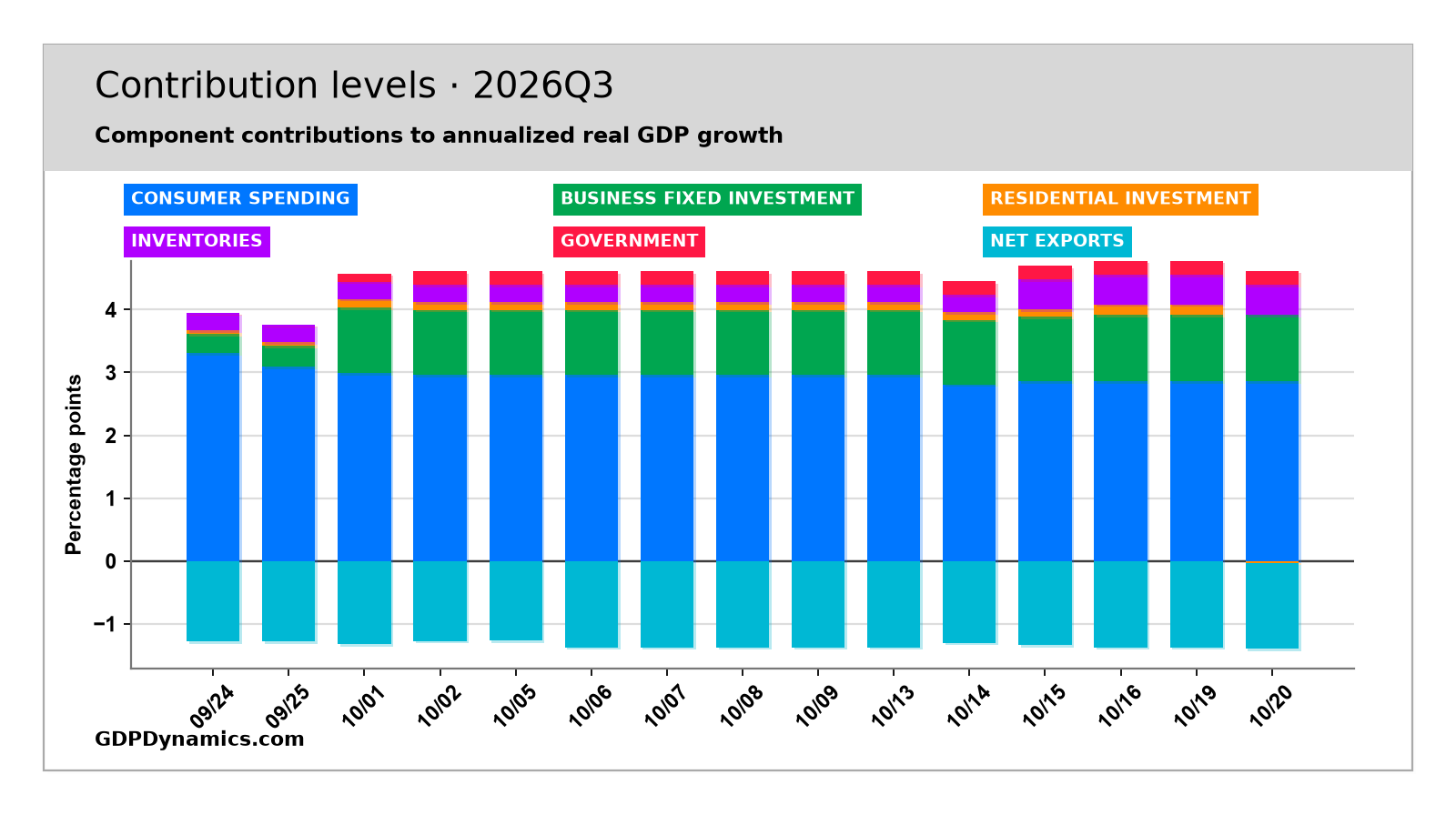
Consumer spending currently contributes approximately 2.9 percentage points to the annualized growth estimate. Business fixed investment adds another 1.1 percentage points, while inventory investment contributes 0.5 percentage points.
Government expenditures add approximately 0.2 percentage points.
The largest negative contribution comes from net exports, which subtract approximately 1.4 percentage points from estimated growth.
Residential investment is now approximately neutral in its contribution to overall growth, following today's downward revision.
These figures describe the current composition of the GDP estimate rather than changes in each component since yesterday.
The distinction is important. Consumer spending represents the largest positive contribution to the level of estimated GDP growth, but it was not responsible for today's revision.
The new information affecting the estimate came from residential construction.
The current picture is therefore one of continued aggregate economic expansion alongside weakness in particular sectors, especially housing and the external balance.
What This Means for the Q3 GDP Estimate
Today's revision illustrates how incoming economic information changes the GDP outlook even after the quarter being estimated has ended.
The third quarter concluded on September 30, but the statistical releases needed to estimate its economic activity continue to arrive throughout October.
September housing starts and building permits provide additional information about residential construction during the final month of the quarter.
The GDP Dynamics nowcast incorporates these releases into its estimate of residential investment, which in turn changes the estimated rate of aggregate economic growth.
This is also why the timing of economic data matters.
A housing report released in October can alter our understanding of economic activity that occurred in September, even though the underlying production decisions were made weeks or months earlier.
The current estimate of 3.2% should therefore be understood as an evolving assessment of third-quarter growth rather than a final measurement.
The September construction data support a weaker residential investment outlook, but they do not by themselves establish the final magnitude of the housing sector's contribution to GDP. Residential investment also includes improvements and other housing-related expenditures that are not fully captured by starts and permits.
Additional information and subsequent revisions can still change the estimate.
Looking Ahead
With the advance third-quarter GDP release approaching, the remaining question is how closely the incoming economic data will support the model's current estimate.
Today's housing figures have lowered the GDP Dynamics forecast by 0.2 percentage points, but the overall estimate remains at 3.2% annualized growth.
The next updates will help determine whether weakness in residential investment remains relatively contained or whether further revisions emerge elsewhere in the expenditure accounts.
For now, the September construction report has delivered a clear message: the housing sector continues to face significant pressure from high financing costs and weak affordability.
The broader economy, however, is still estimated to have expanded at a solid pace during the third quarter.
The GDP Dynamics nowcast will continue updating as additional economic information becomes available.