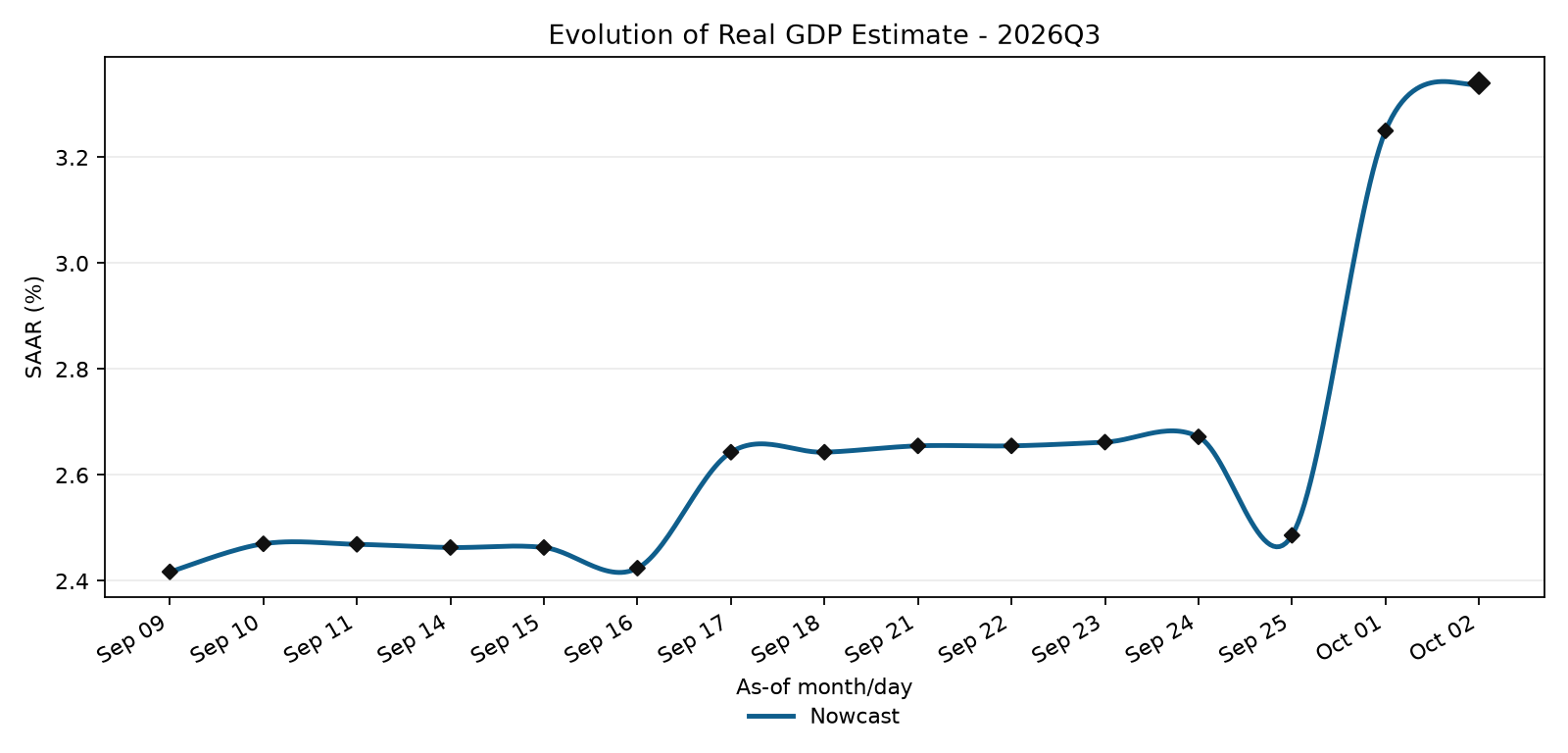
The GDP Dynamics nowcast for U.S. real GDP growth in the third quarter of 2026 rose to 3.34% SAAR on October 2, up 0.09 percentage point from yesterday’s estimate of 3.25%.
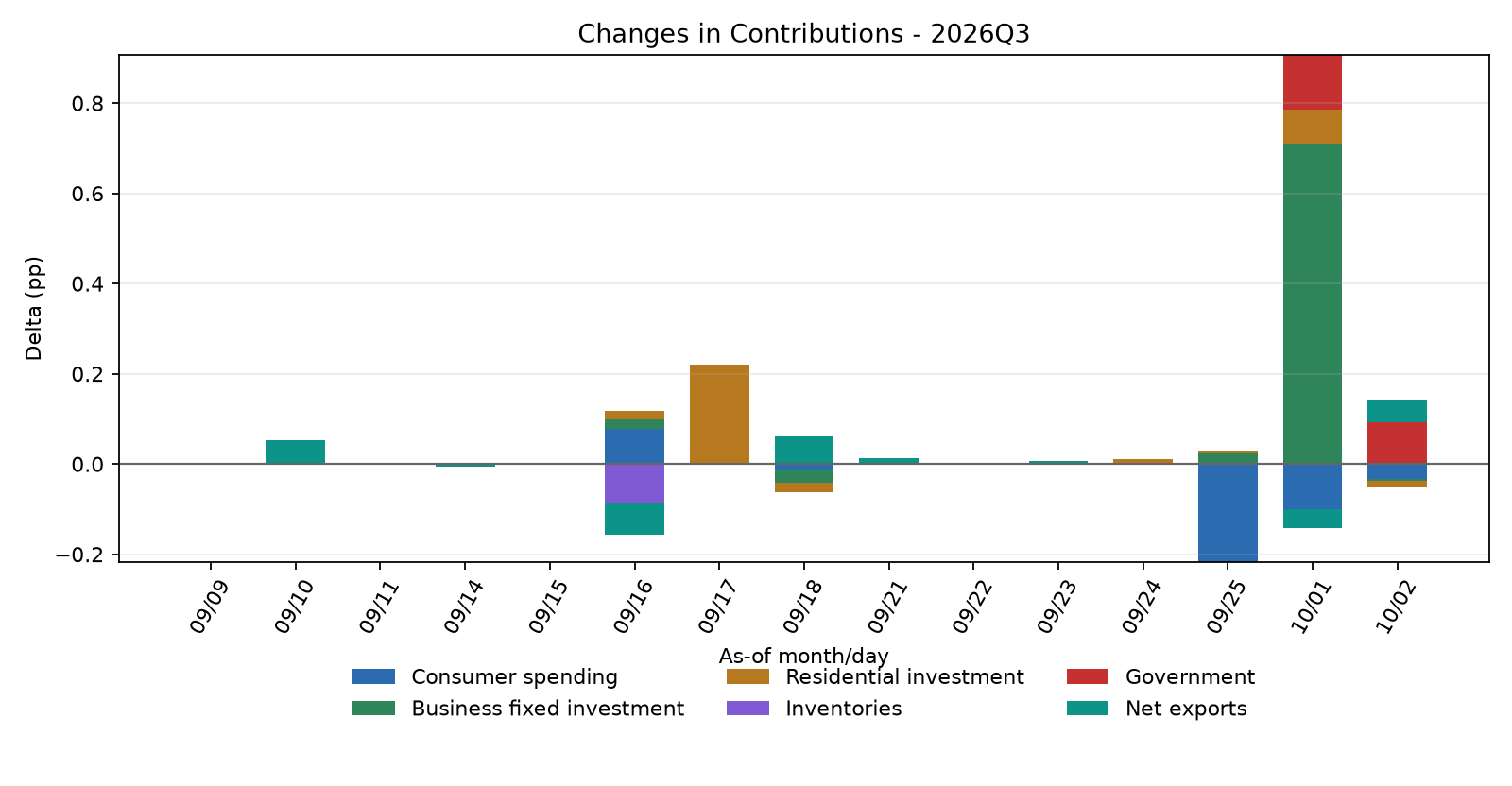
The increase came as the model incorporated the latest round of economic data, including the September employment report. Government and net exports provided the largest upward revisions, while consumer spending and residential investment moved slightly lower.
Nowcast Path
Government Provides the Largest Upward Revision
The government contribution increased by 0.09 percentage point in today’s update, bringing its estimated contribution to Q3 growth to 0.22 percentage point.
That increase should not be read simply as a response to stronger government hiring in September. In fact, the September employment report showed government payrolls falling by 17,000 after increasing by 44,000 in August. The GDP Dynamics model incorporates the underlying federal, state and local employment series separately, so revisions to previous months and changes across those individual series can move the quarterly estimate even when the latest aggregate monthly figure declines.
The broader September employment report was relatively soft. Nonfarm payrolls increased by just 29,000, while the unemployment rate edged up from 4.1% to 4.2%. July and August payroll growth was also revised down by a combined 60,000 jobs.
Recent construction data nevertheless provided a somewhat firmer picture of government-related activity. Public construction spending increased 0.2% in August to a seasonally adjusted annual rate of $547.8 billion. Total construction spending rose 0.9%, with most of that increase coming from the private sector.
Net Exports Also Improve
Net exports added another 0.05 percentage point to the Q3 nowcast, although they remain a substantial drag on growth overall.
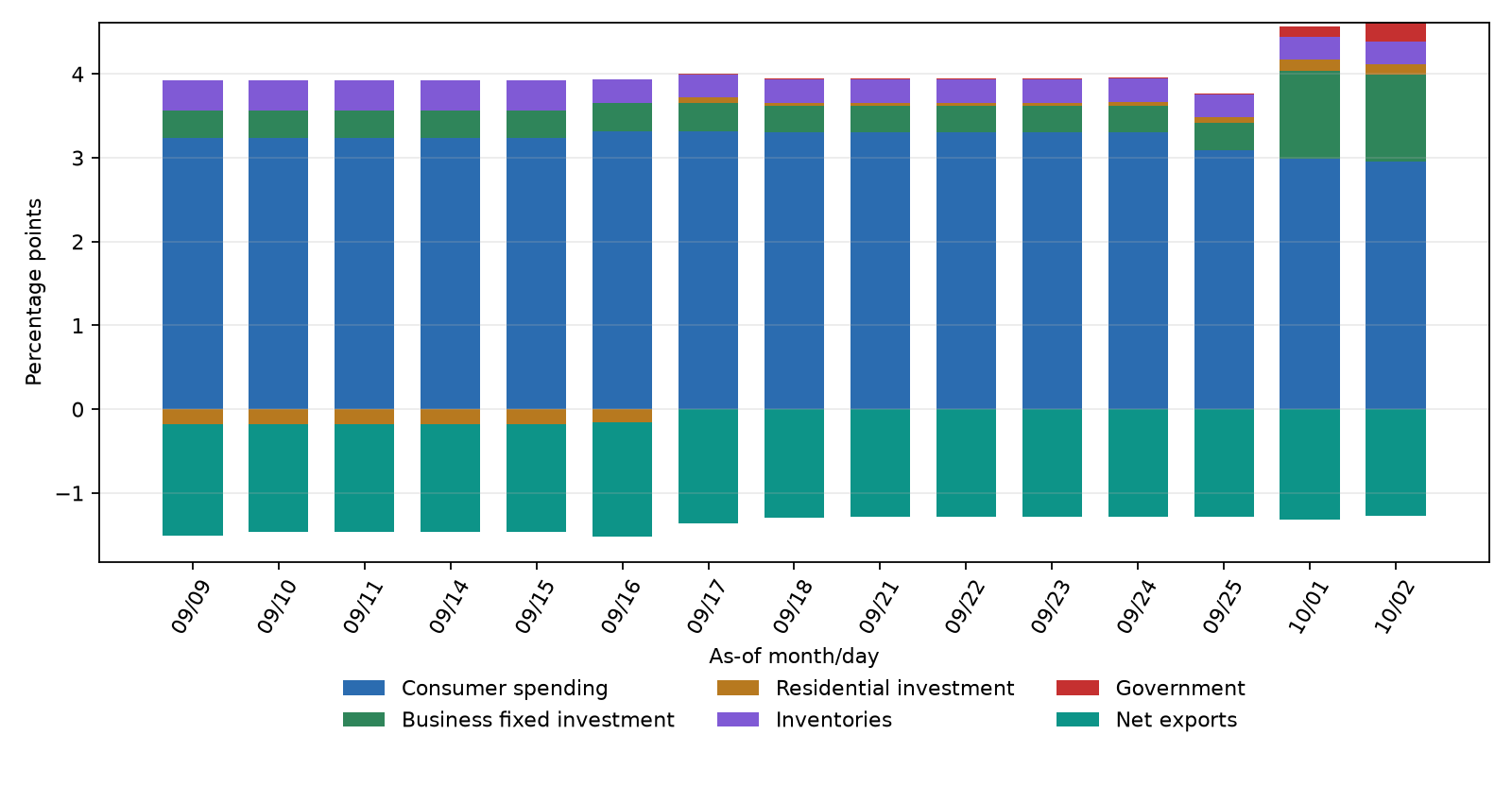
The model currently estimates that net exports will subtract 1.27 percentage points from third-quarter GDP growth. The latest revision therefore represents an improvement in the expected external balance rather than a positive contribution from trade.
There was no new monthly international trade report released today. The next detailed U.S. trade update is scheduled for October 6, so this movement largely reflects the model's evolving estimate based on the information already available rather than a new trade headline.
Contribution Changes
Consumer Spending Edges Lower
Consumer spending was revised down by 0.03 percentage point from yesterday's estimate, although its current contribution remains a substantial 2.96 percentage points.
The small downward revision comes despite relatively strong August spending data released earlier this week. BEA reported that nominal personal consumption expenditures increased 0.9% in August, compared with just 0.1% in July. Spending on goods increased by $114.1 billion while services spending rose by $76.7 billion.
Income growth was considerably weaker. Personal income increased 0.2% and disposable personal income increased 0.3%, while the personal saving rate fell to 4.1%.
Today's employment report also offered a softer signal for household income going into the final month of the quarter. Average hourly earnings increased just 0.1% in September, while average weekly hours were unchanged at 34.4 hours. Aggregate weekly payrolls increased 0.2%.
Taken together, the incoming data still point to substantial consumer spending growth during Q3, but the latest labor-market information caused the model to trim that contribution slightly.
Residential Investment Slips
Residential investment was revised down another 0.02 percentage point, leaving its estimated contribution at 0.12 percentage point.
Housing activity has remained uneven. August housing starts fell 2.6% to a seasonally adjusted annual rate of 1.275 million units, extending the weakness seen during the summer.
Construction spending provided a somewhat better signal. Private residential construction spending increased 1.1% in August to an annualized $882.3 billion.
The result is a mixed housing picture: construction expenditures improved during August, but the flow of new housing starts remained weak enough to restrain the model's estimate of residential investment.
Business Investment Little Changed
Business fixed investment was effectively unchanged in today's update, with the contribution declining by less than 0.01 percentage point.
Its estimated contribution remains 1.04 percentage points, making business investment an important source of Q3 growth in the current model.
Today's employment report was not particularly negative for the goods-producing side of the economy. Manufacturing employment increased by 9,000 in September and construction employment increased by 11,000. The manufacturing workweek was unchanged at 40.6 hours.
Contribution Levels
Q3 Nowcast: 3.34%
After today's data, GDP Dynamics estimates third-quarter real GDP growth at:
3.34% SAAR, equivalent to approximately 0.84% quarter-over-quarter growth.
The current estimated contributions are:
-Consumer spending: +2.96 pp
-Business fixed investment: +1.04 pp
-Inventories: +0.28 pp
-Government: +0.22 pp
-Residential investment: +0.12 pp
-Net exports: −1.27 pp
The important change today is not the level of consumer spending's contribution, which is structurally the largest component of GDP, but the shift in the incoming signals. Government added 0.09 percentage point and net exports added 0.05 percentage point to the nowcast, more than offsetting the 0.03-point decline from consumption and 0.02-point decline from residential investment.
The result pushed the GDP Dynamics Q3 estimate from 3.25% to 3.34% SAAR.