GDP Dynamics Q3 Nowcast Falls to 2.49% as Consumer Signal Weakens
Date: 2026-09-25Author: GDP Dynamics
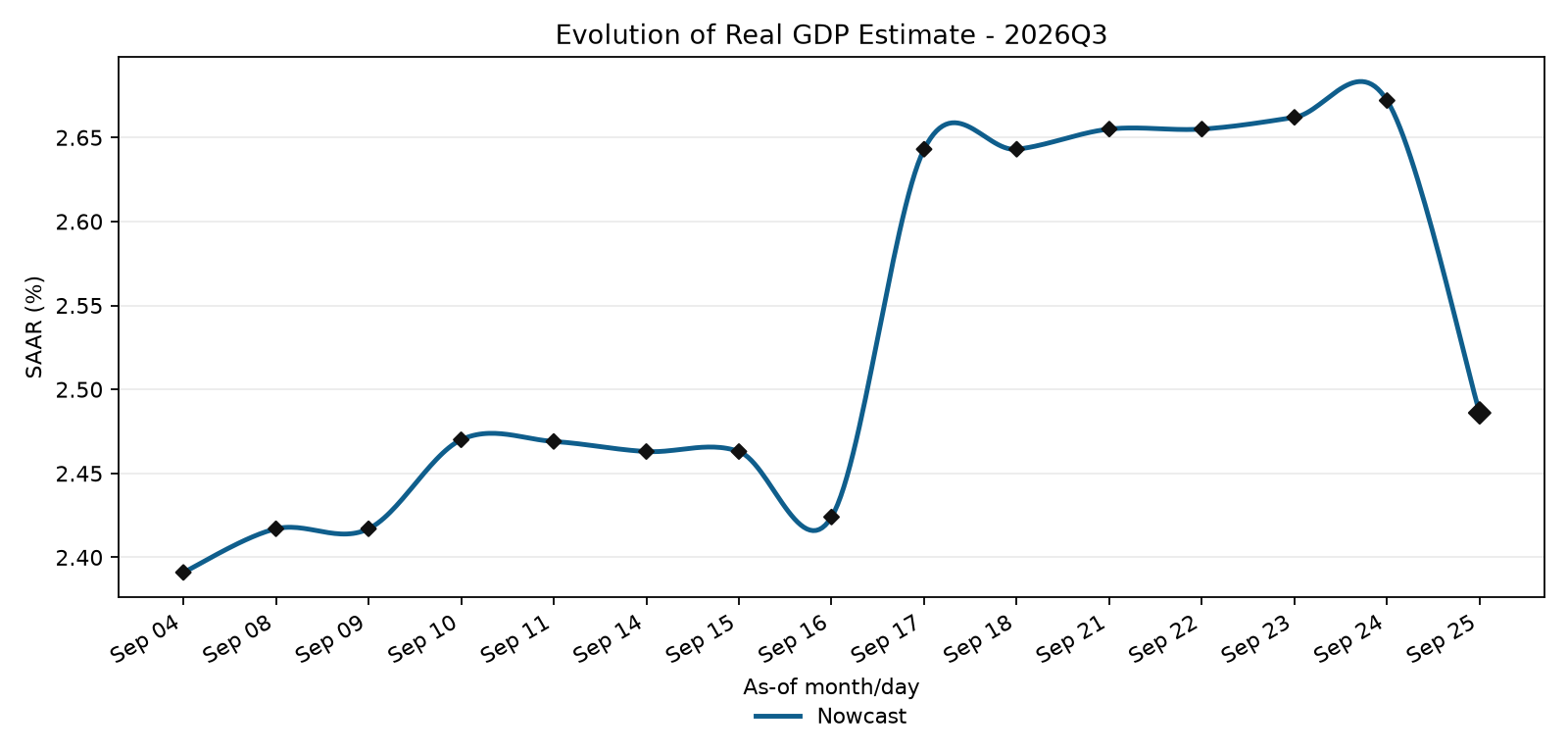
The GDP Dynamics nowcast for third-quarter U.S. real GDP growth fell to 2.49% SAAR on September 25, down 0.19 percentage points from yesterday’s estimate. That is equivalent to roughly 0.62% growth quarter-over-quarter.
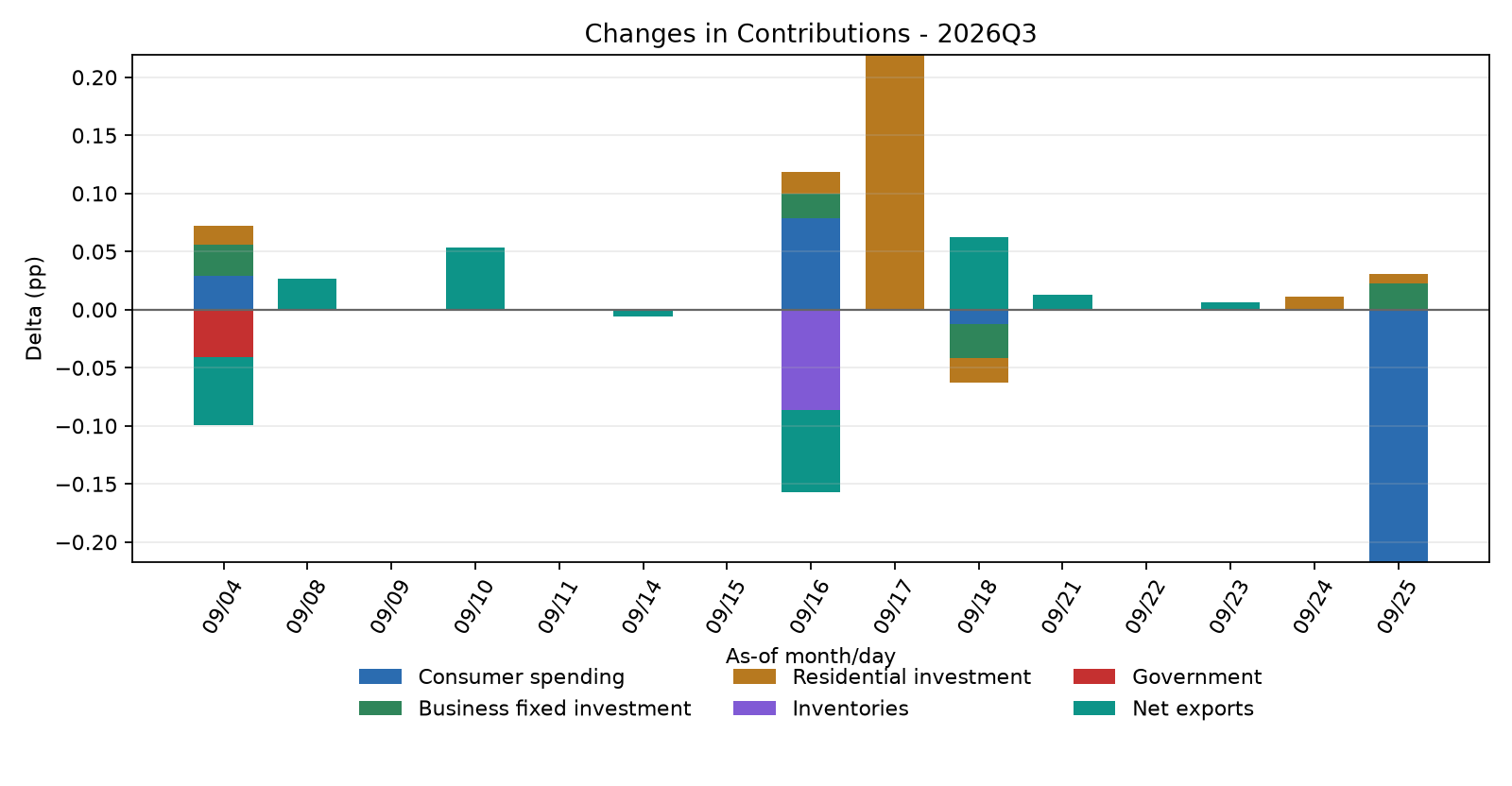
The decline came almost entirely from the consumer side of the model. Consumer spending’s estimated contribution fell by 0.22 percentage points, more than offsetting small improvements in business fixed investment and residential investment. The change leaves an interesting split in the incoming data: household signals weakened while capital spending continues to look surprisingly strong.
Consumer Spending Takes a Hit
Consumer spending remains at a high estimated contribution of 3.09 percentage points, but that level shouldn’t obscure what changed today. Its contribution fell 0.22 percentage points from yesterday’s estimate, making consumption responsible for essentially all of the downward revision.
One of the new signals was September consumer sentiment. The University of Michigan’s final Consumer Sentiment Index fell to 48.1 from 51.7 in August, its lowest level in four months. At the same time, expected inflation over the next year increased to 4.6% from 4.0%. Households are increasingly concerned that higher prices will eat into purchasing power.
That doesn’t mean actual consumer spending has collapsed. August retail sales were quite strong, rising 1.2% from July, and the Michigan survey actually found some evidence that consumers are bringing durable purchases forward because they expect prices to rise further.
The distinction matters for the nowcast. The model is picking up a deterioration in the marginal consumer signal, not saying household spending has suddenly disappeared. Consumption is still making a large positive contribution to Q3 growth, but today’s incoming information reduced the model’s estimate of that contribution.
Contribution Changes
Business Investment Moves the Other Way
Business fixed investment provided the largest positive revision today, adding 0.02 percentage points and bringing its estimated Q3 contribution to 0.33 percentage points.
The new capital-goods report provides a pretty clear explanation.
Orders for nondefense capital goods excluding aircraft, one of the better monthly indicators of business equipment spending, jumped 1.6% in August. July was also revised substantially higher, from an initially reported flat reading to a 0.6% increase. Economists surveyed by Reuters had expected only a 0.5% August gain.
More importantly for GDP, shipments of core capital goods increased 0.6% in August after rising 1.4% in July. Shipments feed more directly into the calculation of equipment investment in GDP than new orders do.
The strength was fairly broad. Electrical equipment orders rose 1.1%, machinery increased 1.1%, and computer orders climbed 1.5%. Computer orders were also 20.1% above their year-earlier level, consistent with continued heavy spending on AI and computing infrastructure.
Headline durable-goods orders looked much weaker, coming in essentially unchanged in August, but that number was held down by transportation. Transportation-equipment orders fell 0.6%, including a 4.3% decline in the volatile civilian-aircraft category. Strip out some of that noise and the underlying capital-spending numbers were considerably stronger.
Housing Adds a Little
Residential investment added another 0.01 percentage points to the nowcast and currently contributes about 0.06 percentage points to Q3 growth.
That is a relatively small move compared with the consumer revision, but it provided another slight offset to today’s decline. The model’s housing block incorporates signals from starts, permits and residential construction, so the change should be viewed as a modest improvement rather than evidence of a major housing acceleration.
Where the Q3 Nowcast Stands
The composition of the 2.49% Q3 nowcast is increasingly interesting.
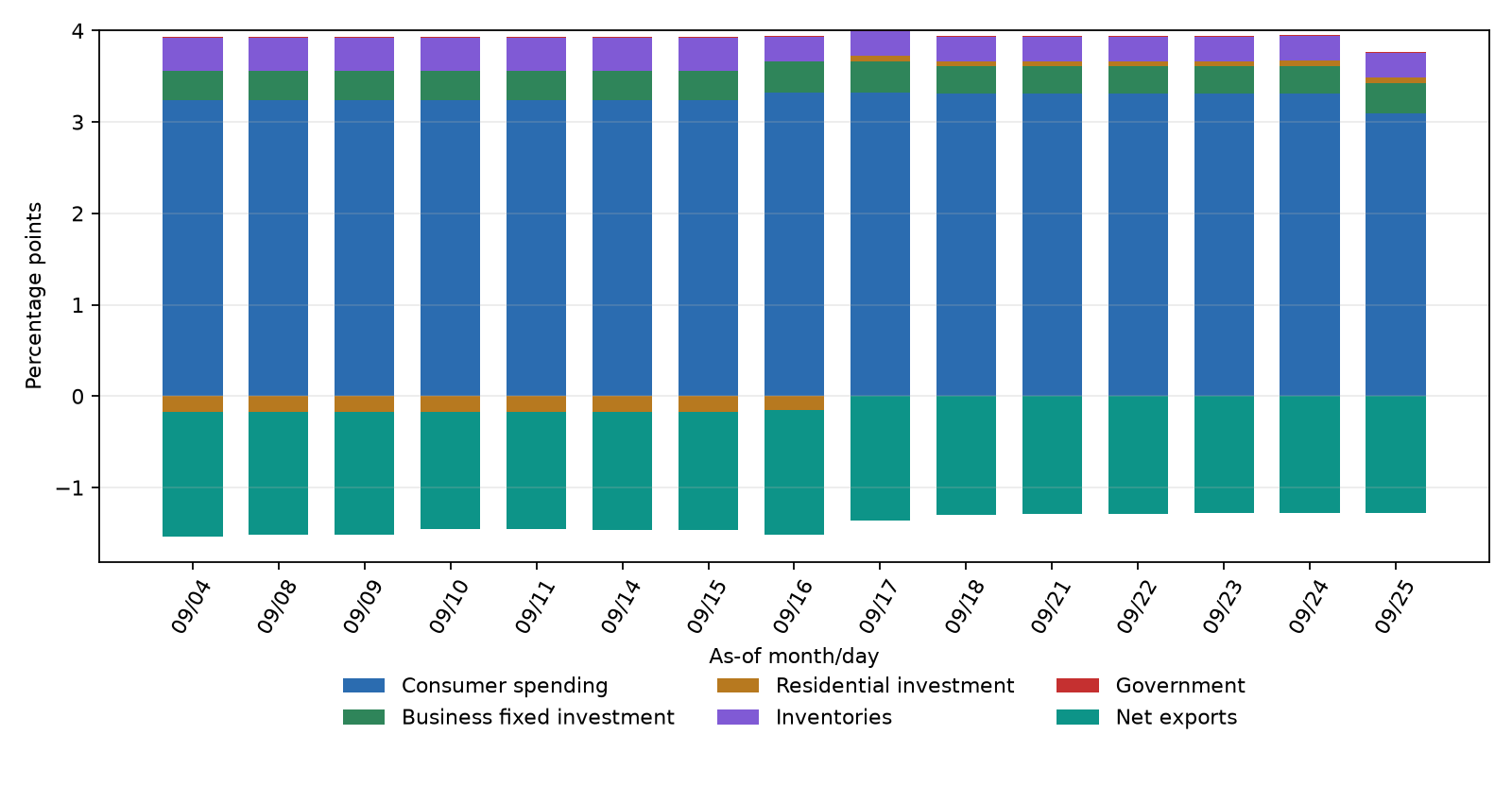
Consumer spending contributes 3.09 percentage points, business fixed investment adds 0.33 points, inventories add 0.28 points, residential investment contributes 0.06 points, and government adds 0.01 points. Net exports remain the major offset, subtracting 1.28 percentage points.
Contribution Levels
The labor-market signal remains relatively firm as well. Initial unemployment claims fell to 197,000 in the week ending September 19, while the four-week moving average declined to 202,250. That does not suggest a sudden deterioration in layoffs, even as consumer sentiment has weakened.
The result is not a uniformly weak set of data. It is a more mixed one. Consumers remain an important source of Q3 demand, but the model marked down that contribution today. At the same time, the August capital-goods report provided unusually strong evidence that equipment investment is continuing to expand.
That divergence is worth watching. If the capital-spending boom persists while household demand cools, the composition of growth could shift noticeably even if headline GDP growth remains relatively solid.
Nowcast Path
The GDP Dynamics model currently estimates 2.49% annualized real GDP growth for Q3 2026. As additional September data arrive, particularly spending, trade, inventories and construction data, the estimate will continue to update.