GDP Nowcast Edges Higher to 2.66% as Net Exports Improve
Date: 2026-09-23Author: GDP Dynamics
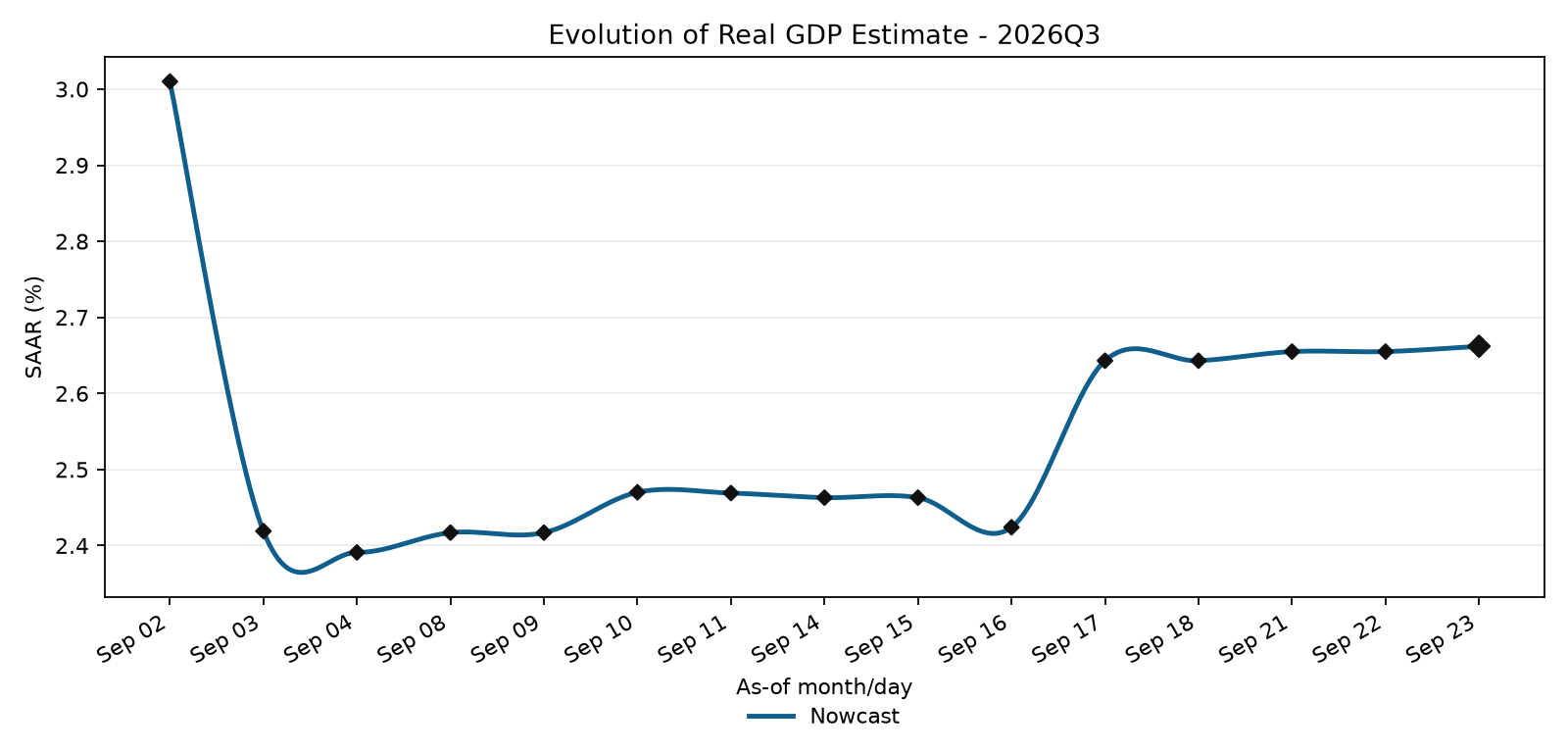
The GDP Dynamics nowcast for 2026 Q3 edged up to 2.66% SAAR on September 23, an increase of just 0.01 percentage point from yesterday’s estimate. On a quarter-over-quarter basis, the model is currently tracking growth of about 0.67%.
It is a small move, and that is probably the most important takeaway from today’s update. There was no major new GDP-related economic release capable of substantially changing the outlook. Instead, the latest update incorporated changes in financial and commodity-market variables, including crude oil prices, Treasury yields, and broader financial conditions.
The result is essentially a stable estimate of Q3 growth, with a small improvement in the composition underneath the headline.
Net Exports Improve Slightly
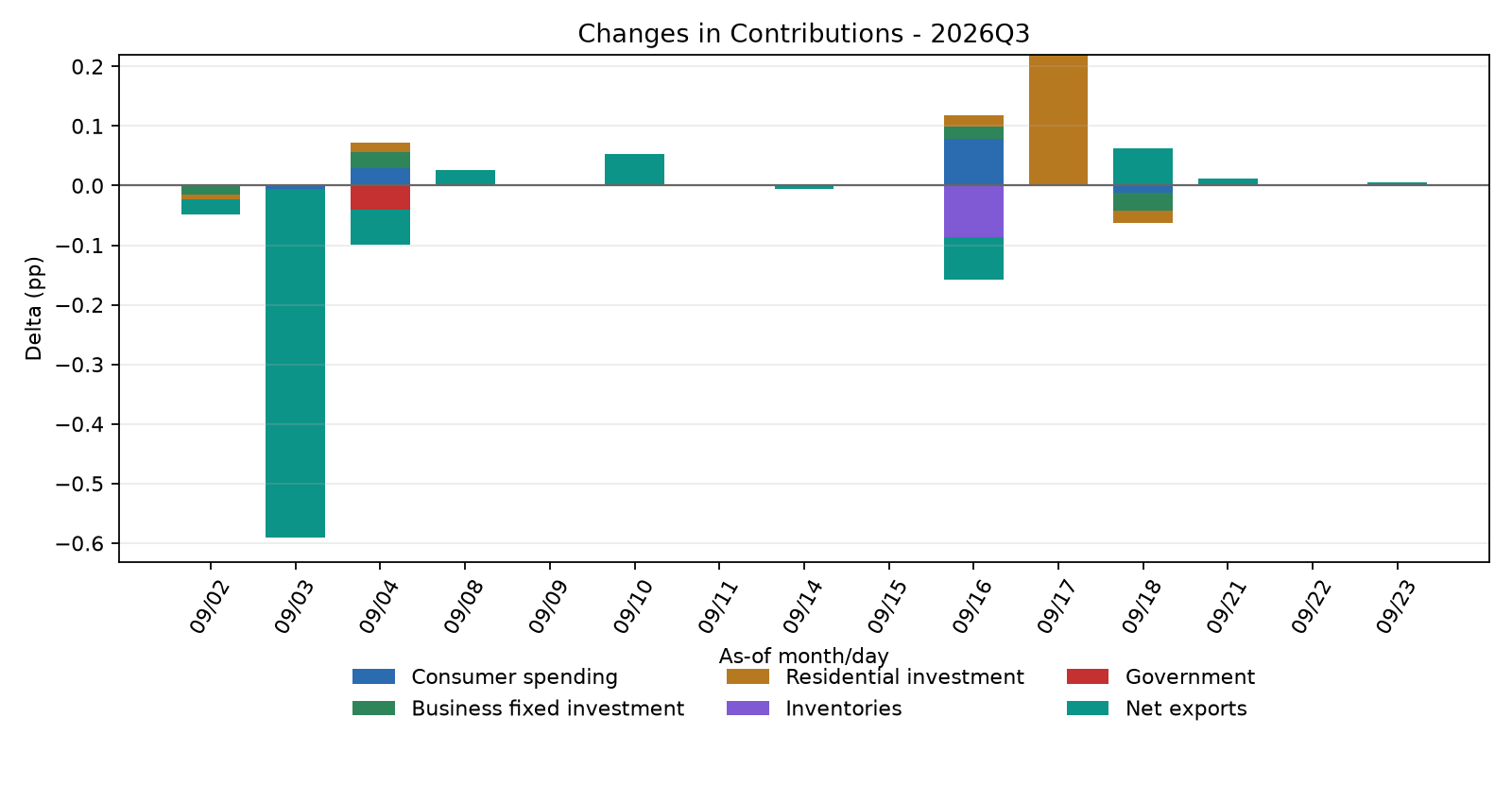
The largest positive change in today’s update came from net exports, which improved the nowcast by approximately 0.01 percentage point.
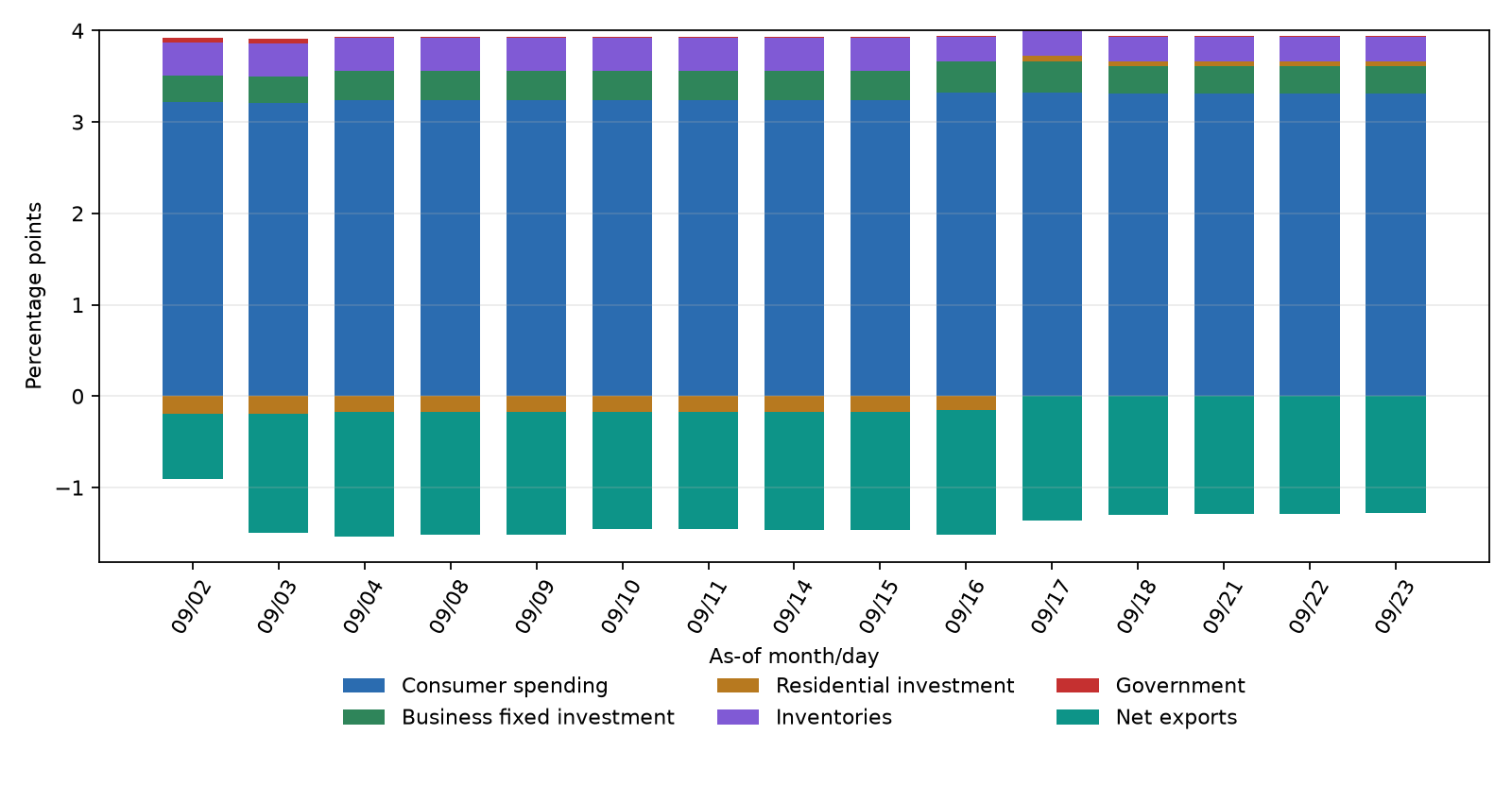
That does not mean net exports are currently contributing positively to Q3 growth. They remain a substantial drag on the level of the nowcast, subtracting approximately 1.28 percentage points from estimated growth.
The distinction between the level and the change matters. Net exports remain negative, but their estimated drag became slightly smaller in today’s model update.
There was no new major trade release behind that adjustment. Instead, the movement reflects the model’s response to the latest information available through its higher-frequency indicators and financial-market variables.
That is particularly important given the volatility currently running through energy and financial markets.
Oil prices moved higher again on September 23 as expectations for a quick resolution of the U.S.-Iran conflict weakened. The previous day's optimism surrounding a possible reopening of the Strait of Hormuz had pushed oil lower, but uncertainty over negotiations quickly returned.
At the same time, the U.S. 10-year Treasury yield pushed to its highest level since 2007. The move continues a broader increase in long-term borrowing costs that has become an increasingly important part of the financial backdrop facing the U.S. economy.
For the nowcast, these market movements affect the higher-frequency indicators feeding into the bridge equations rather than representing new direct observations of Q3 trade.
Contribution Changes
Housing Is Essentially Unchanged
Residential investment also improved marginally in today's update, although the change was small enough to round to 0.00 percentage point.
Residential investment is currently contributing approximately 0.04 percentage point to the Q3 growth estimate.
Again, today's movement should not be interpreted as evidence of a new surge in housing activity. There was no major new housing release incorporated into this update. Instead, the estimate moved slightly as the model processed changes in its available inputs.
That distinction will become more important as additional housing data arrive. Those releases will provide considerably more direct information about whether residential construction is actually strengthening or weakening heading toward the end of the quarter.
Consumer Spending Remains Strong, but Didn't Drive Today's Increase
Consumer spending currently contributes approximately 3.31 percentage points to the Q3 nowcast.
That remains the largest contribution level among the expenditure components, but it should not be confused with the source of today's increase. The consumer contribution did not materially change in this update.
The model continues to see relatively strong household spending underneath the headline estimate, while weakness elsewhere in the expenditure accounts offsets a substantial portion of that contribution.
That is especially visible in net exports, which currently subtract about 1.28 percentage points.
Business fixed investment contributes approximately 0.31 percentage point, while inventories add another 0.28 percentage point. Residential investment contributes around 0.04 percentage point, and government spending is currently adding approximately 0.01 percentage point.
Contribution Levels
The Headline Remains Remarkably Stable
The more interesting story over the past several updates has been the stability of the headline estimate.
Today's movement from roughly 2.65% to 2.66% is economically negligible on its own. Rather than signaling a change in the Q3 outlook, it shows that the incoming information available to the model has so far been broadly consistent with growth in the mid-2% range.
That stability is useful information.
Nowcasting is not about forcing the estimate to move every time a new observation arrives. If new information is largely consistent with what the model already expected, the appropriate response is a small revision.
Financial conditions are nevertheless worth watching closely. Long-term Treasury yields have moved above the levels that prevailed through much of the recent expansion, with the benchmark 10-year yield reaching its highest level since 2007 on September 23.
Meanwhile, energy markets remain unusually sensitive to developments surrounding Iran and the Strait of Hormuz. That volatility can eventually feed into consumer purchasing power, production costs, trade flows, and inflation expectations if it persists.
Neither development has been enough to materially alter the Q3 growth estimate yet.
Nowcast Path
Q3 GDP Nowcast: 2.66%
For now, the GDP Dynamics model continues to point toward moderate real GDP growth in the third quarter of 2026.
Today's estimate:
GDP Dynamics Q3 2026 Nowcast: 2.66% SAAR
Quarter-over-quarter: 0.67%
The estimate is up just 0.01 percentage point from September 22.
Today's revision came primarily through a slightly smaller drag from net exports rather than a meaningful change in the underlying growth outlook. With several important economic releases still capable of moving the estimate before the quarter is complete, the current 2.66% should be viewed as a snapshot of the information available today rather than a final call on Q3 GDP.