GDP Dynamics Q3 Nowcast Holds at 2.66% as Treasury Yields Remain Elevated
Date: 2026-09-22Author: GDP Dynamics
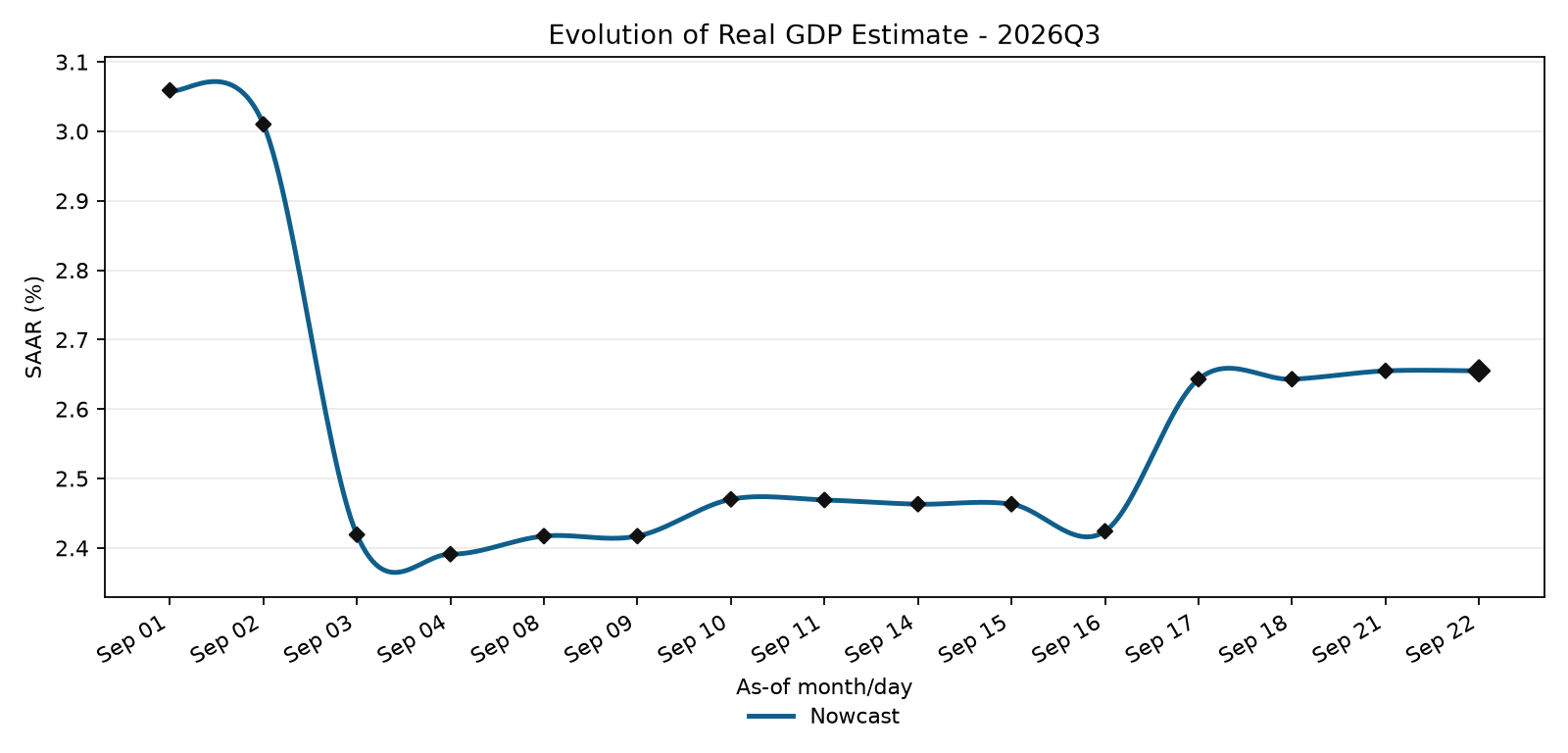
The GDP Dynamics nowcast for the third quarter of 2026 held at 2.66% annualized on September 22, unchanged from yesterday’s estimate. That works out to roughly 0.66% quarter-over-quarter growth.
There was no meaningful change in the headline estimate today. The only newly available input in the current update was the 10-year Treasury yield, and its effect was too small to move the nowcast at two decimal places.
That makes this a relatively quiet update after several weeks of much larger movements in financial markets.
Treasury Yields Remain a Headwind for Investment
Long-term interest rates remain unusually high. The 10-year Treasury yield has spent much of September around the 5% mark, reaching levels not sustained for nearly two decades. Reuters has tied the recent bond selloff to a combination of higher oil prices, renewed inflation concerns, expectations for tighter monetary policy, and broader concerns surrounding government borrowing.
Some of that pressure eased heading into September 22. Oil prices pulled back as markets reacted to improved Middle East supply prospects and the possibility of renewed negotiations with Iran. Treasury yields also eased alongside oil, although expectations of additional central-bank tightening continue to limit the decline.
For the GDP Dynamics model, this matters primarily through the investment side of the economy. Higher long-term borrowing costs can weigh on residential construction and other interest-sensitive investment, but today's change was not large enough to materially alter the Q3 estimate.
Nowcast Path
Where Q3 Growth Currently Stands
The composition of the nowcast remains much more interesting than today's headline change.
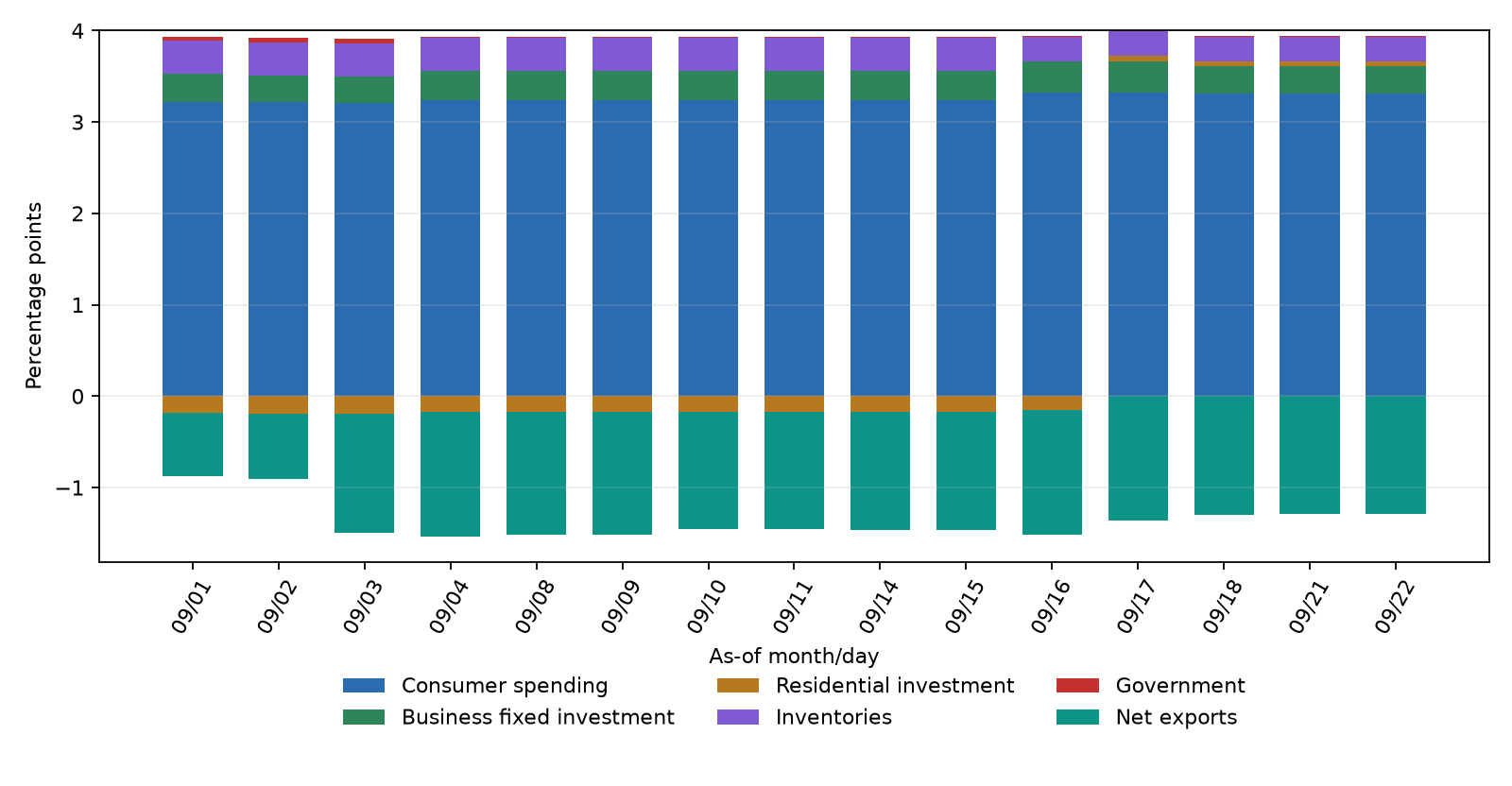
Consumer spending currently contributes 3.31 percentage points to annualized Q3 growth. That large level should not be confused with evidence that consumption was today's main source of movement; its contribution simply reflects the size of household consumption in the U.S. economy.
Business fixed investment contributes another 0.31 percentage points, while inventories add 0.28 points. Residential investment is slightly positive at 0.04 points, and government spending contributes approximately 0.01 points.
The major offset continues to come from net exports, which subtract 1.29 percentage points from the current estimate.
Contribution Levels
Net Exports Remain the Biggest Drag
The weakness in net exports is consistent with the most recent international trade data.
The U.S. goods and services deficit widened sharply to $88.6 billion in July, up $17.4 billion from June. Exports fell 2.1% to $310.7 billion while imports increased 2.8% to $399.3 billion. The deterioration came primarily through goods trade, where the deficit increased to $119.6 billion.
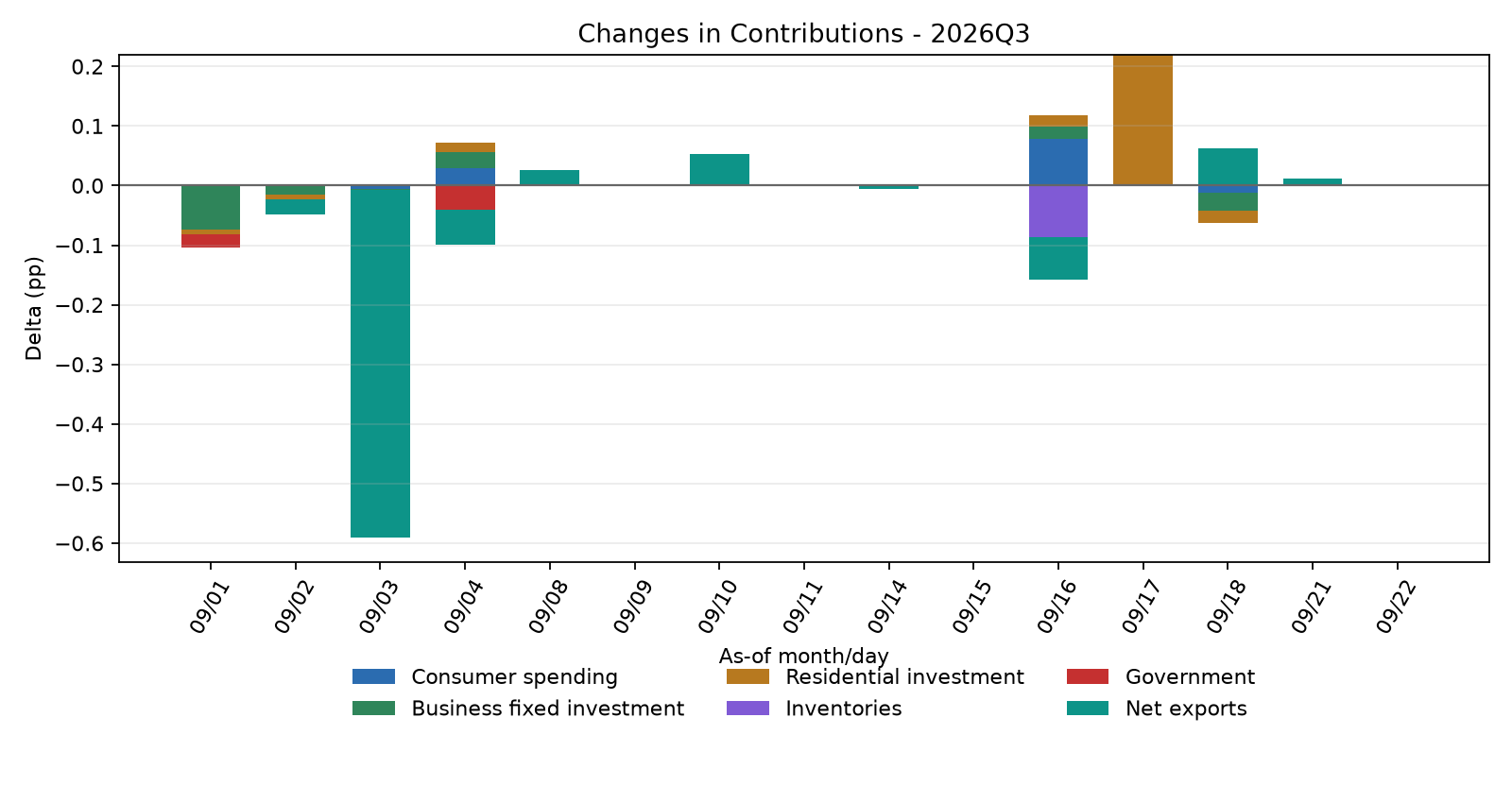
That helps explain why net exports remain such a substantial negative contribution in the Q3 nowcast. It is important, however, to distinguish that existing contribution from today's movement: the trade data were not a new September 22 release, and the model's net-export contribution was effectively unchanged in today's update.
Residential investment similarly registered only a tiny positive change that rounds to 0.00 percentage points. With no new housing starts, permits, or construction-spending release incorporated into today's snapshot, there isn't enough new information to interpret that as a meaningful improvement in housing.
Contribution Changes
The Bottom Line
The September 22 update is mostly a story of stability. The GDP Dynamics Q3 nowcast remains at 2.66% SAAR, with today's financial-market information producing essentially no change in the headline estimate.
Underneath that stable number, the composition remains uneven. Consumer spending provides a large positive contribution, business fixed investment and inventories remain positive, and residential investment is only slightly above zero. Net exports continue to offset a substantial portion of those gains.
With long-term Treasury yields still hovering near historically elevated levels and the trade balance already weighing heavily on the quarter, the next meaningful economic releases will matter much more than today's fractional movement.