GDP Dynamics Nowcast Rises to 2.64% as Single-Family Housing Rebounds
Date: 2026-09-17Author: GDP Dynamics
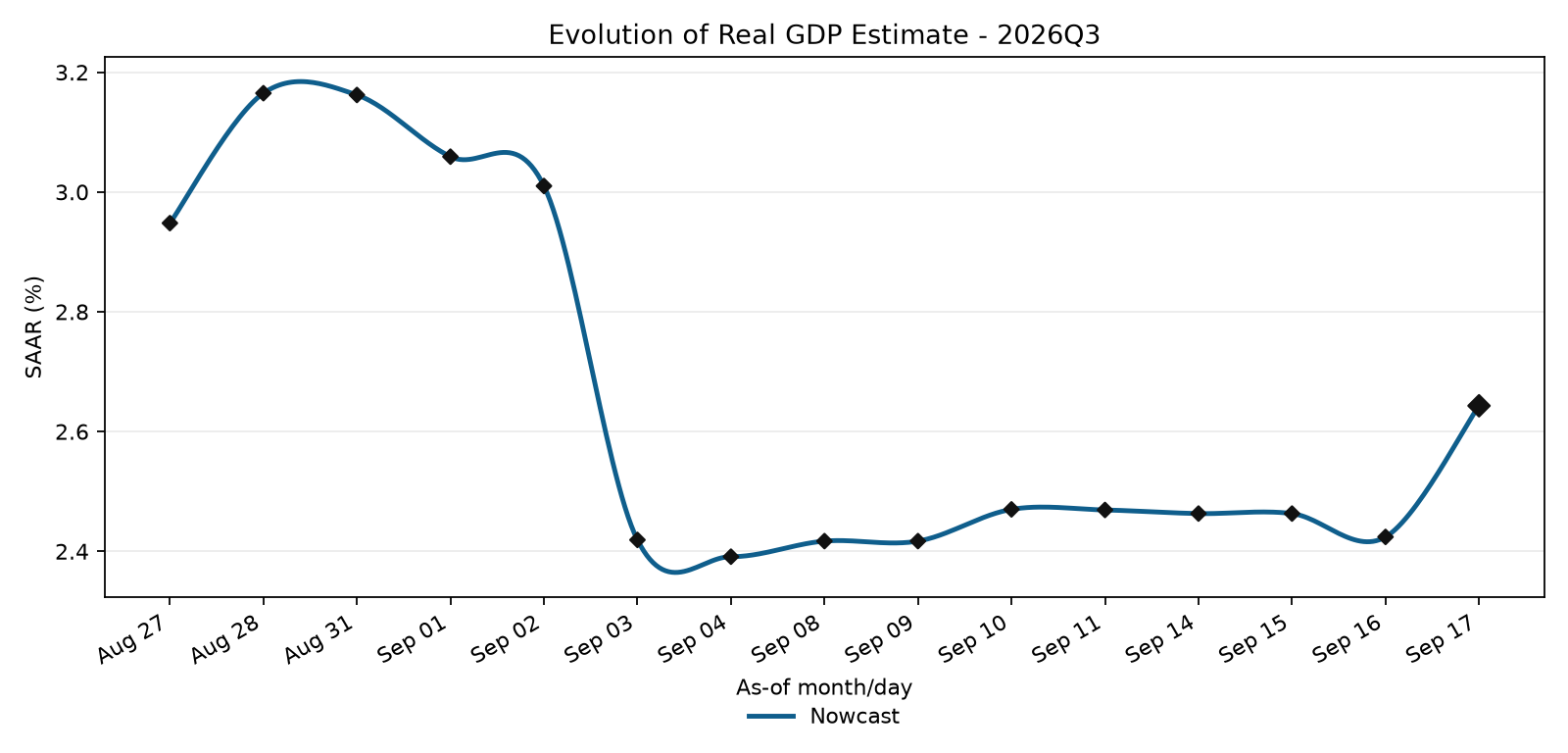
The GDP Dynamics nowcast for third-quarter U.S. real GDP growth rose to 2.64% SAAR on September 17, up 0.22 percentage points from yesterday’s estimate of 2.42%. On a quarter-over-quarter basis, the model is now tracking growth of about 0.66%.
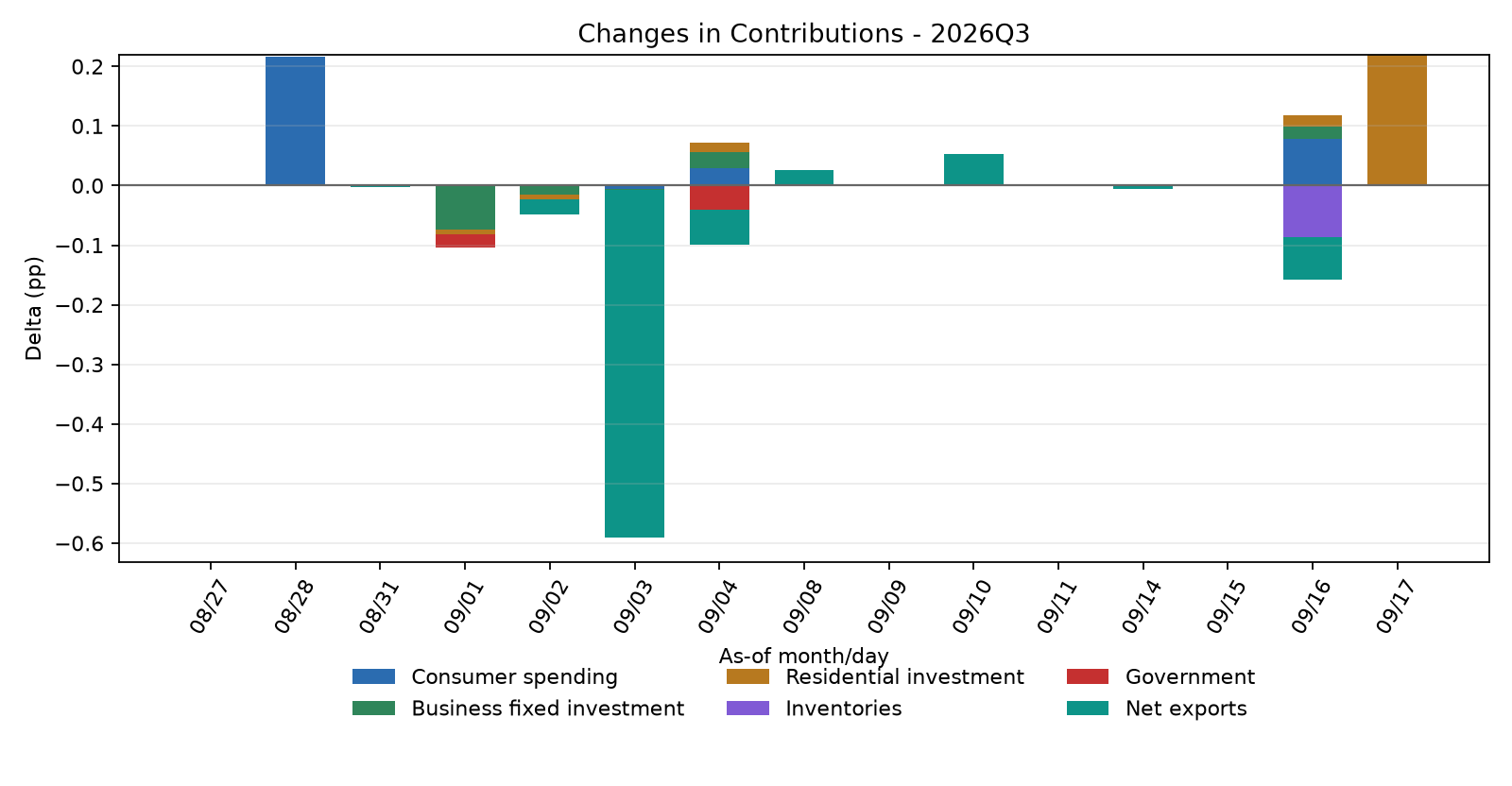
The entire increase in today’s estimate came from residential investment, but the underlying housing report was considerably more mixed than the change in the nowcast might suggest. Total housing starts and building permits both declined in August. Underneath those headline numbers, however, there was a sharp rebound in single-family construction, which was enough to materially improve the model’s estimate for residential investment.
Nowcast Path
Single-Family Construction Gives the Nowcast a Boost
The Census Bureau reported this morning that privately owned housing starts fell 2.6% in August, to a seasonally adjusted annual rate of 1.275 million units. That followed a revised July rate of 1.309 million. Total building permits also declined, falling 2.7% to 1.394 million.
Those headline numbers look weak, but they hide an important split inside residential construction.
Single-family housing starts jumped 7.6% in August, rising from a revised annual rate of 853,000 in July to 918,000. The weakness in total starts therefore came largely from the multifamily side of the market rather than from single-family construction. Multifamily starts fell to an annual rate of 344,000.
That distinction matters for the nowcast. The model separately incorporates total and single-family housing information, and the improvement in single-family starts was strong enough to push the estimated contribution from residential investment higher.
Residential investment increased by 0.22 percentage points in today’s update, moving its contribution to real GDP growth to approximately +0.06 percentage points. Yesterday, the model had residential investment subtracting roughly 0.16 percentage points from growth.
There is still reason to be cautious about reading the August rebound as the beginning of a sustained housing recovery. Single-family building permits fell 1.8%, from 894,000 to 878,000, suggesting the pipeline for future construction did not strengthen alongside current starts.
Contribution Changes
So I would characterize today's housing data as a rebound in current single-family construction rather than a broad improvement across the housing sector.
Mortgage Rates Remain a Headwind
Financing conditions also remain difficult.
Freddie Mac reported today that the average 30-year fixed mortgage rate rose to 6.95%, up from 6.76% last week. Rates have now moved higher from 6.66% on August 27 and 6.71% on September 3.
That makes the jump in single-family starts more interesting, but it also gives me another reason not to extrapolate too much from one month's increase. Builders are still operating in an environment where borrowing costs are close to 7%, while permits point toward softer future activity.
For the nowcast, however, the question is narrower: what does the incoming data tell us about production during the current quarter? On that basis, the August increase in single-family starts was enough to substantially improve the residential-investment estimate.
The Rest of the Nowcast Was Essentially Unchanged
Contribution Levels
There were no negative contribution changes identified in today's model update.
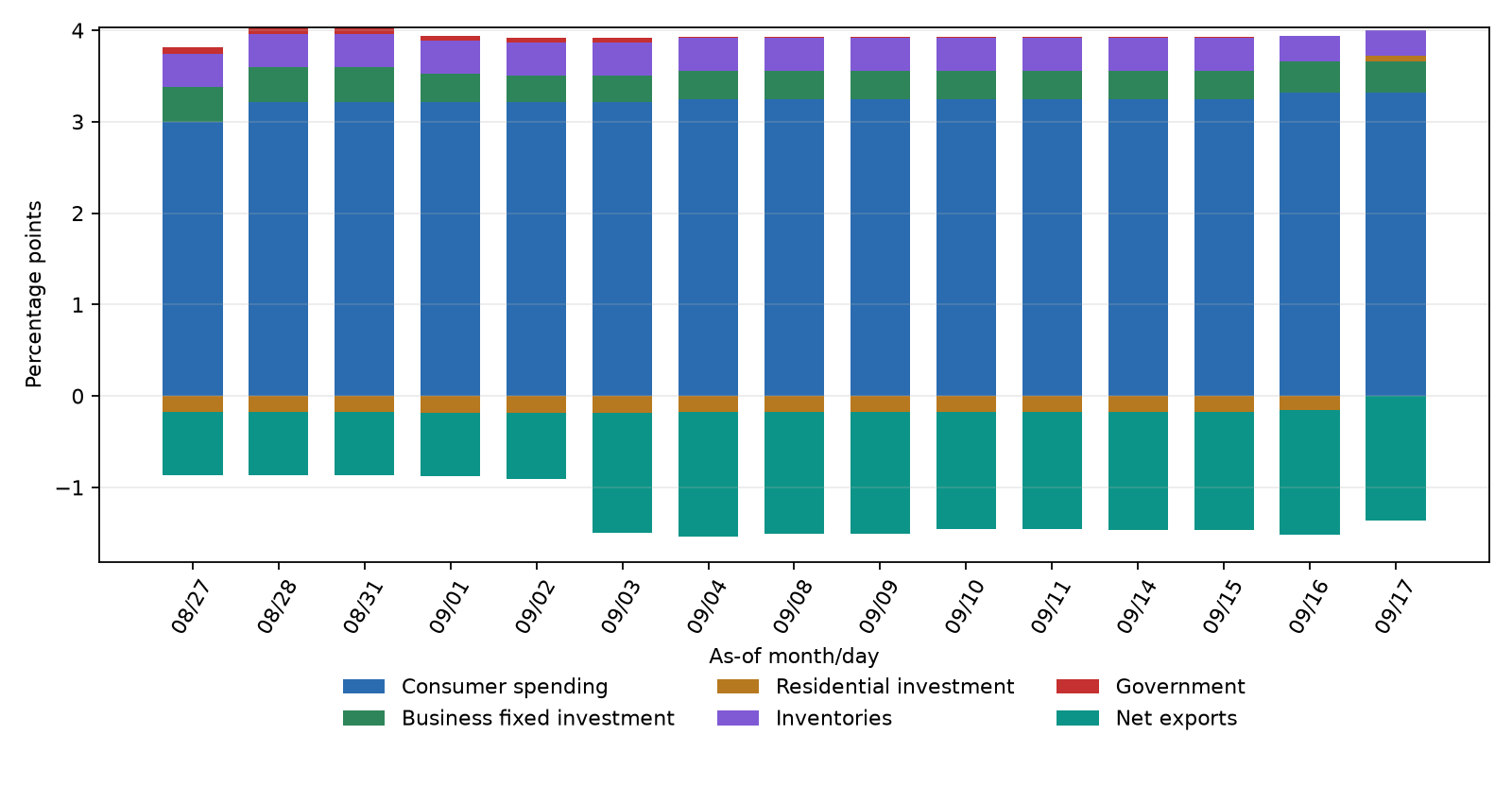
Consumer spending currently contributes approximately 3.32 percentage points to Q3 growth, while business fixed investment adds another 0.34 points and inventories contribute 0.28 points. Government spending contributes about 0.01 points.
The major offset continues to come from net exports, which are currently subtracting approximately 1.36 percentage points from the model's Q3 growth estimate.
Those are contribution levels rather than changes from yesterday. Consumer spending remains the largest positive component because consumption itself makes up the largest share of GDP; today's upward revision did not come from consumers. The meaningful change in this update was residential investment.
Labor Data Remain Firm
Today's weekly unemployment claims report provided another relatively firm reading on the labor market, although it did not materially change the model's component contributions in this update.
Initial claims fell by 10,000 to 196,000 during the week ending September 12, down from an unrevised 206,000 the previous week. The four-week moving average declined by 2,750 to 203,250.
Claims therefore remain low by recent historical standards. That doesn't directly explain today's 0.22-point increase in the GDP estimate—the housing variables do—but it provides additional evidence that layoffs have not accelerated sharply heading deeper into the third quarter.
Q3 Growth Now Tracking at 2.64%
After incorporating today's releases, GDP Dynamics is now estimating 2.64% annualized real GDP growth for 2026Q3, compared with 2.42% in the previous update.
Today's move is a good example of why I prefer looking beneath the headline economic releases. If you only looked at total housing starts, you would see a 2.6% decline. If you only looked at permits, you would see another decline. But underneath the aggregates, single-family starts increased 7.6%.
That change matters for estimating what is actually happening to residential construction during the quarter, and it was enough to move the GDP Dynamics estimate upward by 0.22 percentage points.
At the same time, falling permits and mortgage rates near 7% make it difficult to call this a broad housing recovery yet. For now, the model is picking up stronger current-quarter residential construction, not necessarily signaling that the housing sector has turned the corner.
The next releases will tell us whether that improvement persists and whether strength or weakness elsewhere in the economy reinforces or offsets it.