GDP Dynamics Q3 Nowcast Edges Down to 2.46% as Net Exports Weigh
Date: 2026-09-14Author: GDP Dynamics
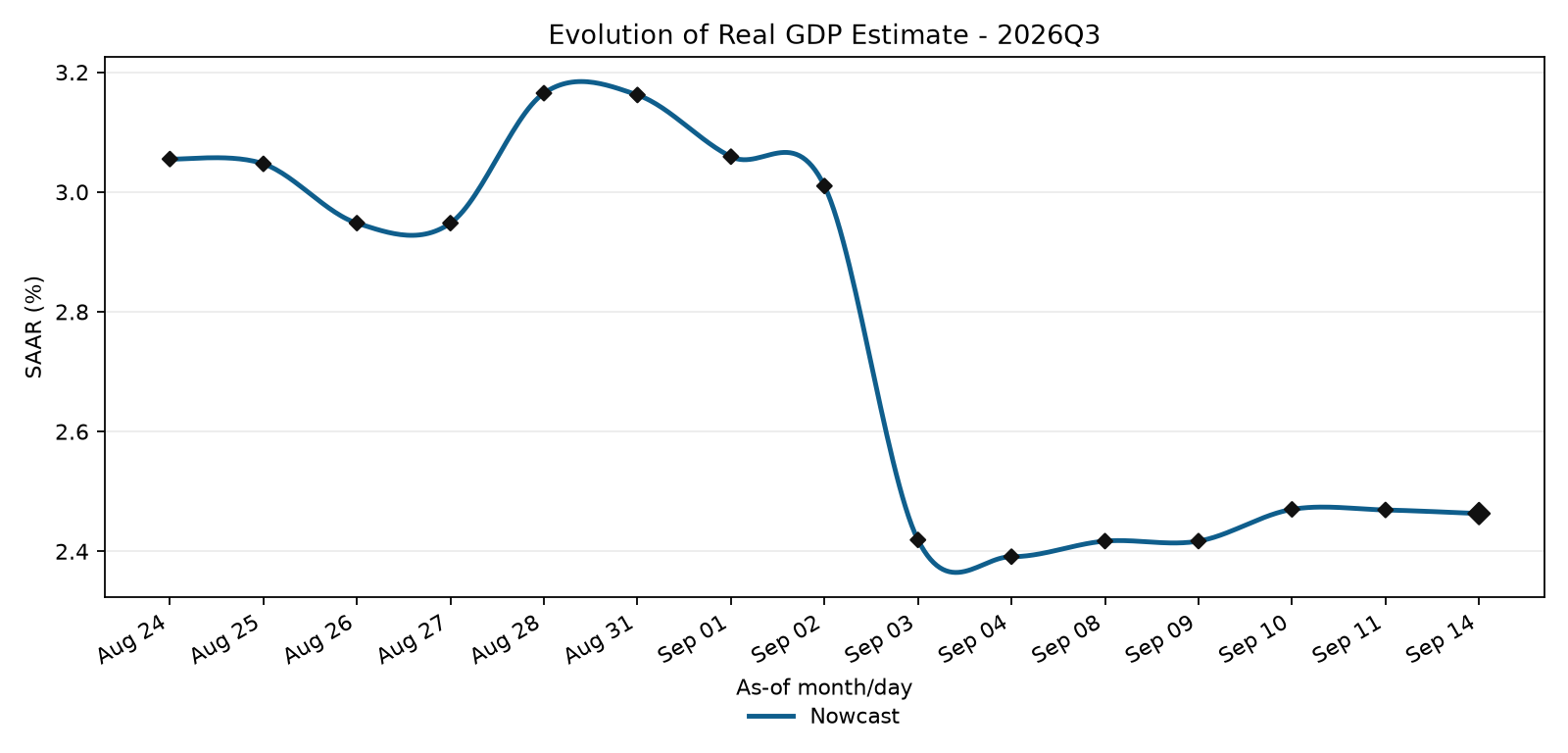
The GDP Dynamics estimate for third-quarter U.S. real GDP growth edged slightly lower on September 14, falling 0.01 percentage point to 2.46% at a seasonally adjusted annual rate (SAAR). That is equivalent to roughly 0.62% quarter-over-quarter growth.
This was a very small update, and importantly, it was not driven by a major new economic release. The new information available to the model consisted of updates to the Broad Dollar Index and the 10-Year Treasury yield. The result was therefore more of a marginal adjustment to the model’s financial conditions and component estimates than a meaningful change in the underlying Q3 outlook.
Nowcast Path
Net Exports Remain the Main Drag
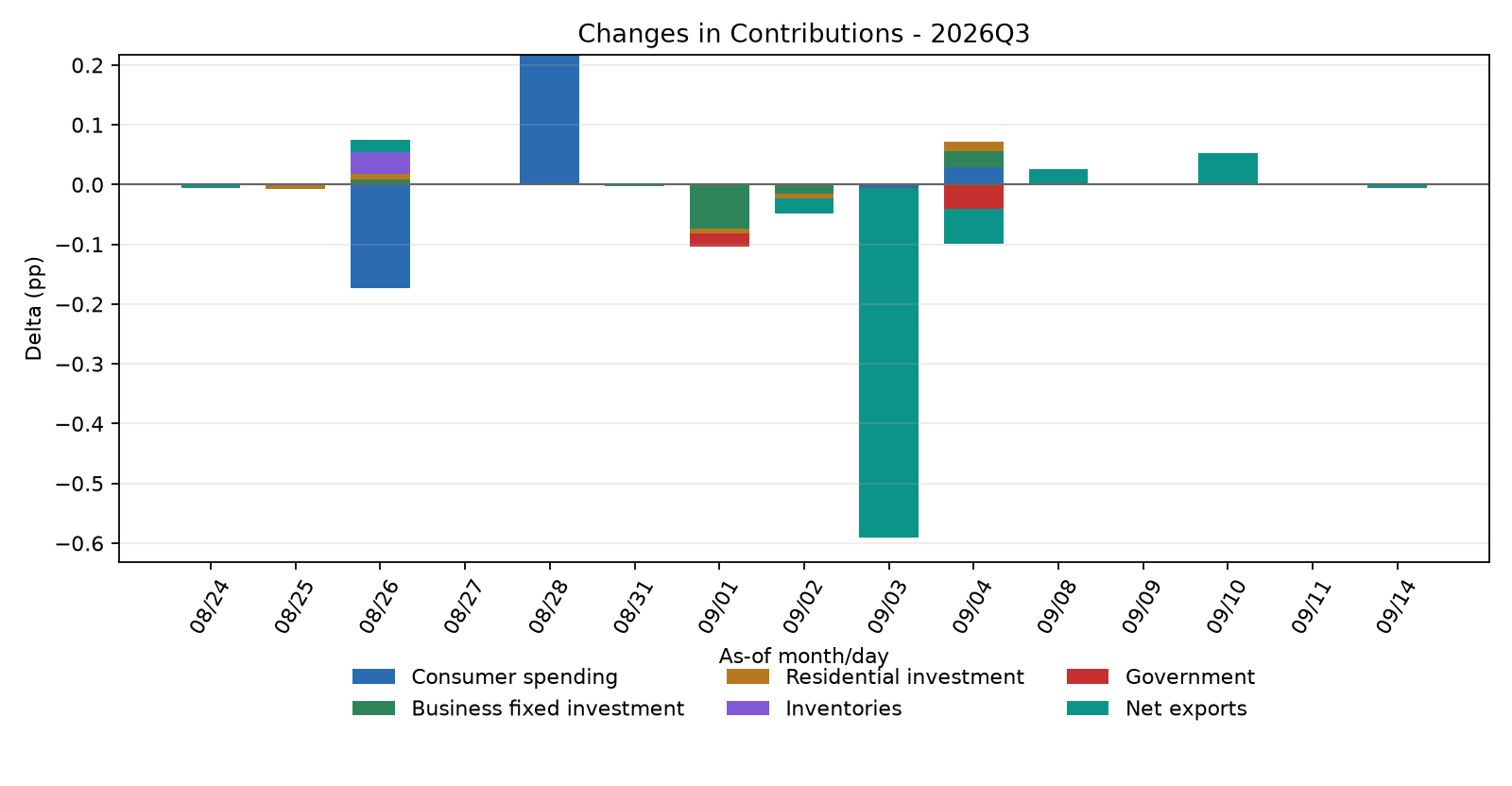
The largest negative change in this update came from net exports, which shaved another 0.01 percentage point from the Q3 estimate. Net exports are now estimated to subtract approximately 1.29 percentage points from third-quarter GDP growth.
While there was no new monthly trade report released with this update, the latest official trade figures help explain why the model continues to see substantial weakness from the external sector.
The U.S. goods and services trade deficit widened sharply in July to $88.6 billion, up from a revised $71.2 billion in June. Exports fell $6.6 billion, or 2.1%, to $310.7 billion, while imports increased $10.8 billion, or 2.8%, to $399.3 billion. The goods deficit alone widened by $17.6 billion to $119.6 billion.
That combination — falling exports alongside rising imports — is consistent with a sizable negative contribution from net exports during the quarter. The three-month average trade deficit also increased to $78.5 billion in July, with average exports falling and average imports rising.
Residential Investment Improves Slightly
Residential investment moved fractionally higher in today's model update, although the change was small enough to round to 0.00 percentage points.
Contribution Changes
The component nevertheless remains a drag on the overall Q3 estimate, currently subtracting approximately 0.17 percentage points from growth.
There was no new housing starts or building permits report released today. The latest available Census data are still for July, when housing starts fell 12.4% from June to an annualized rate of 1.239 million units. The next New Residential Construction report, covering August, is scheduled for September 17.
That makes the small improvement in today's residential estimate better interpreted as a model adjustment associated with changing financial conditions rather than evidence of a newly reported improvement in housing activity. With long-term interest rates remaining elevated, the September 17 housing report should provide a much clearer test of where residential investment is heading during Q3.
Business Investment Remains Positive
Business fixed investment also moved fractionally lower in the latest update, although again the change was small enough to round to 0.00 percentage points. It is still estimated to contribute approximately 0.32 percentage points to Q3 growth.
The most recent manufacturing data remain relatively supportive. New orders for manufactured goods increased 0.9% in July to $663.6 billion, while shipments rose 0.8%. Durable-goods orders increased 1.1%, with orders excluding transportation rising 0.4%.
Those figures don't point to a broad collapse in capital spending. Instead, the latest model movement looks more like a modest reassessment of investment conditions as financial variables change. The next major update on durable-goods orders will arrive September 25.
Consumer Spending Still Provides a Large Contribution
Consumer spending is currently estimated to contribute 3.24 percentage points to Q3 GDP growth.
That number is large, but consumer spending is also structurally the largest component of GDP, so its contribution level by itself should not be interpreted as evidence that consumption strengthened in today's update. There was no new retail sales or personal consumption report included in this snapshot.
The next important test comes quickly. August retail sales are scheduled for release on September 16 and should provide considerably more information about household spending during the middle of the third quarter.
Current Q3 GDP Composition
The underlying composition of the 2.46% nowcast remains mixed.
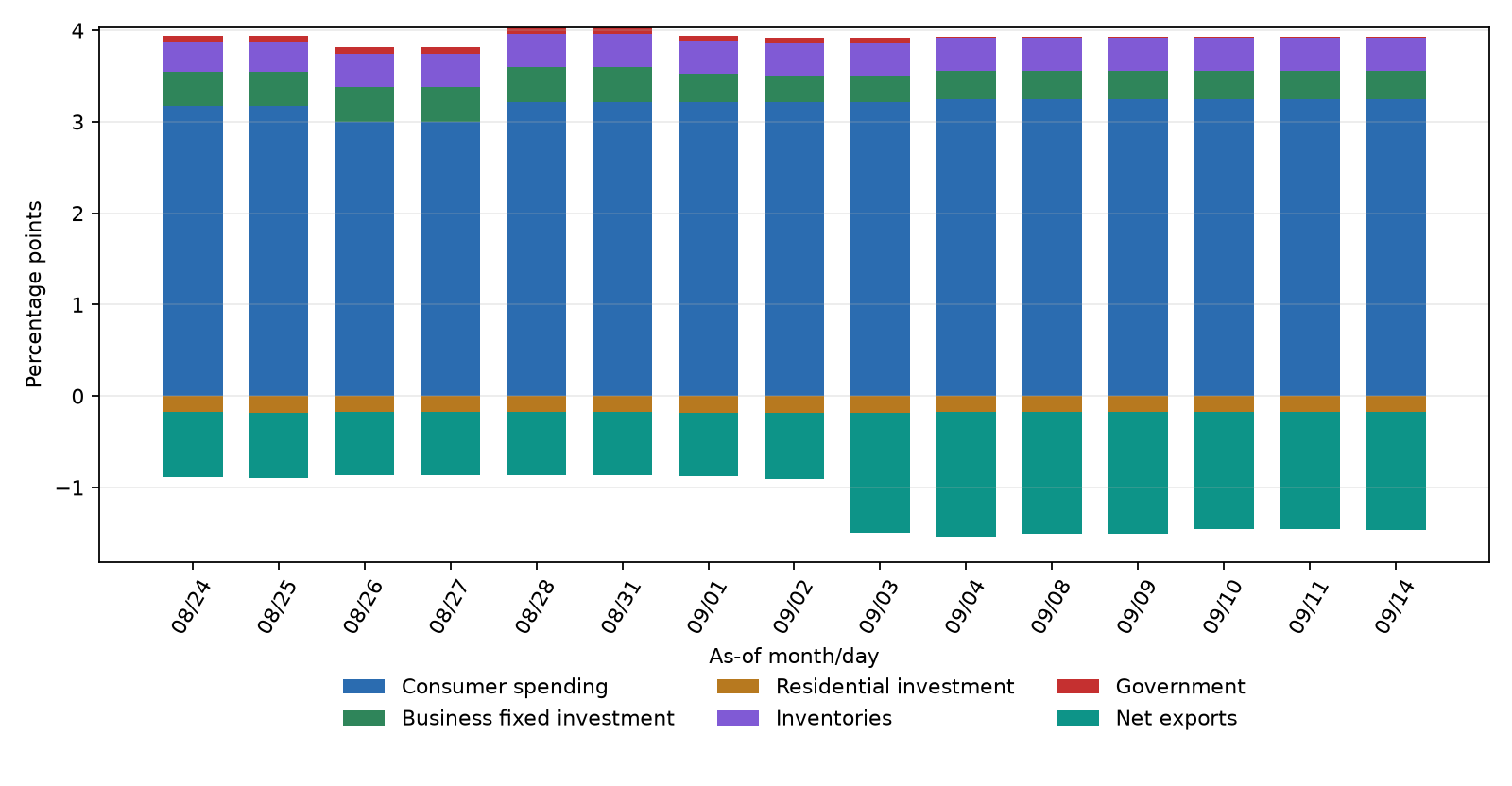
Contribution Levels
Consumer spending contributes approximately +3.24 percentage points, inventories add +0.36, business fixed investment adds +0.32, and government spending adds around +0.01.
Those gains are partly offset by residential investment at −0.17 percentage points and, most importantly, net exports at −1.29 percentage points.
The resulting picture is an economy still expanding at a moderate pace, but with a substantial portion of domestic demand being offset by deterioration in the external balance.
What Comes Next
Today's 0.01 percentage-point decline doesn't materially change the Q3 outlook. At 2.46% SAAR, the GDP Dynamics model continues to point toward moderate economic growth rather than either a sharp acceleration or an imminent contraction.
More meaningful changes could arrive over the next several days. August retail sales and July business inventories are scheduled for September 16, followed by August housing starts and building permits on September 17. Those releases will provide fresh hard data for consumption, inventories, and residential investment and should matter considerably more for the nowcast than today's financial-market update.