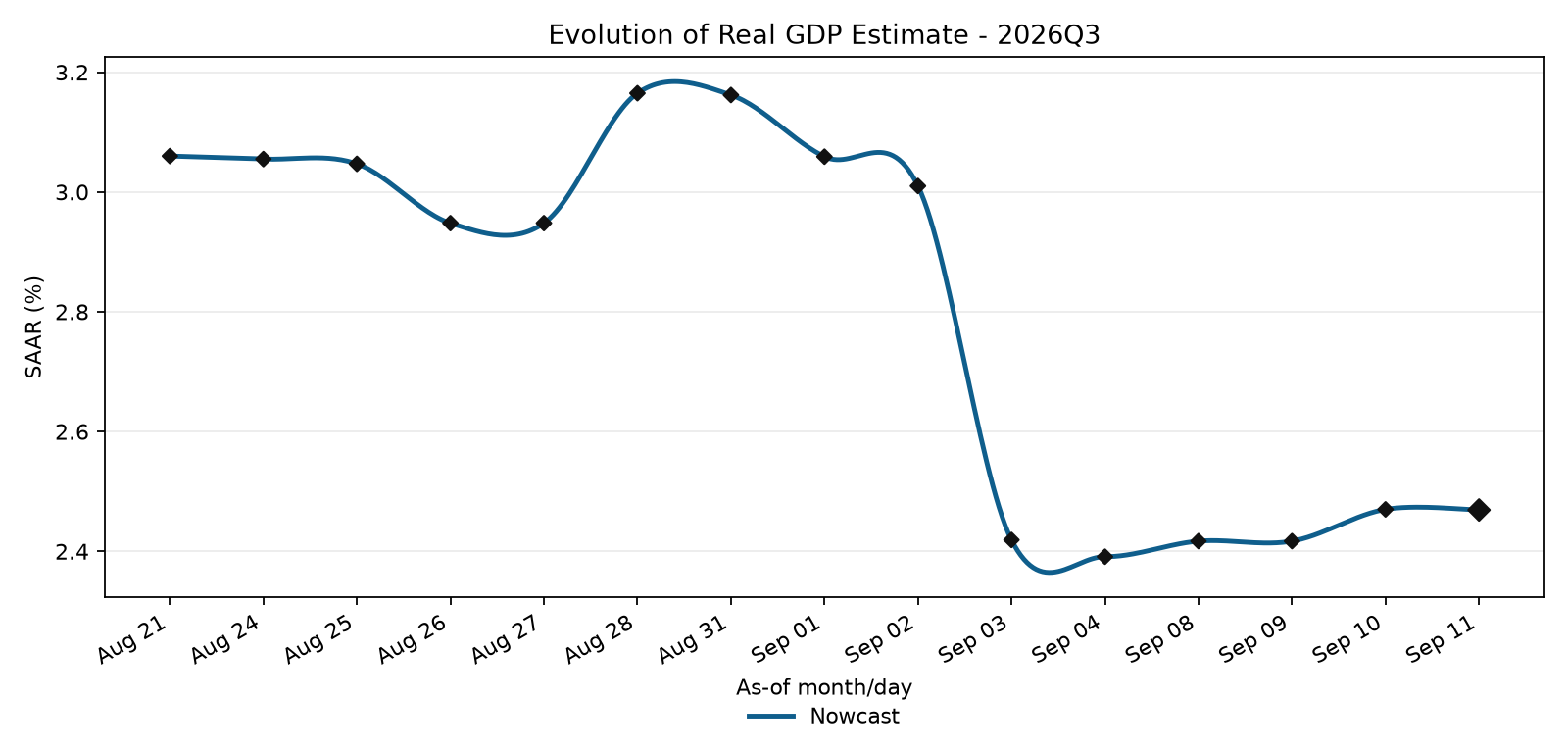
The GDP Dynamics nowcast for third-quarter U.S. real GDP growth held essentially unchanged at 2.47% SAAR on September 11, equivalent to roughly 0.62% quarter-over-quarter growth.
That lack of movement is notable because today's update incorporated two economically important pieces of information: the August Consumer Price Index and the latest movement in the 10-year Treasury yield. Neither was enough to materially alter the model's estimate of real economic activity during the quarter.
August inflation came in considerably hotter on a monthly basis. The Consumer Price Index rose 0.4% in August, compared with just 0.1% in July, while the year-over-year inflation rate remained at 3.4%. Core CPI, excluding food and energy, increased 0.3% during the month.
Much of the acceleration in headline inflation came from energy. Gasoline prices jumped sharply as the conflict in the Middle East continued to push energy costs higher. There were also signs of persistent underlying price pressure in categories including airline fares, wireless services and other services.
That makes today's CPI report important for monetary policy, but it does not automatically translate into stronger or weaker real GDP growth. CPI is primarily a price measure, and the GDP Dynamics model separates movements in prices from the real activity indicators used to estimate production and expenditure during the quarter.
The Treasury market also moved substantially around the release. The 10-year Treasury yield approached 5% before reversing and falling back toward the low-to-mid 4.9% range. That leaves long-term borrowing costs exceptionally high, but the movement was not large enough to materially alter the model's investment estimates in today's update.
Nowcast Path
Underneath the headline number, the composition of the nowcast remains much more interesting.
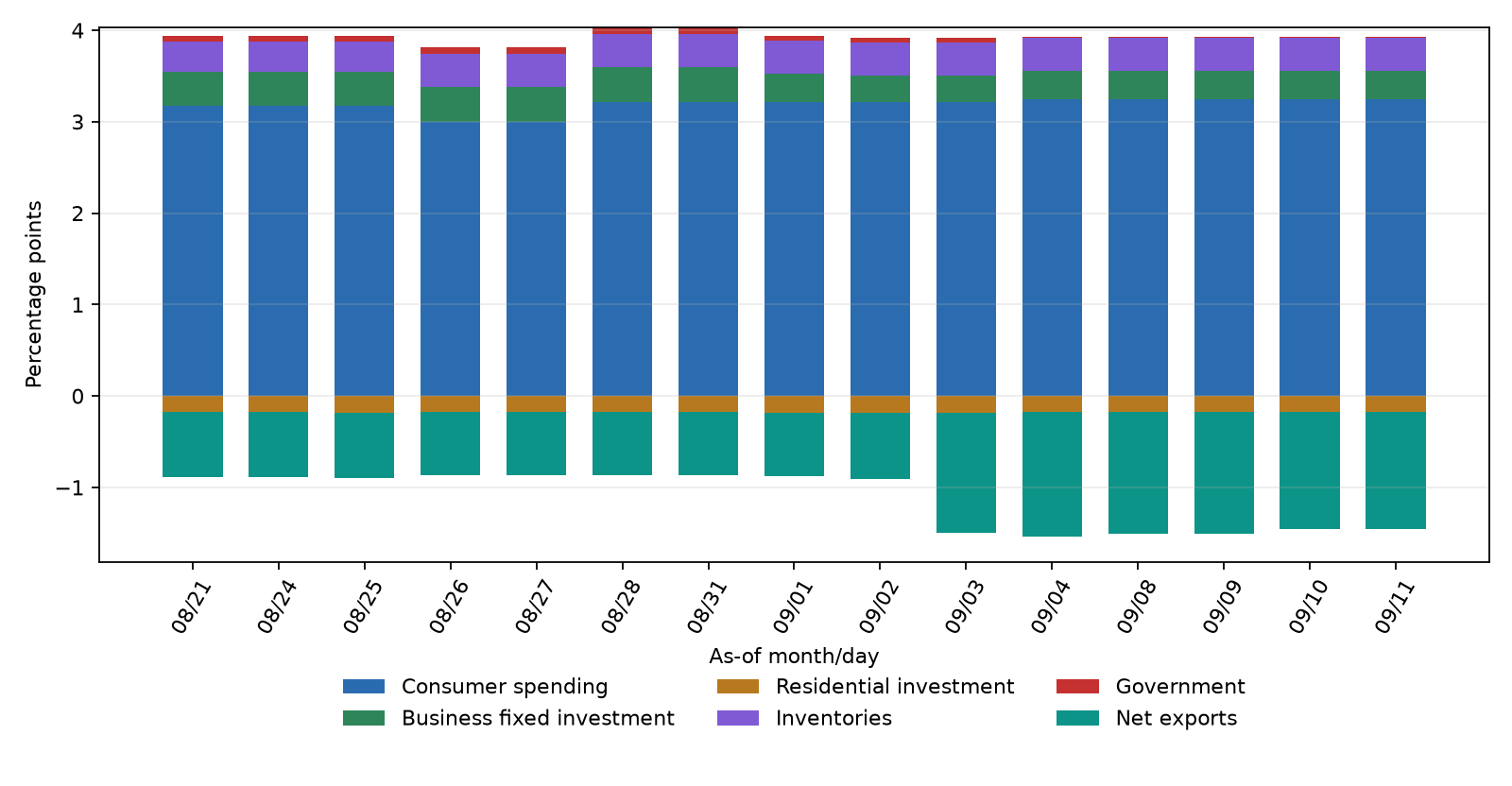
Consumer spending currently contributes approximately **3.24 percentage points** to annualized Q3 growth. That remains a very large contribution, although today's update did not produce a meaningful change in the consumption estimate itself.
Net exports remain the largest offset, subtracting approximately 1.28 percentage points from growth. Inventories add around 0.36 percentage points, while business fixed investment contributes another 0.32 percentage points.
Residential investment remains a modest drag at approximately -0.17 percentage points, while the government contribution is close to neutral at roughly +0.01 percentage points.
Put together, those contributions leave the model at its current 2.47% Q3 growth estimate.
Contribution Levels
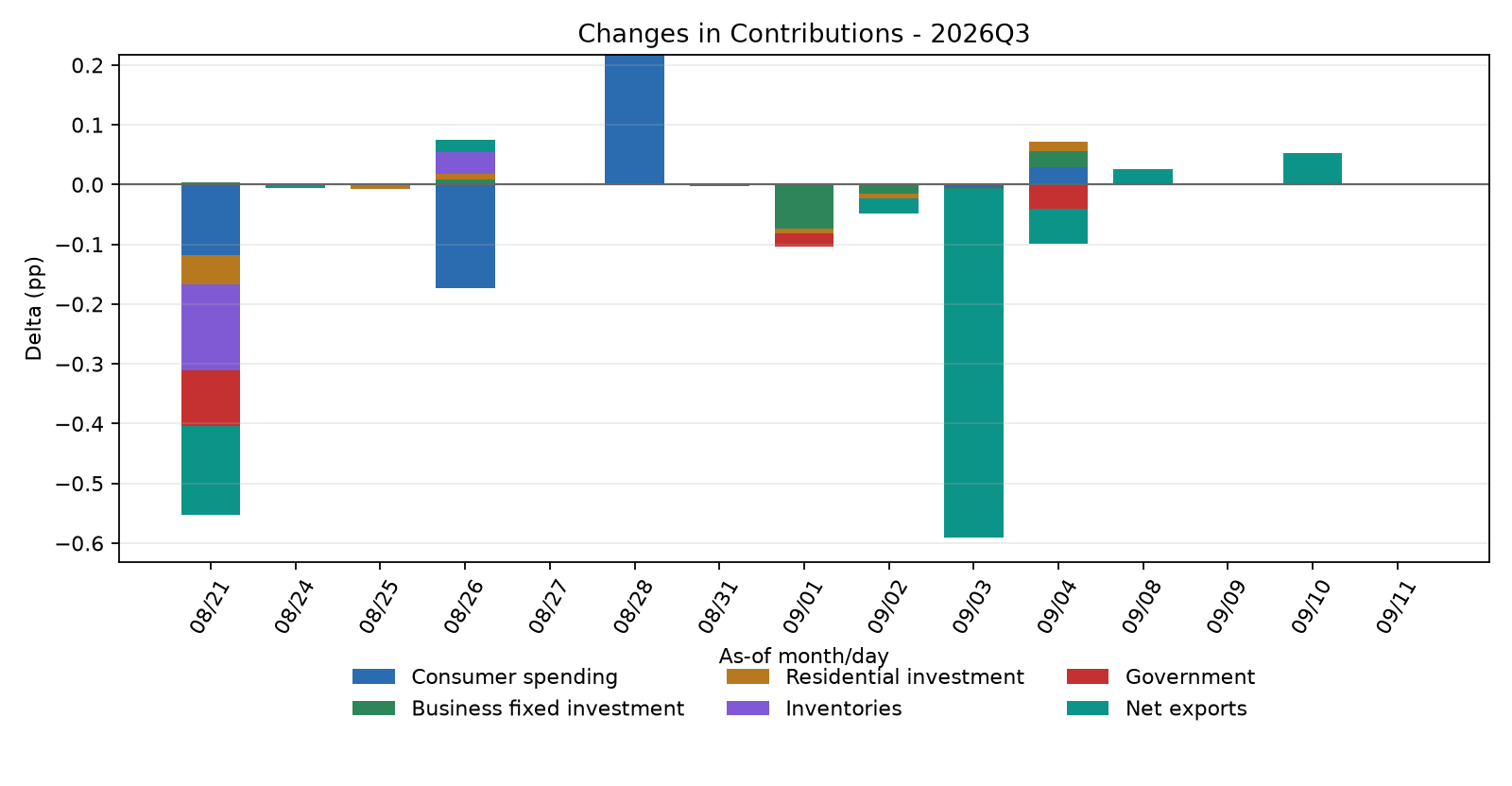
Today's tiny component-level changes were concentrated primarily in residential investment, business fixed investment and government, but the movements round to essentially zero at two decimal places. In other words, there isn't much justification for constructing a dramatic economic story around today's model change.
That distinction matters. The inflation report itself was important. The bond-market reaction was important. But an important economic release does not necessarily have to produce a large GDP nowcast revision.
The model is currently telling us that the information received today changes the inflation and interest-rate environment considerably more than it changes our estimate of real Q3 economic activity.
Contribution Changes
The broader Q3 picture therefore remains intact. GDP Dynamics continues to estimate real GDP growth of approximately 2.47% SAAR, with strong consumption expenditures being partially offset by a substantial negative contribution from net exports and a smaller drag from residential investment.
The next meaningful move in the nowcast will likely require new information directly tied to real activity rather than prices alone. Upcoming releases on production, trade, housing, spending and investment should provide considerably more information about whether the underlying Q3 growth trajectory is actually changing.