GDP Dynamics Q3 Nowcast Holds at 2.42% as Treasury Yields Climb
Date: 2026-09-09Author: GDP Dynamics
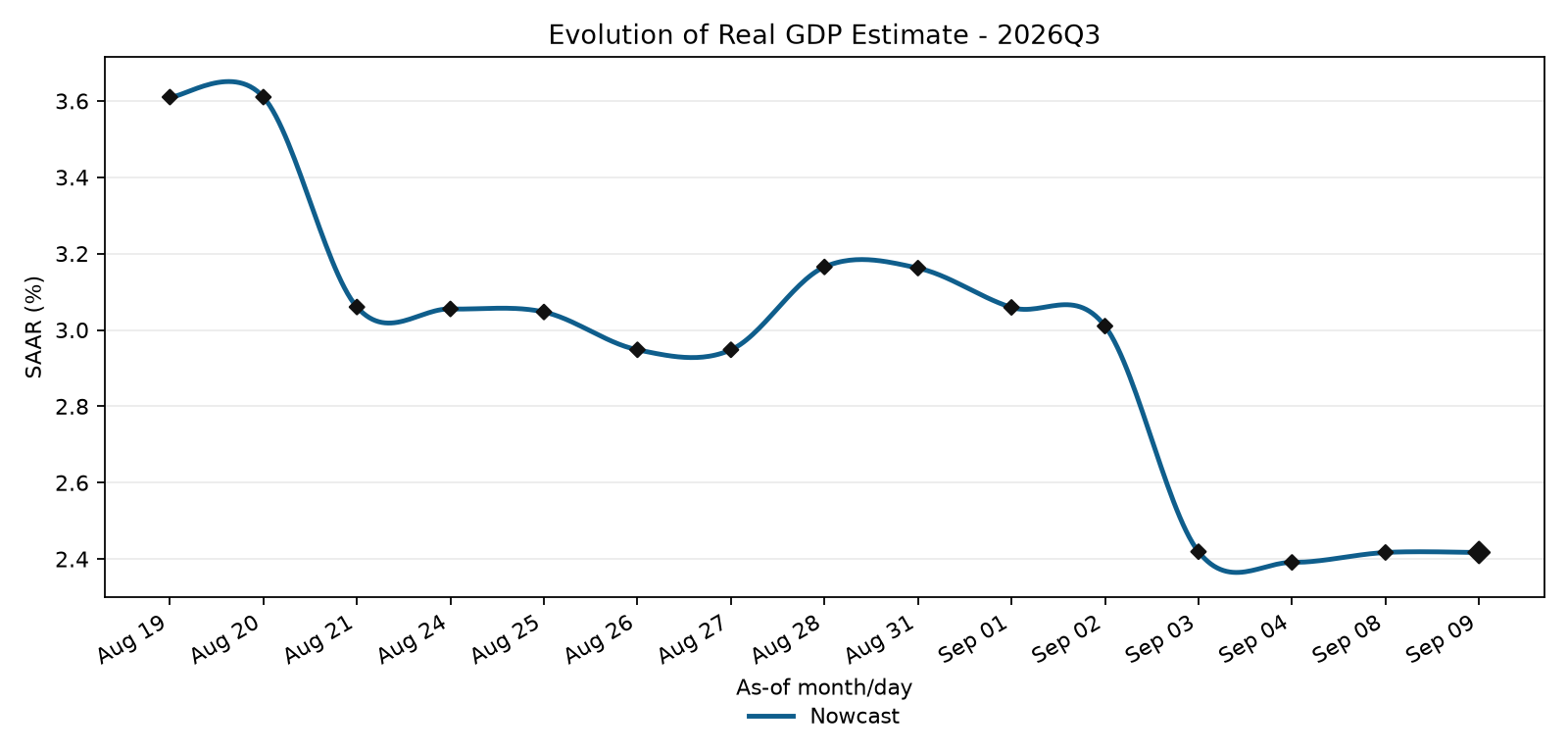
The GDP Dynamics nowcast for third-quarter U.S. real GDP growth held essentially unchanged on September 9, remaining at **2.42% at a seasonally adjusted annual rate**, equivalent to roughly **0.60% quarter-over-quarter growth**.
There was very little new macroeconomic information entering the model today. The only newly released input in the current snapshot was the **10-year Treasury yield**, so this update was never likely to produce the kind of movement we see following a major consumption, investment, trade, or government-spending release. The lack of movement is therefore meaningful in itself. The incoming financial-market information was not large enough to materially alter the model's estimate of Q3 growth.
The Treasury market was anything but quiet, however. The benchmark 10-year yield climbed to around **4.84%**, reaching its highest level since 2023. Part of the pressure came from another jump in oil prices, with Brent crude moving back above $100 per barrel as concerns about Middle East supply disruptions intensified. Higher energy prices are again raising concerns about inflation persistence and how much room the Federal Reserve will have to ease policy.
There was also a more direct Treasury-market story. The Treasury Department announced that it would buy up to **$6 billion of 10-to-20-year government securities** in its September 10 buyback operation, triple the size of its recent long-duration operations. Rather than pushing yields down, the announcement was followed by another move higher. Some investors had been expecting an even larger purchase, so the $6 billion figure fell short of what had already been priced into parts of the market.
That matters for the nowcast primarily through financial conditions rather than as an immediate change in measured GDP. Higher long-term yields raise borrowing costs across mortgages and business credit and can eventually weigh on interest-sensitive investment. But those effects operate with a lag. A movement in the 10-year yield today does not mean residential or business investment suddenly changed today, which helps explain why the model barely moved.
Nowcast Path
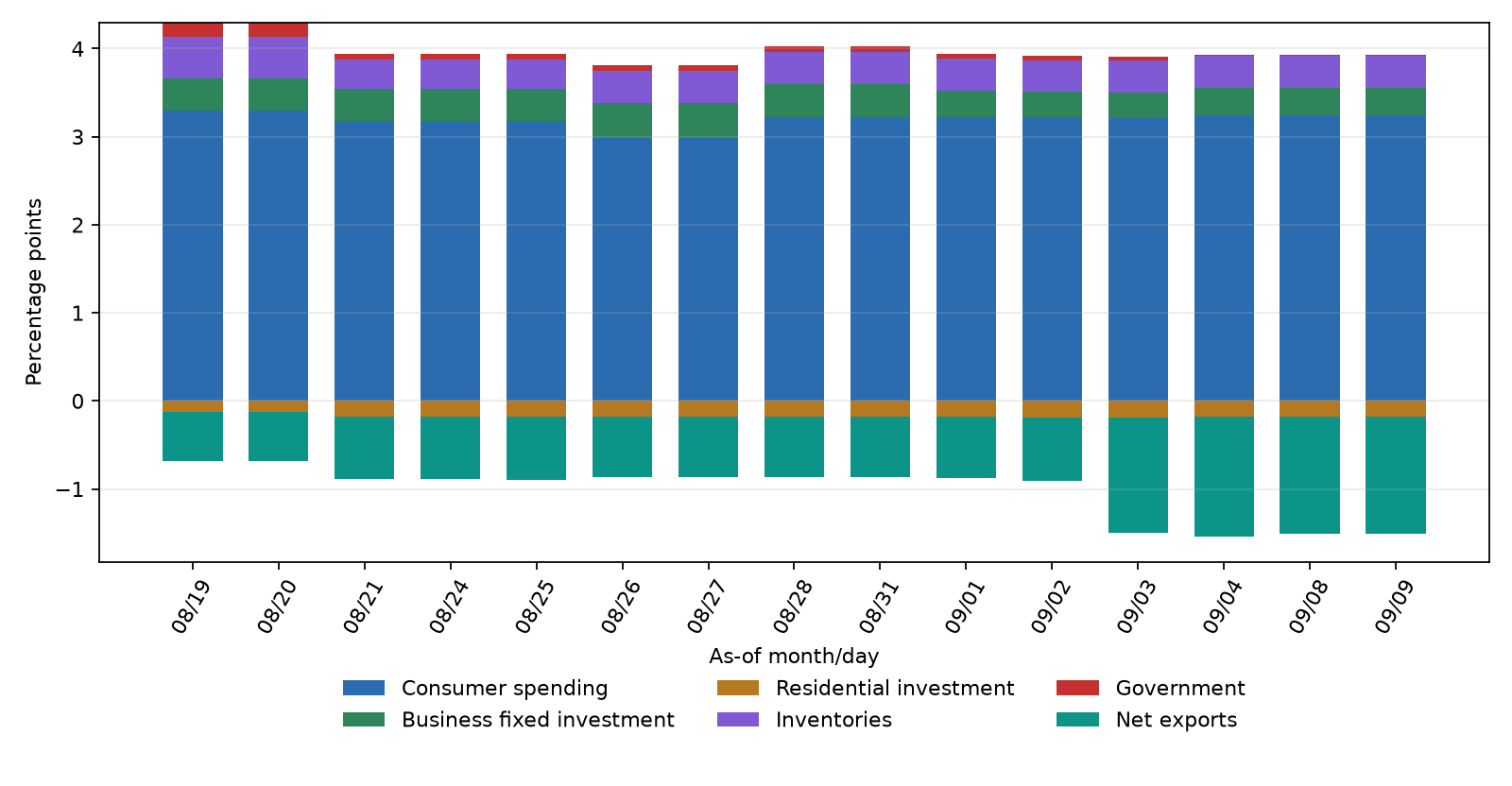
The lack of movement also means the internal composition of the forecast remains largely unchanged. **Consumer spending currently contributes 3.24 percentage points** to the Q3 estimate. That remains a very large contribution, but there was no new consumer-spending release in today's update that would justify treating consumption as the source of today's movement.
The largest offset remains **net exports, subtracting 1.34 percentage points**. Inventories currently contribute **0.36 percentage points**, while business fixed investment contributes another **0.32 percentage points**. Residential investment remains a drag at **-0.17 percentage points**, and government spending is currently contributing approximately **0.01 percentage points**.
Contribution Levels
Taken together, those contributions leave the model at **2.42% SAAR**. The composition is more interesting than the unchanged headline number. Domestic private demand remains positive in the model, while the foreign sector is removing a substantial amount from estimated Q3 growth. Residential investment is also still negative, something worth watching closely given the renewed increase in long-term borrowing costs.
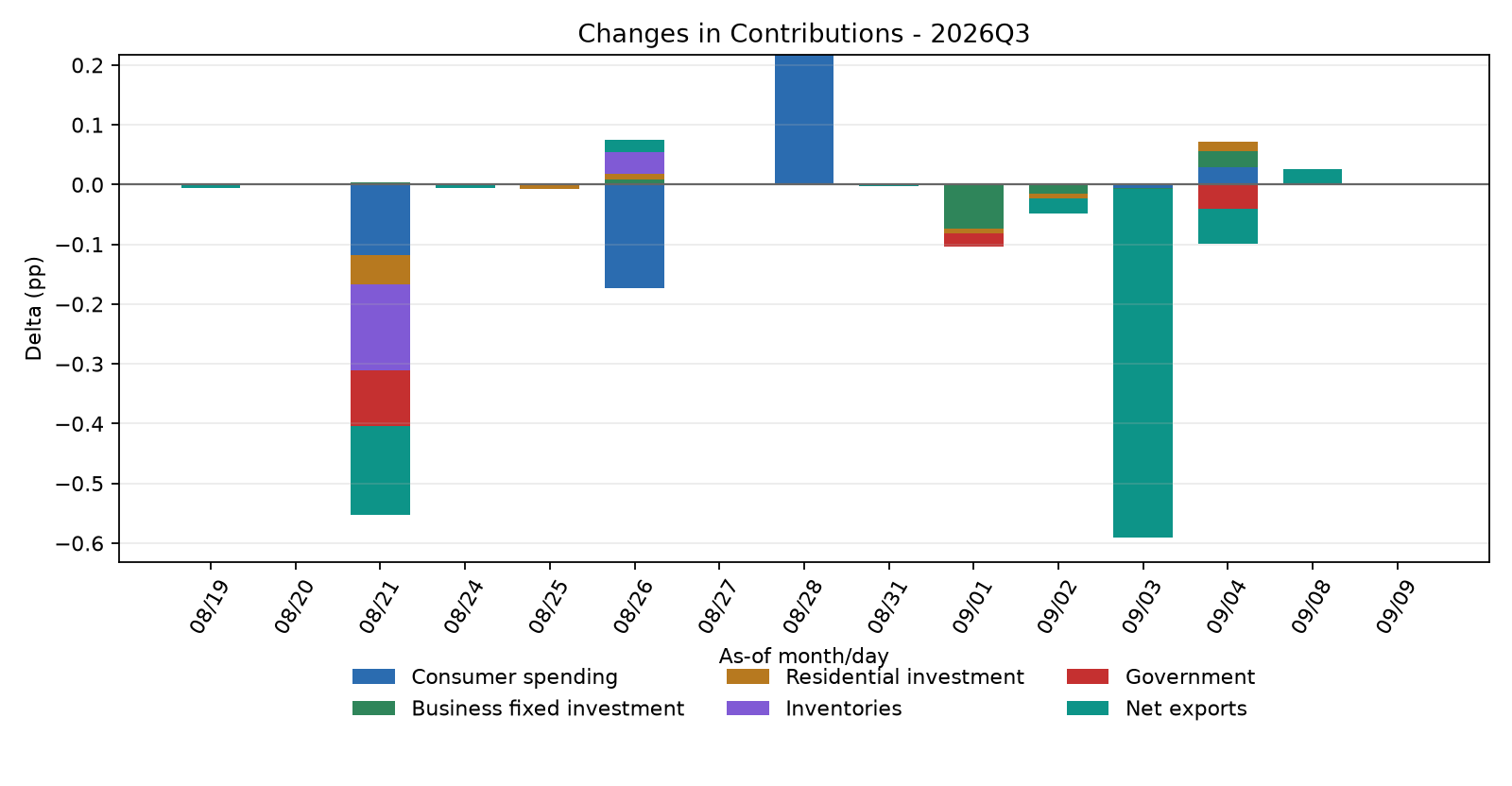
Today's update technically registered extremely small changes in residential and business fixed investment, both rounding to **0.00 percentage points** at the precision used in the daily report. These should not be interpreted as meaningful improvements. There simply was not enough new information today to materially revise either component.
Contribution Changes
That is an important distinction when reading a daily nowcast. Not every update should move the headline number. A model that reacts dramatically to every financial-market fluctuation would probably be telling us more about market noise than about current-quarter GDP. Today's higher Treasury yields matter for the economic outlook, particularly if they persist, but their effect on actual Q3 spending and investment needs to show up in the incoming economic data before we should expect a substantial revision.
For now, the GDP Dynamics estimate continues to point to **roughly 2.4% annualized real GDP growth in Q3 2026**. The next meaningful move will depend much more heavily on incoming evidence for consumption, investment, inventories, trade and government spending than on today's isolated movement in Treasury yields.
Follow the continuously updated GDP nowcast, component estimates, and economic models at GDP Dynamics.