GDP Dynamics Q3 Nowcast Slips to 2.39% After August Jobs Report
Date: 2026-09-04Author: GDP Dynamics
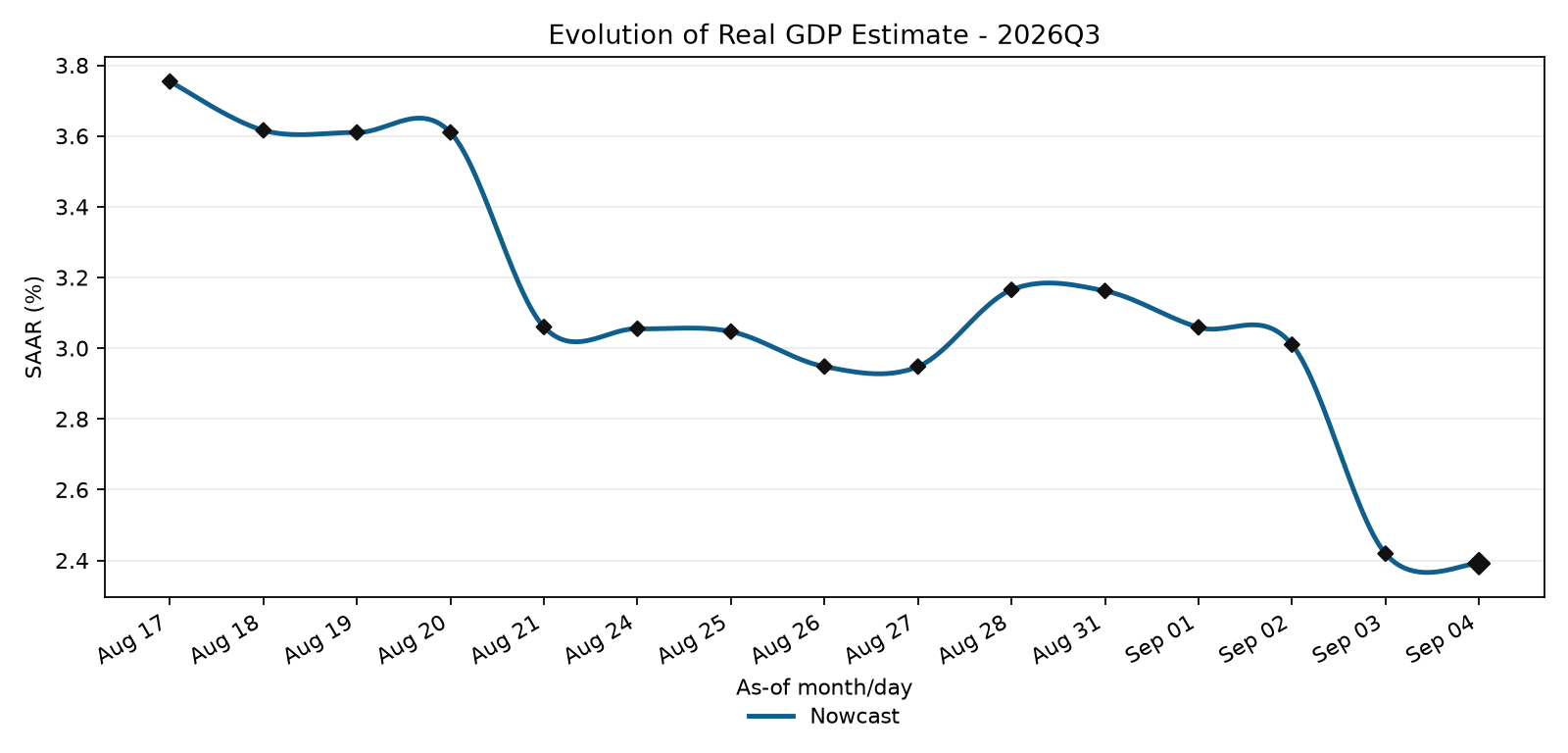
The GDP Dynamics estimate for third-quarter U.S. real GDP growth edged down to 2.39% SAAR on September 4, a decline of 0.03 percentage point from yesterday's estimate. On a quarter-over-quarter basis, the model is currently tracking growth of roughly 0.60%.
The headline move was small, but there was considerably more movement underneath it. Consumer spending, business fixed investment, and residential investment all improved in today's update, while net exports and government moved in the opposite direction. The result was a modest decline in the overall estimate despite somewhat better signals from the domestic private economy.
Today's major new information was the August employment report, which provided a generally firmer picture of the labor market than recent data had suggested.
The U.S. economy added 162,000 jobs in August, while the unemployment rate remained unchanged at 4.1%. That was a substantial acceleration from the unusually weak readings of the previous two months. June payroll growth was revised from 20,000 to 31,000, while July was revised from a loss of 23,000 jobs to a gain of 21,000. Combined, the revisions added another 55,000 jobs to previously reported employment.
The details were also reasonably supportive. Average hourly earnings increased 0.3% in August and were 3.1% higher than a year earlier, while the average private-sector workweek increased from 34.3 to 34.4 hours. Labor-force participation also edged higher from 61.4% to 61.6%.
Those developments helped improve several of the domestic components of the GDP Dynamics model.
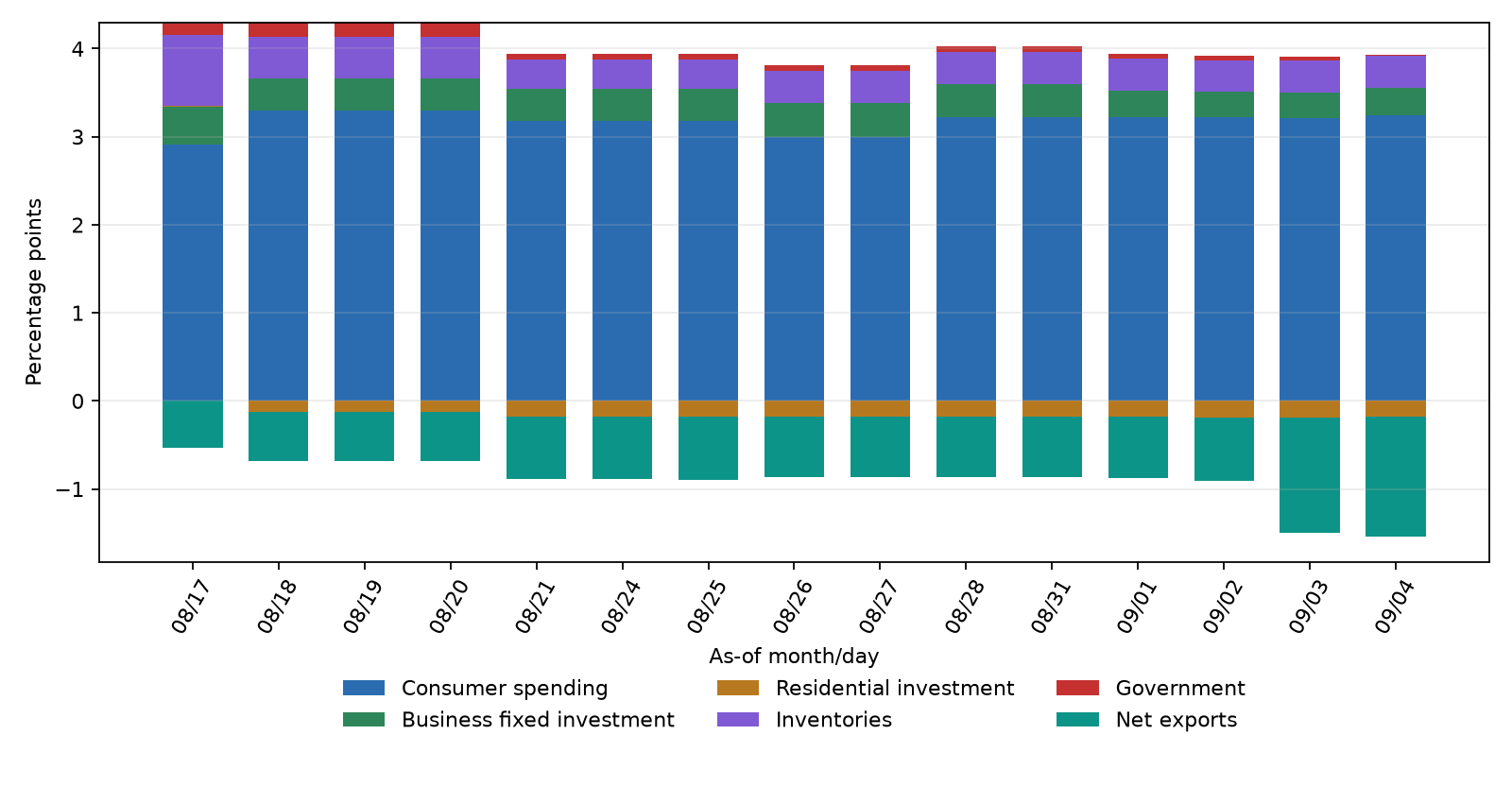
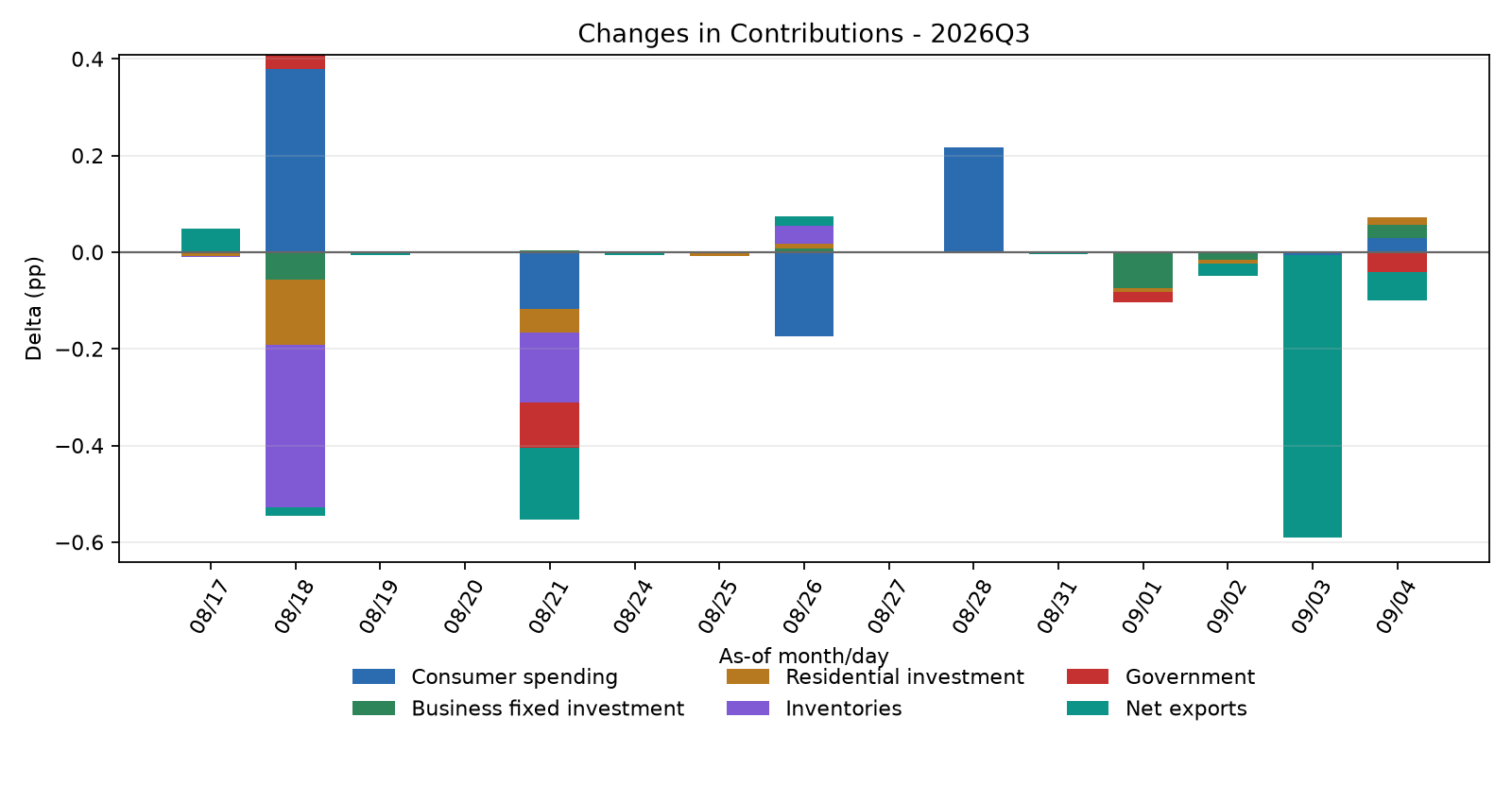
Consumer spending increased its contribution by 0.03 percentage point in today's update and is now contributing approximately 3.24 percentage points to the Q3 growth estimate. That should not be interpreted as consumption suddenly becoming the primary source of today's movement. Consumption is structurally the largest component of GDP and therefore normally carries a large contribution level. What matters for today's update is the 0.03-point improvement.
The employment report offered some support for that move. Payroll growth strengthened, hourly earnings continued rising, and aggregate labor input received some additional support from the longer workweek. Together, those indicators point toward continued household income growth and provide a somewhat stronger foundation for consumer demand than the recent employment numbers had suggested.
Contribution Levels
Business fixed investment also improved by 0.03 percentage point. The employment report contained a couple of encouraging signals on that front. Manufacturing employment increased by 16,000, extending an upward trend that has added 58,000 manufacturing jobs since December 2025. Machinery manufacturing and fabricated metals each added 6,000 jobs. Construction employment also increased by 22,000, although BLS characterized the overall monthly construction change as little changed.
None of those figures by themselves establish that capital spending is accelerating. Factory orders, capital-goods orders, industrial production, and other investment indicators remain much more direct measures of that part of the economy. But the employment figures are at least consistent with the modest improvement being picked up by the model rather than contradicting it.
Residential investment provided another small positive contribution to today's revision, improving by 0.02 percentage point. Its contribution to overall Q3 growth nevertheless remains negative at approximately -0.17 percentage point. In other words, the model is detecting an improvement at the margin rather than signaling that residential investment has become an outright source of GDP growth.
The largest negative movement came from net exports, which reduced the nowcast by 0.06 percentage point. Net exports are currently subtracting approximately 1.36 percentage points from the Q3 growth estimate, making the external sector a substantial drag in the current model snapshot.
Government provided the other major offset, lowering the estimate by 0.04 percentage point. Its overall contribution is now essentially neutral at approximately +0.01 percentage point.
There is an interesting wrinkle in today's government numbers. Local government education added 42,000 jobs in August, largely reversing its decline in July. However, BLS notes that employment in the sector has shown little net change since January 2025. The model therefore isn't simply translating a positive government payroll number into stronger government GDP. Its government estimate incorporates a broader set of public-sector indicators, and the net effect of today's update was negative.
The arithmetic is useful because it shows why focusing exclusively on the headline change can be misleading. There was 0.08 percentage point of improvement across consumption, business investment, and residential investment, but it was overwhelmed by 0.10 percentage point of deterioration from net exports and government. Rounding among the underlying components accounts for the difference between those displayed changes and the model's 0.03-point headline decline.
Contribution Changes
The broader labor-market picture also looks somewhat better after today's release, but I wouldn't characterize it as a return to a booming labor market. August's 162,000 payroll gain was well above the average increase of just 31,000 per month over the previous 12 months, while unemployment remained at 4.1%. At the same time, the participation rate remains 0.5 percentage point below its January level.
There were also clear differences across industries. Restaurants and bars added 59,000 jobs, local government education added 42,000, and manufacturing added 16,000. Information employment, meanwhile, fell by 23,000. Health-care employment continued increasing, but its 13,000-job gain was considerably below its average pace over the previous year.
So today's report is better interpreted as evidence that the labor market still has some underlying momentum rather than evidence of a major reacceleration.
For the GDP Dynamics nowcast, the more important result is that the domestic private-sector signals improved slightly. Consumer spending, business fixed investment, and residential investment all moved upward. The problem was that those improvements weren't large enough to overcome the deterioration elsewhere.
The Q3 estimate consequently moves from 2.42% to 2.39% SAAR.
Nowcast Path
At 2.39%, the GDP Dynamics model continues to point toward moderate real GDP growth in the third quarter. Today's update didn't materially change that picture. What changed was the composition underneath it: somewhat stronger domestic demand indicators were offset by weaker contributions from trade and government.
That composition will matter as more of the quarter's hard data arrive. If the improvement in household demand and private investment persists while the drag from net exports stabilizes, the headline estimate has room to move higher. If the external-sector weakness continues, however, stronger domestic activity may continue to be partially hidden by the GDP arithmetic.
The next several releases should therefore tell us considerably more about whether today's internal improvement is the beginning of a stronger domestic trend or simply noise within an otherwise stable Q3 trajectory.