GDP Dynamics Q3 Nowcast Falls to 2.42% as Trade Becomes a Much Larger Drag
Date: 2026-09-03Author: GDP Dynamics
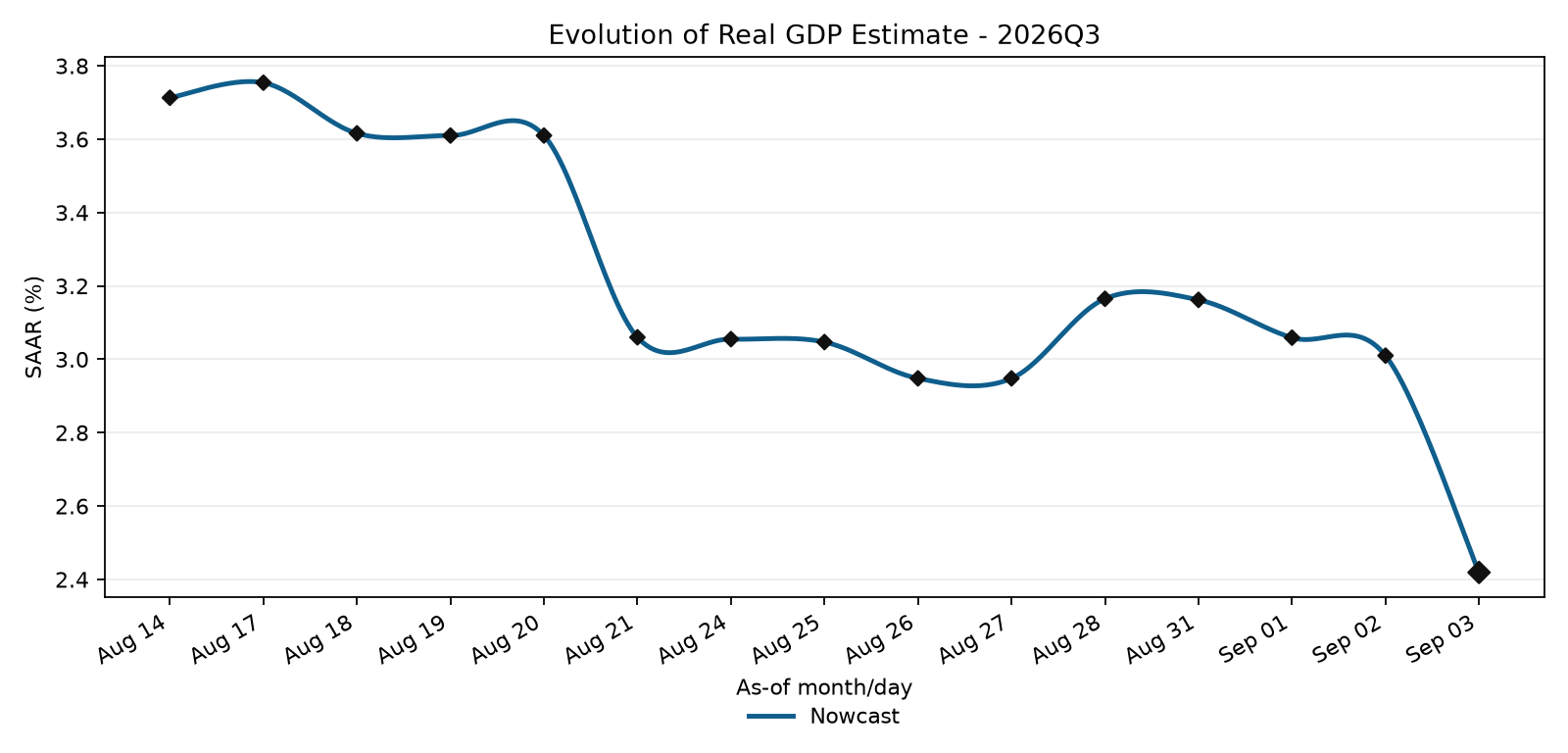
The GDP Dynamics estimate for third-quarter U.S. real GDP growth fell sharply on September 3, dropping 0.59 percentage points from 3.01% to 2.42% at a seasonally adjusted annual rate. That is equivalent to roughly 0.60% growth on a quarter-over-quarter basis.
Unlike some of the smaller changes we have seen in recent updates, there is very little ambiguity about what caused today's decline. Almost the entire revision came from net exports following the release of July international trade data.
Nowcast Path
The Trade Deficit Widened Sharply in July
The U.S. goods and services trade deficit increased to $88.6 billion in July, up $17.4 billion from a revised $71.2 billion in June. That represents a 24.4% increase in the monthly deficit.
The deterioration came from both sides of the trade balance. Exports declined 2.1% to $310.7 billion while imports increased 2.8% to $399.3 billion.
For the GDP calculation, however, the inflation-adjusted numbers matter more than the headline nominal trade figures. The real goods deficit widened substantially as real exports declined while real imports increased. In other words, this was not simply a change in import or export prices. The underlying volume of trade moved in a direction that is unfavorable for measured Q3 GDP growth.
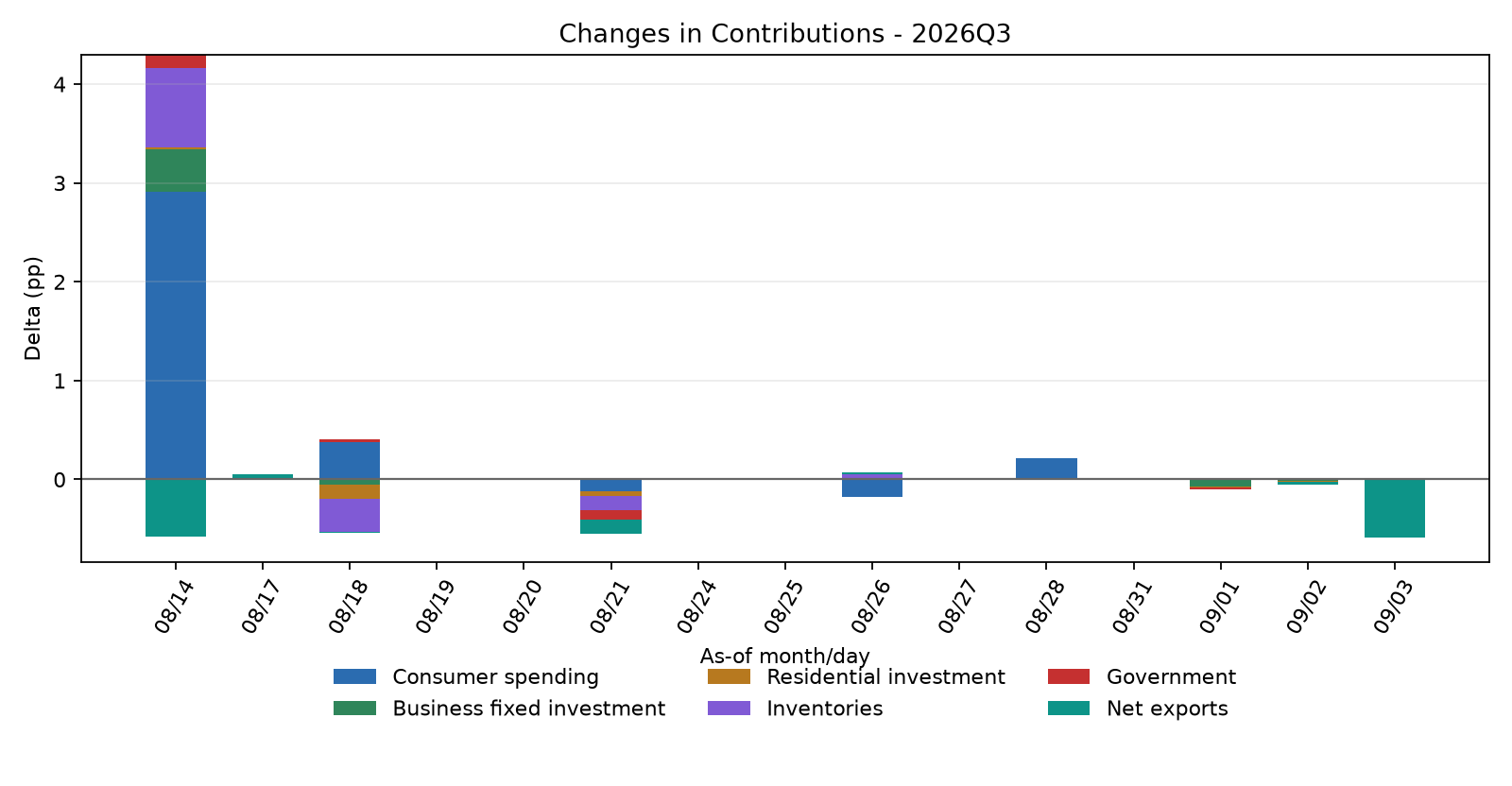
The GDP Dynamics model responded accordingly. Net exports reduced the Q3 nowcast by approximately 0.58 percentage points in today's update alone, accounting for nearly the entire 0.59-point decline in the headline forecast.
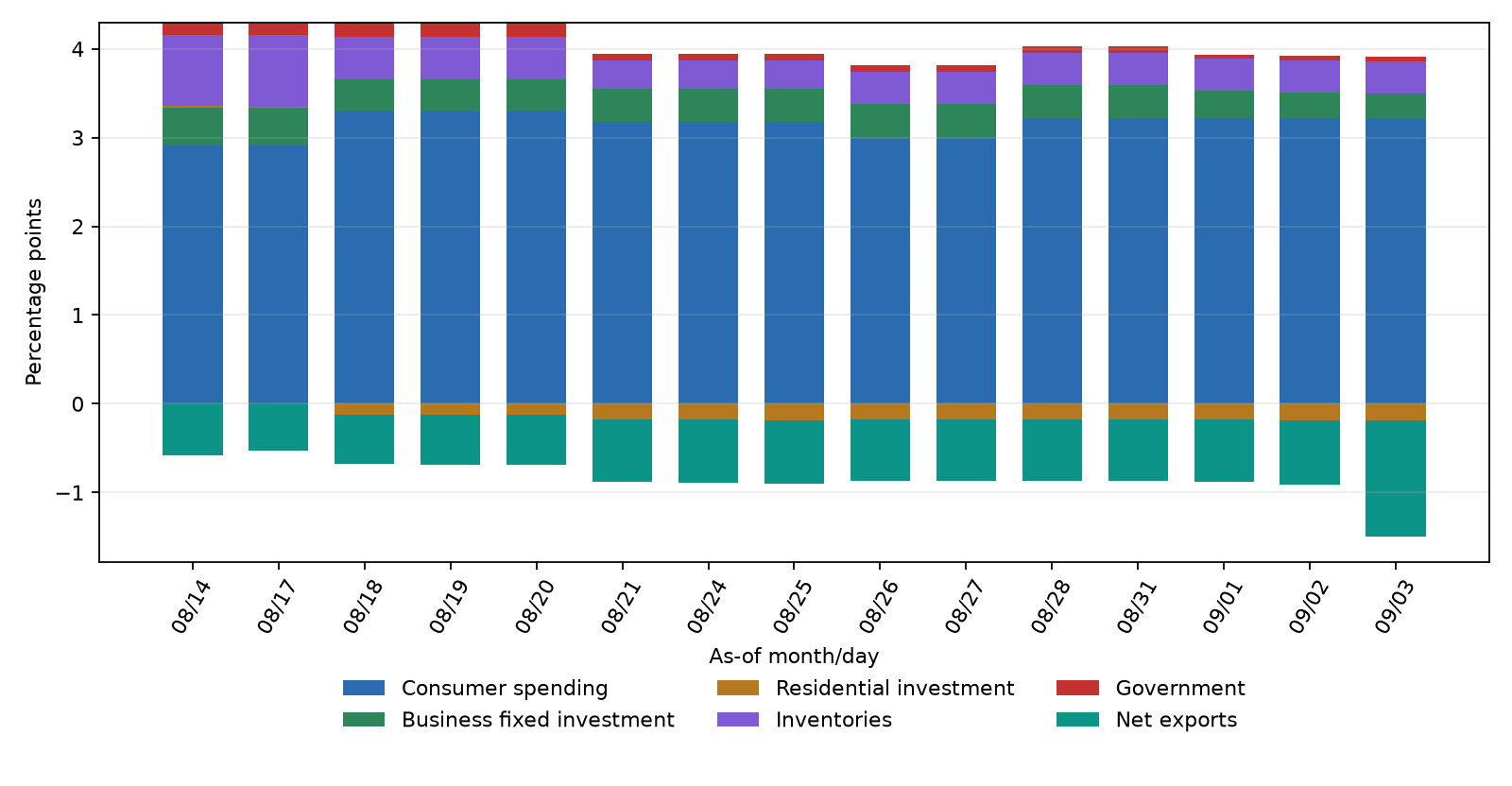
Net exports are now estimated to subtract 1.31 percentage points from third-quarter growth. That makes foreign trade by far the largest negative contribution currently in the model.
There is an important distinction here. A deterioration in net exports does not necessarily mean that domestic economic activity suddenly weakened by the same amount. Imports enter the GDP accounting identity negatively because they represent production occurring outside the United States. Stronger imports can therefore lower measured GDP even when some of those imports reflect healthy domestic demand.
That distinction appears particularly relevant in the July report. Part of the increase in imports came from capital goods, including computers, computer accessories and semiconductors. So while the accounting effect on current-quarter GDP is negative, some of the underlying import demand may be associated with domestic business investment rather than a straightforward deterioration in private demand.
Consumer Spending Was Nearly Unchanged
Consumer spending also moved slightly lower in today's model update, but the change was small. Its contribution declined by only 0.01 percentage point.
Consumption is currently contributing an estimated 3.21 percentage points to Q3 growth. That remains a strong level, but today's update provided little new evidence that materially changed the household spending outlook.
This is also why I would not characterize consumption as the "driver" of today's update simply because it has the largest contribution level. The important information in a daily nowcast update is what changed. Today, the change came overwhelmingly from trade.
The Labor Market Still Shows Few Signs of Layoffs Accelerating
Today's initial unemployment claims release provided relatively little reason to alter the near-term labor-market picture.
Initial claims increased by 2,000 to 206,000 for the week ending August 29. The previous week's figure was revised from 203,000 to 204,000. The four-week moving average increased to 207,250 from a revised 205,750.
Continuing claims increased by 8,000 to 1.779 million for the week ending August 22, while their four-week moving average actually declined by 5,000 to approximately 1.782 million.
Those numbers continue to suggest a labor market in which hiring may have cooled without producing a significant increase in layoffs. Initial claims remain low by historical standards, and there is nothing in today's release resembling the kind of rapid claims acceleration normally associated with a sharp deterioration in employment.
That helps explain why today's large GDP Dynamics revision should primarily be interpreted as a trade revision rather than evidence of a sudden broad-based weakening in domestic activity.
Mortgage Rates Edge Higher
Mortgage rates also moved slightly higher this week. Freddie Mac reported that the average 30-year fixed mortgage rate increased to 6.71%, up from 6.66% last week. The 15-year rate increased from 5.98% to 6.04%.
Freddie Mac noted that purchase demand has remained relatively stable despite the higher borrowing costs.
The GDP Dynamics residential investment contribution barely changed in today's update and remains negative at -0.19 percentage points.
The mortgage-rate increase therefore does not materially explain today's headline revision, but rates around these levels continue to represent a constraint on residential investment.
Where the Q3 Nowcast Stands
After incorporating today's releases, the composition of the GDP Dynamics Q3 estimate is increasingly unusual.
Consumer spending contributes +3.21 percentage points, inventories contribute +0.36, business fixed investment contributes +0.29, and government contributes +0.05. Residential investment subtracts 0.19 percentage points, while net exports subtract 1.31 percentage points.
Contribution Levels
The important story is therefore not simply that the Q3 outlook weakened today. It is where the weakness came from.
Domestic demand has not been revised downward by anything close to 0.59 percentage points. Instead, July's substantially wider trade deficit caused the model to reassess the contribution coming from the external sector.
Contribution Changes
That distinction matters when interpreting the headline number. A 0.59-point decline in a GDP nowcast could indicate that several parts of the economy simultaneously weakened. That is not what happened today. Roughly 0.58 percentage points of the revision came from net exports alone.
The result is a Q3 nowcast of 2.42% SAAR. That is a meaningful downgrade from yesterday's estimate, but the underlying release data do not currently point toward an equivalent deterioration in domestic economic conditions.
Instead, today's update is largely a reminder of how dramatically trade can move quarterly GDP estimates. With imports rising and exports falling in July, the external sector has become a considerably larger drag on the quarter.
As additional August data arrive, the question will be whether that trade deterioration persists or whether stronger domestic components offset some of the drag. For now, GDP Dynamics continues to point toward positive Q3 growth, just at a considerably slower pace than it did yesterday.