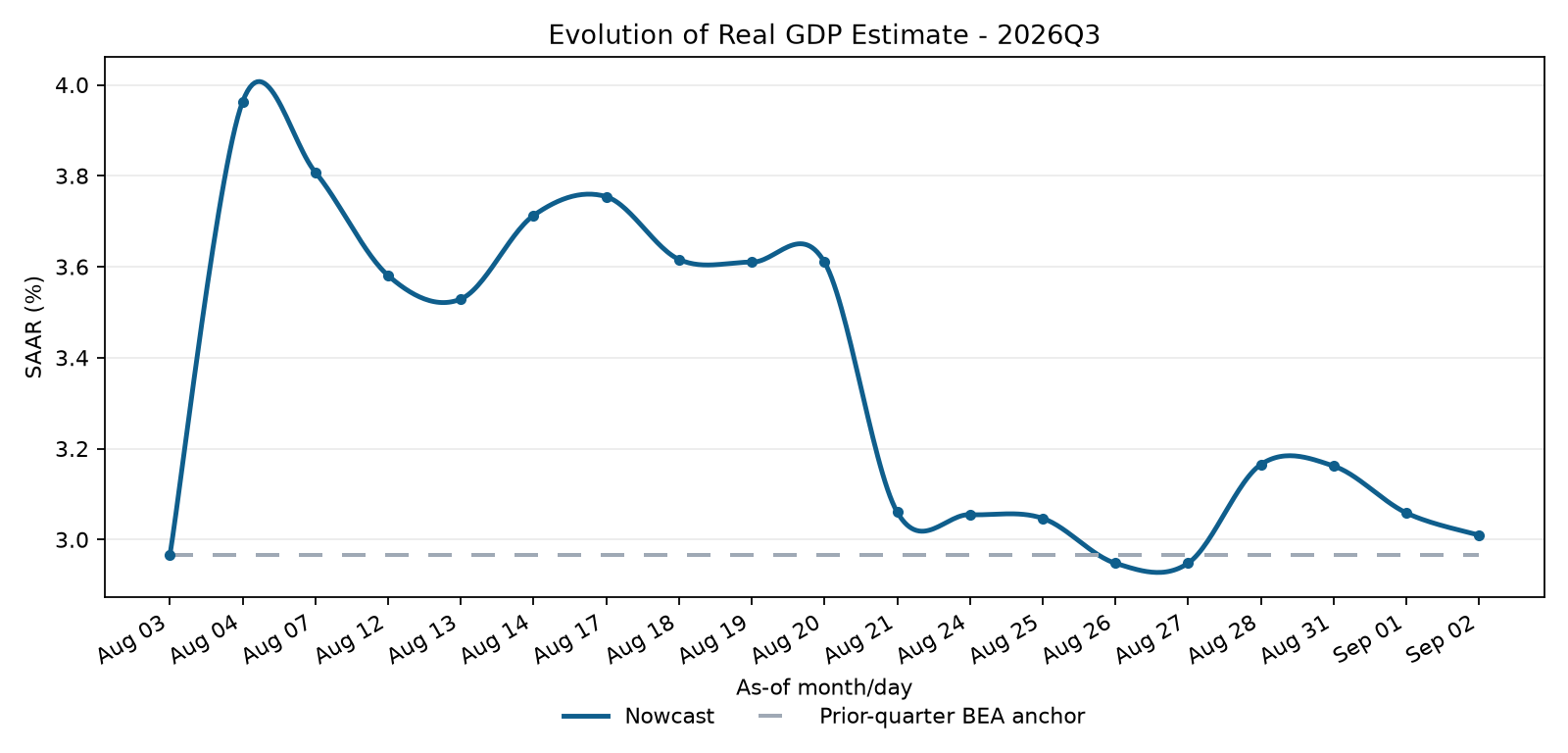
My estimate for third-quarter U.S. real GDP growth slipped another 0.05 percentage point today, falling from 3.06% to 3.01% at a seasonally adjusted annual rate. That works out to roughly 0.75% growth quarter-over-quarter.
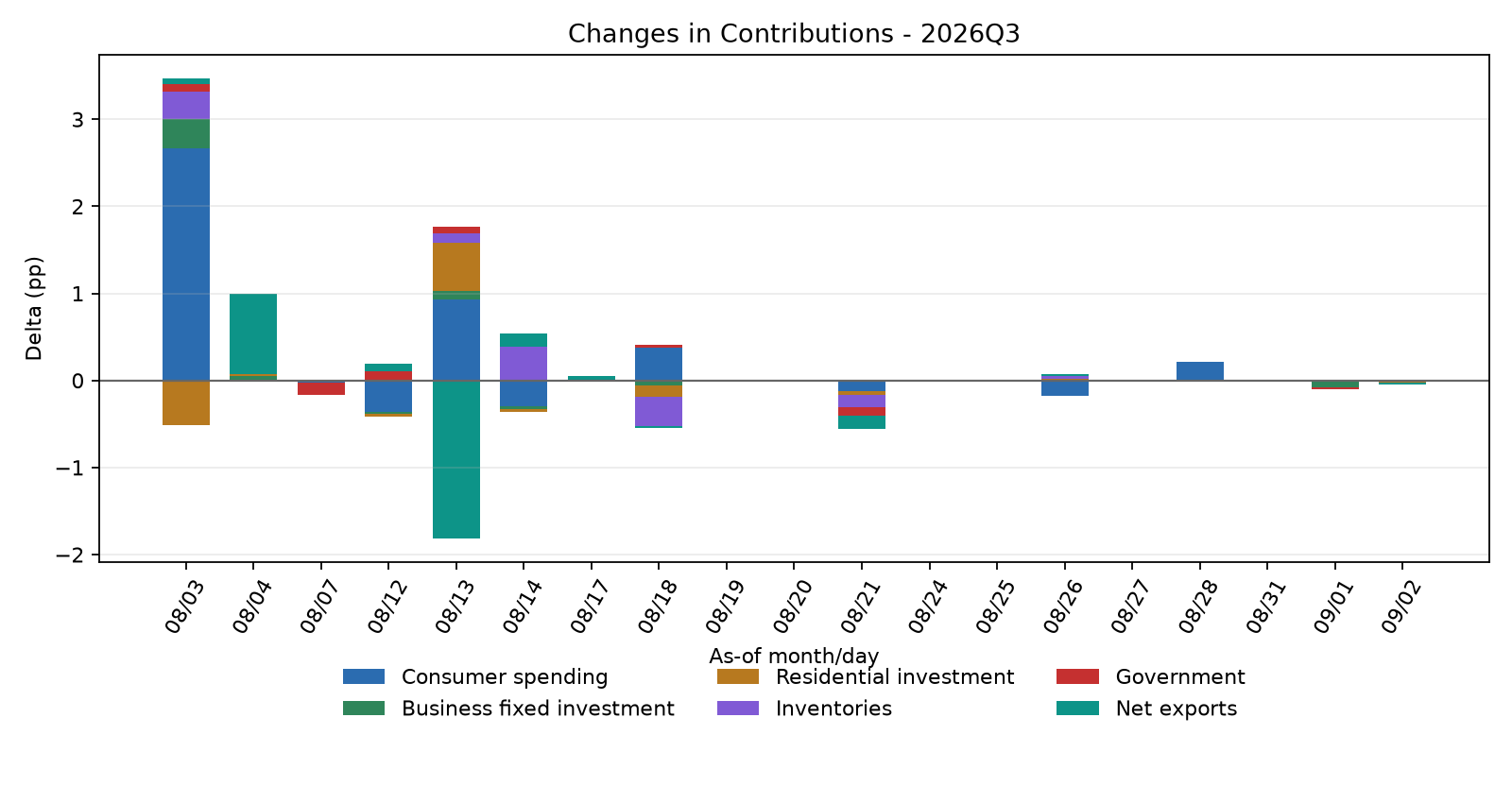
The move was small, but unlike some recent updates there were no components pushing the estimate higher. Net exports reduced the nowcast by 0.03 percentage point, business fixed investment took off another 0.02 point, and residential investment shaved off roughly 0.01 point.
The interesting part of today's update is business investment. Headline factory orders actually looked fairly good. New orders for manufactured goods increased 0.9% in July, beating expectations for a 0.6% increase and reversing a revised 0.2% decline in June. Much of that strength, however, came from a 12.7% jump in civilian aircraft and parts orders. Machinery orders also increased 0.8%.
Underneath those headline numbers, the data that matter more for estimating underlying equipment investment were weaker. Orders for nondefense capital goods excluding aircraft, commonly used as a proxy for business equipment spending, were revised to no growth in July, rather than the previously reported 0.2% increase. Shipments were also revised slightly lower, although they still increased 1.2%.
That distinction matters for the nowcast. A large aircraft order can make the factory-orders headline look considerably stronger without telling us nearly as much about the broad direction of business capital spending. The revised core capital-goods numbers therefore pulled the business fixed investment contribution down by 0.02 percentage point despite the apparently strong factory-orders report.
Contribution Changes
Housing was another small drag. Residential investment reduced the estimate by about 0.01 percentage point. The latest construction-spending numbers showed total U.S. construction spending falling 0.5% in July, taking spending to its lowest level in nearly three years.
The housing data are not uniformly weak. July building permits increased 5.0% from June, while single-family permits increased 2.5%. But other housing indicators continue to show the effects of high financing costs. New single-family home sales fell 10.5% in July to a 607,000 annual rate, their lowest level since January. Taken together, the housing picture remains mixed rather than pointing toward a sustained rebound in residential investment.
Net exports produced the largest downward revision today, subtracting 0.03 percentage point from the Q3 estimate. I would be careful about interpreting that as a new trade-data signal because today's model snapshot does not contain a new comprehensive goods-and-services trade release. Instead, the change reflects the model's incoming external-sector indicators and updated information feeding its trade estimates.
There was some evidence today of strong U.S. energy exports. EIA data showed crude exports jumping by about 691,000 barrels per day to 4.5 million barrels per day last week, while net crude imports declined. That is supportive for the energy side of the trade account, but it is not enough by itself to determine the direction of total real net exports. For now, the model is estimating that the overall external balance will subtract more from Q3 growth than it did yesterday.
Contribution Levels
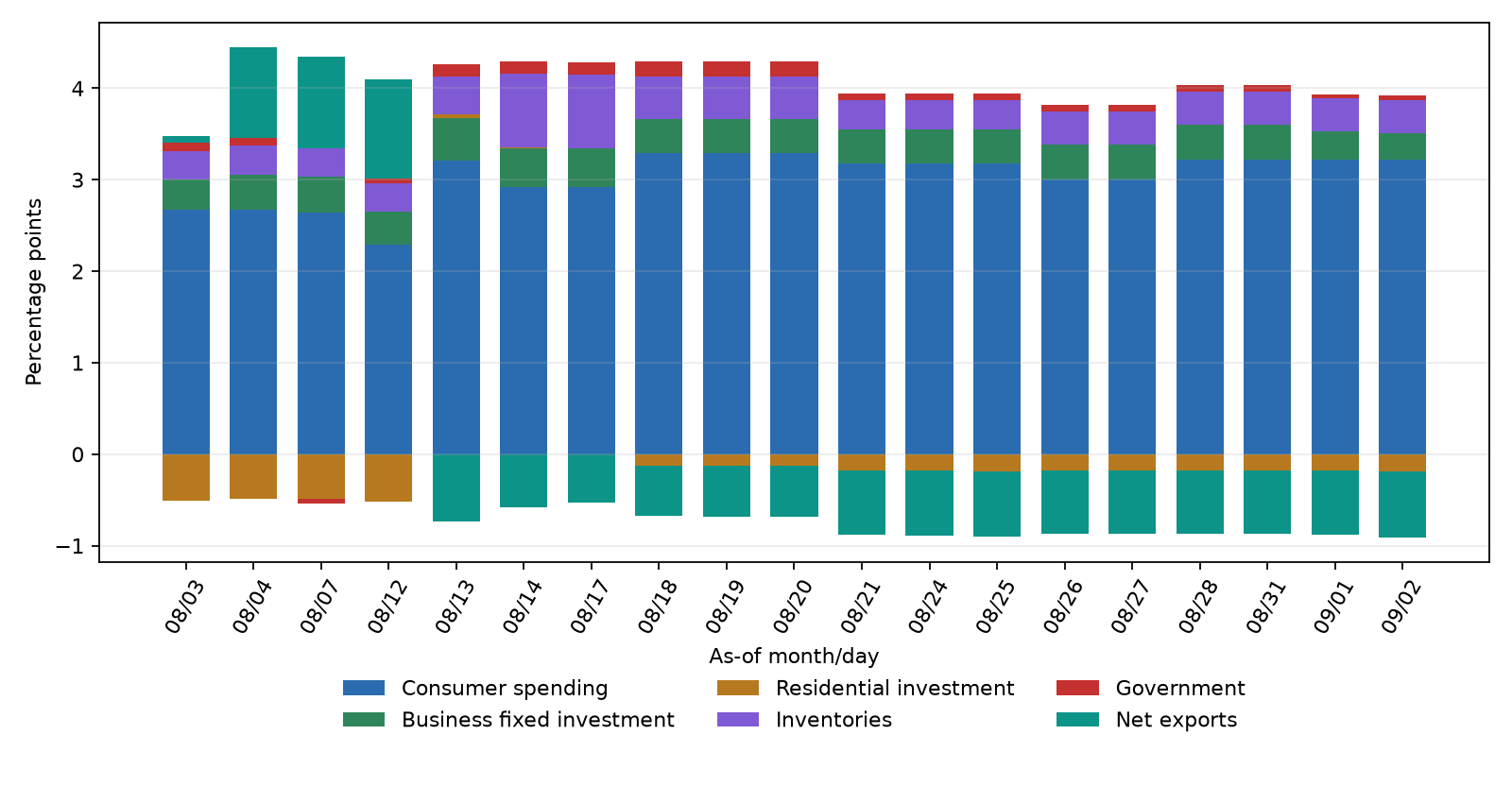
The composition of the nowcast remains heavily tilted toward consumer spending. Consumption is currently contributing 3.22 percentage points to Q3 growth. Inventories add another 0.36 point and business fixed investment contributes 0.29 point. Government spending adds 0.05 point.
Those gains are partly offset by the external sector and housing. Net exports are now subtracting 0.72 percentage point, while residential investment subtracts another 0.19 point.
That leaves the overall Q3 estimate at 3.01%, still pointing to fairly strong real GDP growth despite today's modest downgrade. More importantly, the recent movement has not come from a sudden deterioration in household spending. The weaker revisions have instead been concentrated in investment, housing and the external side of the economy.
Nowcast Path
As more August data arrive, the question will be whether consumer spending continues to carry the quarter while investment and net exports remain a drag, or whether the strength begins to broaden again. For now, the GDP Dynamics model continues to point to Q3 real GDP growth of about 3.0% SAAR.
You can follow the latest GDP nowcast and model updates at GDPDynamics.com.