Q3 GDP Nowcast Slips to 3.06% as Construction Weakens
Date: 2026-09-01Author: GDP Dynamics
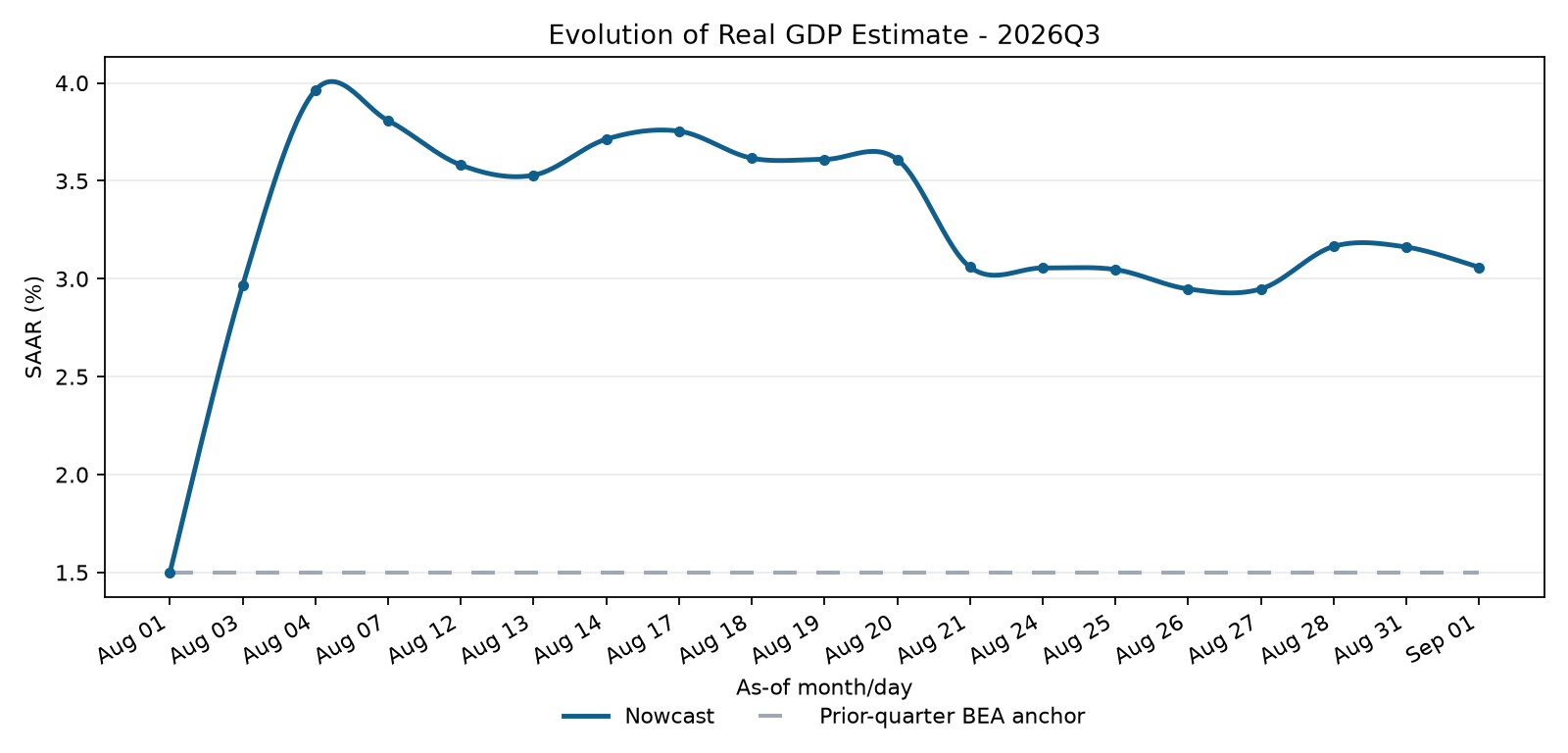
My Q3 2026 GDP nowcast fell another 0.10 percentage point today, dropping from 3.16% to 3.06% at a seasonally adjusted annual rate. That works out to roughly 0.76% quarter-over-quarter growth.
The September 1 update was driven primarily by the latest construction spending data, and this time the weakness was broad enough to pull several parts of the model lower.
Nowcast Path
The Census Bureau reported that total U.S. construction spending fell 0.5% in July to a seasonally adjusted annual rate of $2.158 trillion. June was revised to essentially flat, and the July decline left construction spending 3.8% below its level a year earlier. The monthly decline was also weaker than expectations for roughly unchanged spending.
That weakness showed up most clearly in residential construction. Residential spending fell 1.3% in July, while spending on single-family construction dropped 3.2%. Single-family spending is now 6.5% below its level a year ago. Mortgage rates remain a major constraint on this part of the economy, limiting housing demand and making new projects more difficult to finance.
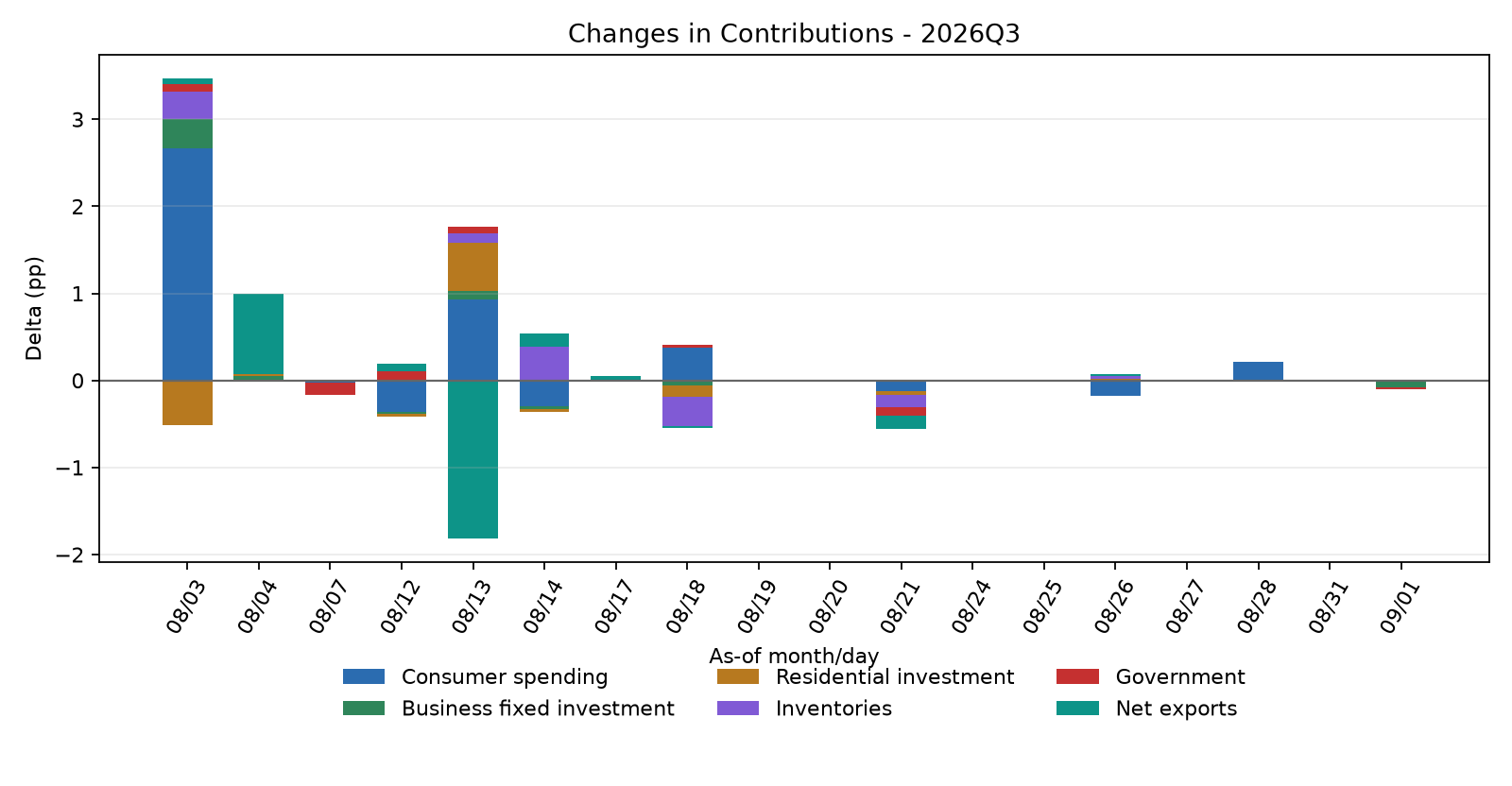
In the GDP Dynamics model, residential investment consequently knocked 0.01 percentage point off the Q3 growth estimate. Residential investment is now making a negative contribution of about 0.18 percentage point to the overall nowcast.
Business fixed investment produced the largest downward revision in today's update, subtracting 0.07 percentage point from the previous estimate.
The construction report was not uniformly weak on the business side. Private nonresidential construction actually increased 0.4% in July, with power-related construction rising 0.5%. But manufacturing construction fell another 0.8% and is now down 21.7% from a year ago. At the same time, data-center construction remains exceptionally strong, meaning that a relatively narrow group of projects continues to support nonresidential investment while other areas weaken.
This is an important distinction for the nowcast. Business fixed investment is still contributing about 0.31 percentage point to Q3 GDP growth. Today's data did not turn business investment into an outright drag on growth. Instead, they reduced the amount of support the model expects from it.
Government also moved slightly lower. Public construction spending declined 0.2% in July. Federal construction spending was particularly weak, falling 3.5%, while state and local construction was essentially unchanged. That reduced the government contribution to the GDP Dynamics nowcast by 0.02 percentage point. Government is now adding only about 0.05 percentage point to projected Q3 growth.
Contribution Changes
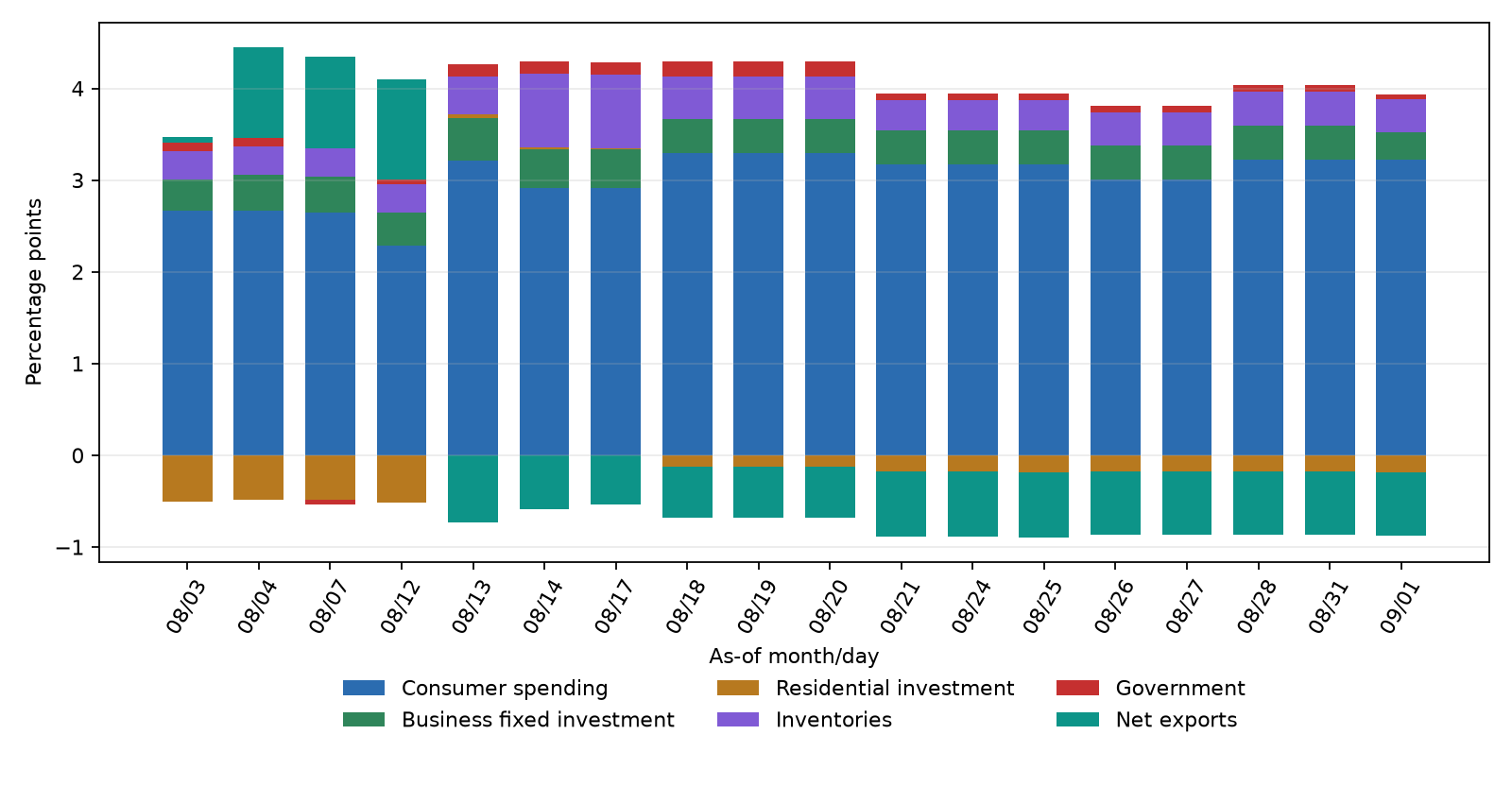
Despite today's decline, the composition of the nowcast still points to strong domestic consumption as the main source of Q3 growth. Consumer spending is currently contributing 3.22 percentage points, easily the largest positive contribution in the model.
Contribution Levels
Inventories are adding another 0.36 percentage point and business fixed investment remains positive at 0.31 percentage point. Those gains are being partially offset by net exports, which are subtracting 0.70 percentage point, and residential investment, which is subtracting 0.18 percentage point. Government is providing only a small 0.05 percentage-point contribution.
The result is a 3.06% annualized Q3 growth estimate.
Today's revision is therefore less about a sudden deterioration in the overall economy than about the construction side of the expansion continuing to lose momentum. Housing remains under pressure from elevated borrowing costs, manufacturing construction has fallen substantially from last year's levels, and public construction provided little offset in July. Data centers and some other nonresidential projects remain strong, but they are increasingly carrying a larger share of the construction investment story.
For now, consumer spending is doing most of the work keeping the Q3 estimate above 3%. That makes the next round of consumer, labor-market and income data particularly important. If household spending holds up, the economy can absorb some of the weakness appearing in construction and investment. If consumption begins to soften as well, the current 3.06% estimate would become considerably harder to maintain.
The GDP Dynamics Q3 nowcast will continue to update as new data arrive throughout the quarter.
More forecasts, charts and economic analysis are available at GDPDynamics.com.