GDP Nowcast Rises to 3.17% as Consumer Spending Strengthen
Date: 2026-08-28Author: GDP Dynamics
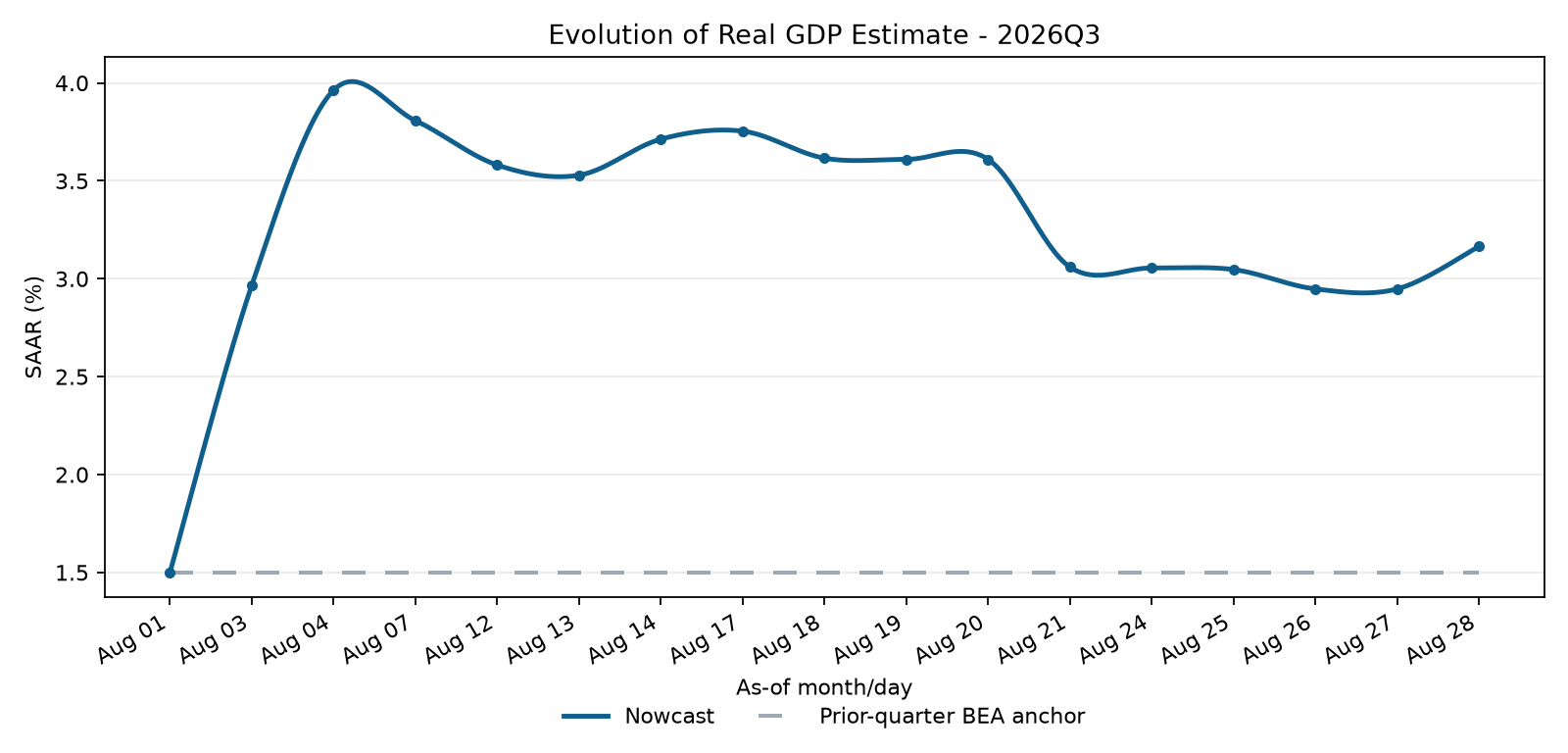
My GDP Dynamics nowcast for third-quarter real GDP growth rose again on August 28, moving from 2.95% to 3.17% at a seasonally adjusted annual rate. That is an increase of 0.22 percentage point from yesterday's estimate and works out to roughly 0.79% growth quarter over quarter.
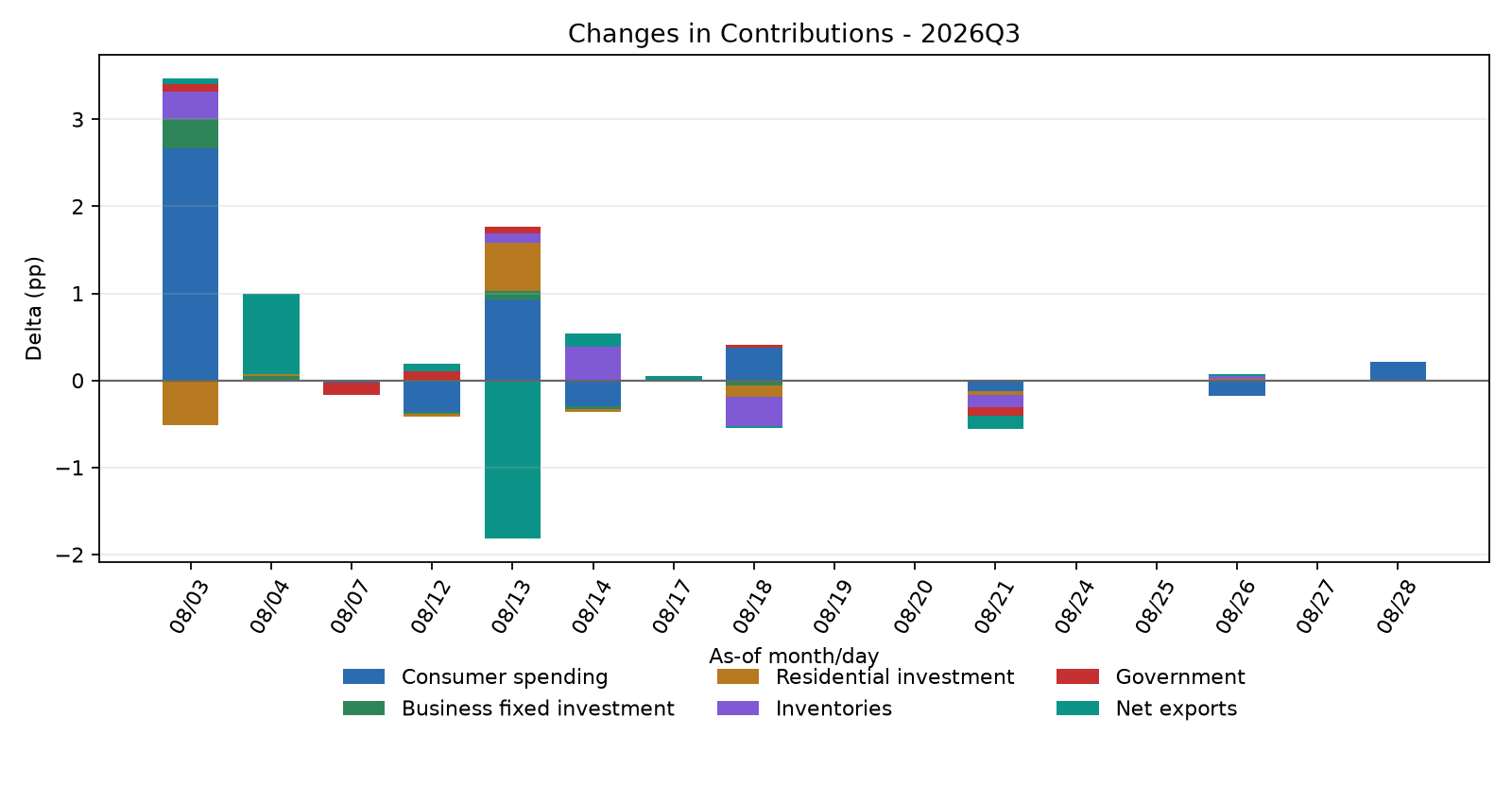
The increase came almost entirely from the consumer side of the model. Consumer spending's contribution increased by 0.22 percentage point in today's update, while the other major components were essentially unchanged.
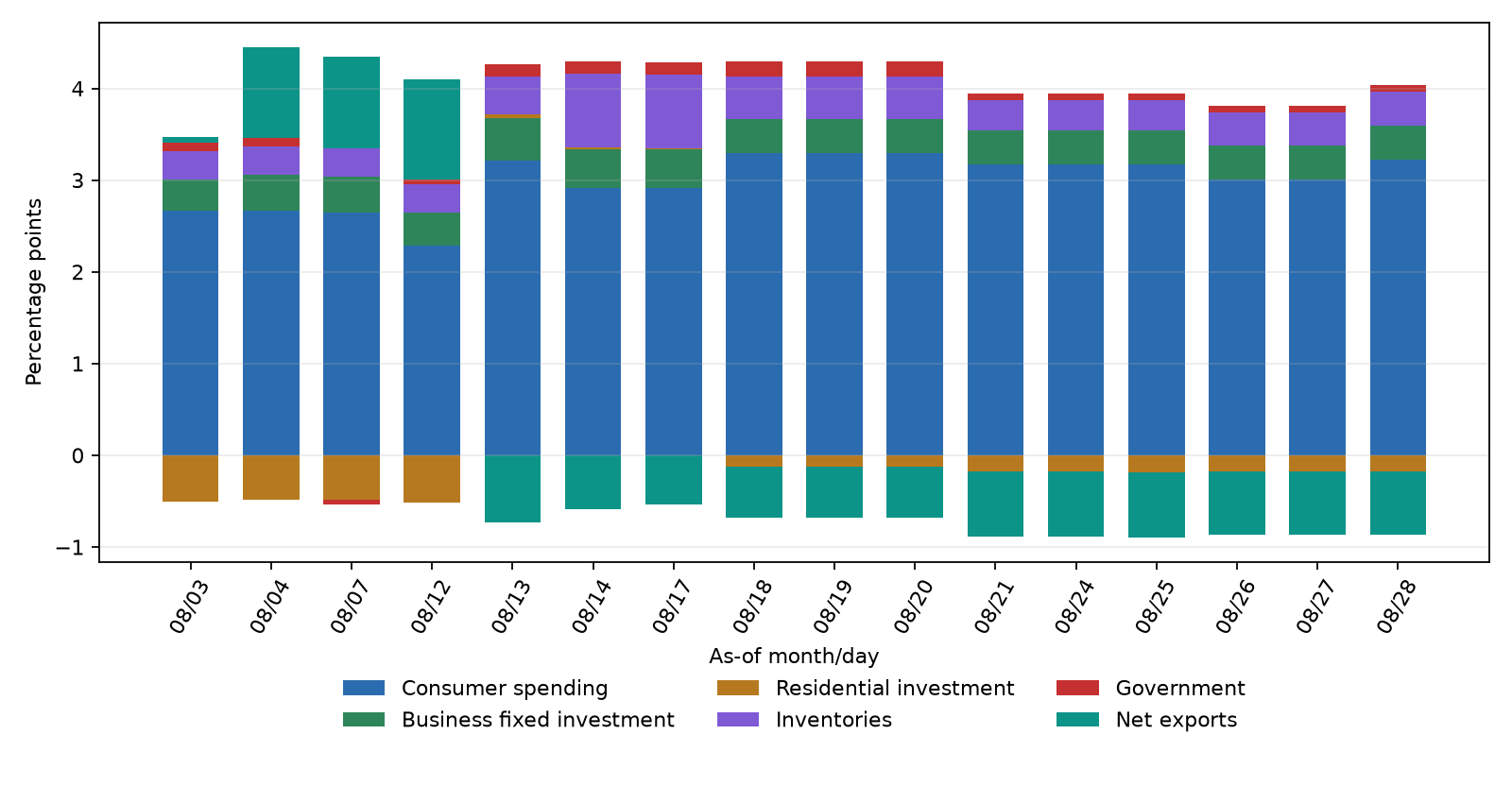
That leaves consumer spending contributing 3.22 percentage points to the current Q3 estimate. Business fixed investment contributes another 0.38 point, inventories add 0.36 point and government spending adds 0.07 point. Residential investment remains a small drag at -0.17 point, while net exports subtract 0.69 point.
Contribution Levels
Consumer Data Pushes the Model Higher
The important new consumer release today was the University of Michigan's final August Survey of Consumers.
The final Consumer Sentiment Index came in at 51.7, compared with 55.2 in July and 58.2 a year earlier. Current economic conditions fell to 51.9 from 54.8, while the expectations index declined to 51.5 from 55.4.
So this wasn't a strong consumer-confidence report in the conventional sense. Sentiment remains weak and deteriorated substantially from July.
There was, however, a little more going on underneath the headline.
Year-ahead inflation expectations declined from 4.2% to 4.0%, while longer-run inflation expectations remained at 3.3%. The University of Michigan also reported that 53% of consumers spontaneously mentioned high prices as hurting their personal finances, up from 50% in July.
Consumers therefore remain unhappy about prices, but the latest survey does not show a corresponding collapse in the spending signal picked up by the model. That distinction matters. People can report that they feel worse about the economy while continuing to spend.
The GDP Dynamics model responded to the new information by raising the consumer contribution by 0.22 percentage point. That single change accounts for essentially all of today's increase in the overall Q3 nowcast.
Contribution Changes
Interest Rates Moved the Other Way
Today's other new input was the 10-year Treasury yield, and the bond market was reacting to Federal Reserve Chair Kevin Warsh's speech at Jackson Hole.
Warsh put considerably more emphasis on the inflation side of the Fed's mandate, arguing that policymakers need to be confident underlying inflation is moving back toward the 2% target at a sufficient pace.
Markets interpreted the remarks as increasing the possibility of another rate increase. The 2-year Treasury yield, which is particularly sensitive to expectations about Federal Reserve policy, jumped sharply. The 10-year yield also moved higher, reaching roughly 4.7% during Friday trading.
That creates an interesting split in today's data. The consumer side of the GDP Dynamics model became stronger, while financial conditions moved in a less supportive direction.
For now, the consumer effect won.
Higher Treasury yields can eventually work through mortgage rates, business financing and other borrowing costs, but those effects do not occur instantly. Today's nowcast is estimating current-quarter economic activity, not making the assumption that a move in interest rates immediately reduces GDP.
That is particularly relevant for residential investment, which is already one of the weaker pieces of the Q3 estimate. Housing currently subtracts 0.17 percentage point from growth. If higher long-term rates persist, that is one place I will be watching closely in future updates.
Q3 Is Still Being Driven by Domestic Demand
The composition of the nowcast is becoming at least as interesting as the headline number.
Consumer spending alone is contributing 3.22 percentage points. Business fixed investment and inventories together contribute another 0.74 point. Against that, net exports subtract 0.69 point and residential investment subtracts another 0.17 point.
That means the 3.17% headline understates the strength currently showing up in some parts of domestic demand because several components are offsetting it.
It also means I would be cautious about interpreting today's increase as evidence that every part of the economy is accelerating. It isn't.
Housing remains weak. Net exports remain a meaningful drag. Government's contribution is small. Today's increase was overwhelmingly a consumer story.
That concentration is something I'll be watching as more August data arrive. A 3.17% nowcast supported by broader gains across consumption and investment would be more convincing than one that continues to depend heavily on household spending.
The Nowcast Has Moved Back Above 3%
Today's increase puts the Q3 estimate firmly above 3% again and continues the movement in the nowcast as new information arrives.
Nowcast Path
There is still plenty of Q3 data to come, and a nowcast at this stage should not be confused with a final forecast. Each new release changes the information available to the model, sometimes substantially.
For August 28, though, the message is fairly straightforward: the GDP Dynamics Q3 nowcast increased 0.22 percentage point to 3.17%, and consumer spending accounted for essentially the entire revision.
The next question is whether upcoming income, spending, employment and production data confirm that strength or begin pulling the estimate back down.
Follow the latest GDP nowcast and model updates at GDP Dynamics.