GDP Nowcast Holds at 2.95% as Labor Market Remains Firm
Date: 2026-08-27Author: GDP Dynamics
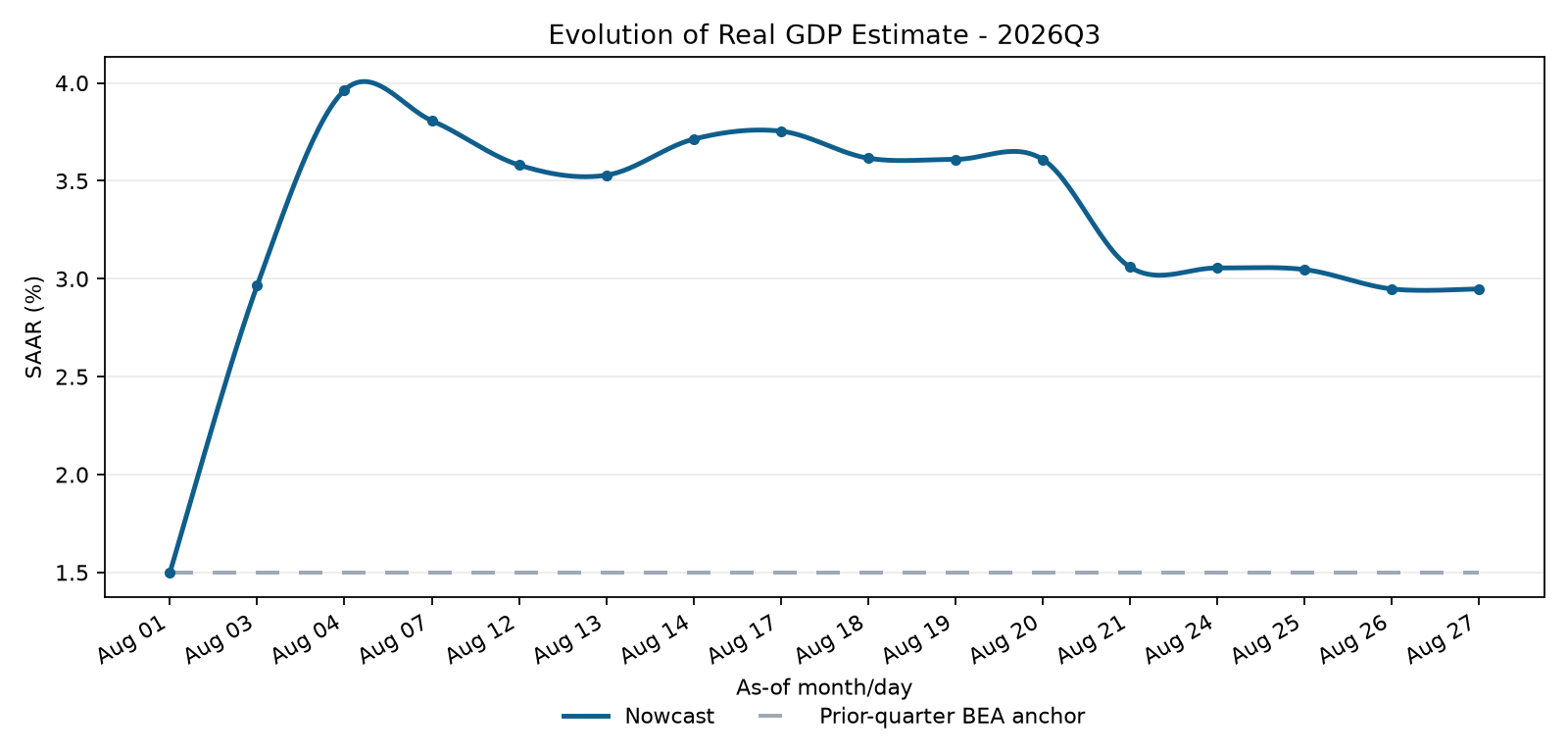
My Q3 2026 GDP nowcast held at 2.95% annualized on August 27, unchanged from yesterday's estimate. That works out to roughly 0.74% growth quarter over quarter.
There was no meaningful change in the headline forecast today, but that does not mean the new data were uneventful. Initial jobless claims, mortgage rates and the 10-year Treasury yield were incorporated into the latest run, giving us another look at the labor market and the financial conditions facing housing.
The strongest piece of data came from initial jobless claims. New claims fell by 4,000 to 203,000 for the week ending August 22, down from a revised 207,000 the previous week and below the 208,000 economists had expected. Continuing claims also fell, dropping to 1.778 million.
That continues to paint a fairly unusual picture of the labor market. Hiring has slowed considerably, but employers still are not laying off workers in large numbers. For the GDP outlook, that matters because employment and income remain important supports for household spending. As long as layoffs remain this low, it becomes harder to make the case for an abrupt deterioration in consumer demand.
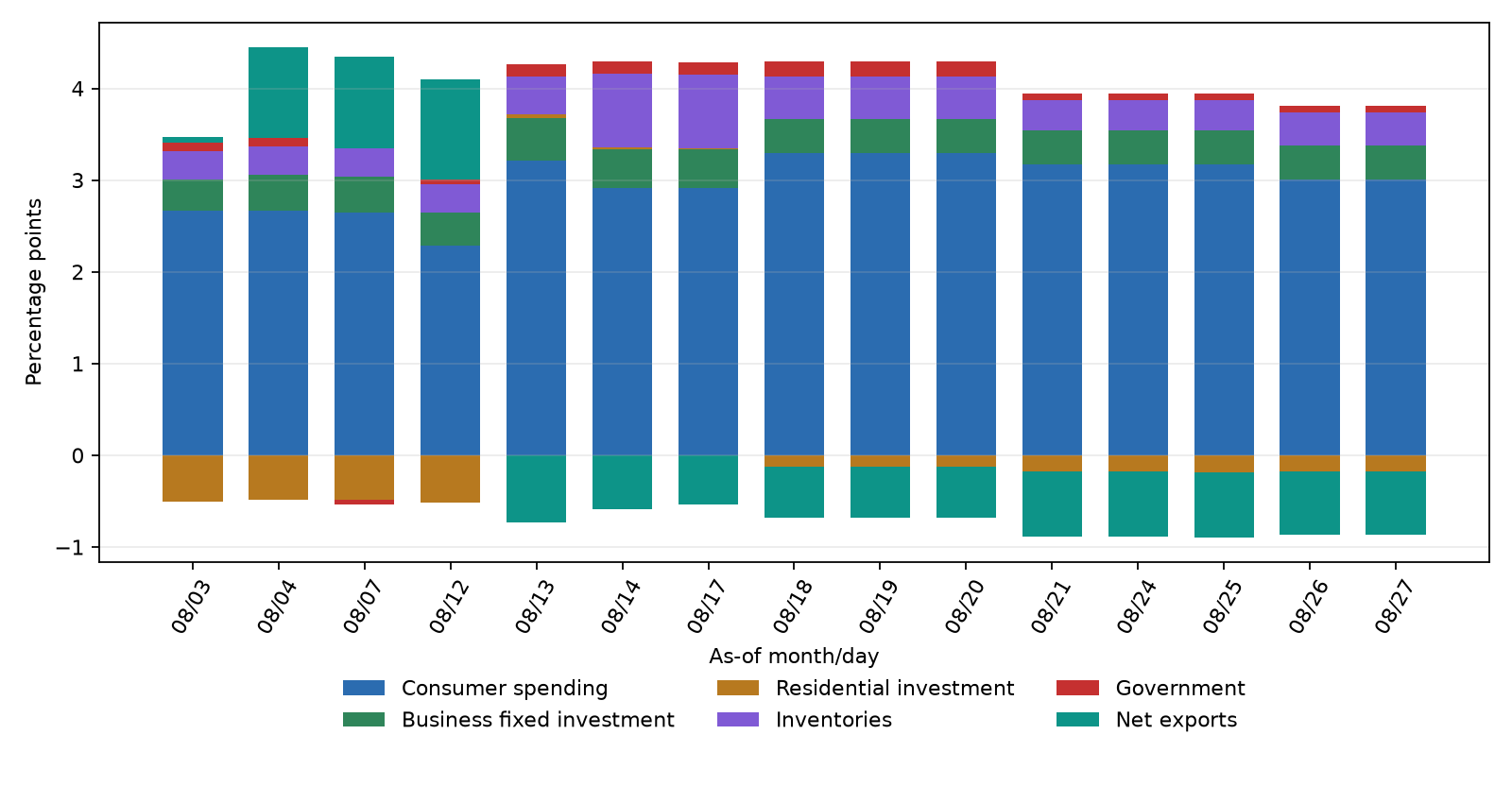
That is particularly important for my current forecast because consumer spending is contributing about 3.00 percentage points to Q3 growth. It remains by far the largest positive component in the model.
Contribution Levels
Housing remains a different story. Freddie Mac reported that the average 30-year fixed mortgage rate edged up from 6.65% to 6.66% this week. That is only a one-basis-point increase, but mortgage rates remain high enough to restrain affordability and housing demand.
The 10-year Treasury yield also remained elevated, trading around 4.67% Thursday as markets continued to weigh inflation, oil prices and the outlook for Federal Reserve policy. Mortgage rates tend to move with longer-term Treasury yields, so persistently high bond yields continue to limit the amount of interest-rate relief reaching the housing market.
That helps explain why residential investment remains one of the weak spots in the Q3 forecast. It is currently subtracting about 0.17 percentage points from growth. Today's releases did not materially change that contribution, but they also did little to improve the interest-rate environment facing residential construction and homebuyers.
Elsewhere, business fixed investment is contributing approximately 0.38 percentage points, while inventories are adding another 0.36 percentage points. Government spending is making a relatively small positive contribution of about 0.07 percentage points.
The major drag remains net exports, which are currently subtracting approximately 0.69 percentage points from Q3 growth.
That part of the forecast deserves particular attention after today's separate advance trade data. The July goods trade deficit widened sharply to $118.8 billion, up from $101.4 billion in June. Exports fell 2.9% while imports increased 3.7%, with particularly strong growth in capital-goods imports.
Those numbers are not reflected in today's listed model inputs, so I would not attribute today's unchanged nowcast to the trade report. But the release gives us an important indication of where the external side of the Q3 accounts may be heading once the relevant trade data work their way through the model. A wider deficit creates a potentially larger subtraction from GDP through net exports, although some of the import strength also appears connected to capital investment.
That distinction will be worth watching. Imports subtract mechanically in the GDP accounting identity, but businesses importing equipment for AI infrastructure and other investment projects are not necessarily signaling weak domestic demand. The same activity can show up as stronger investment while simultaneously increasing the import subtraction.
Contribution Changes
For now, the basic Q3 picture remains intact. My nowcast continues to show 2.95% annualized real GDP growth, supported overwhelmingly by consumer spending, with additional help from business investment and inventories. Net exports remain the largest drag, while residential investment continues to struggle under high borrowing costs.
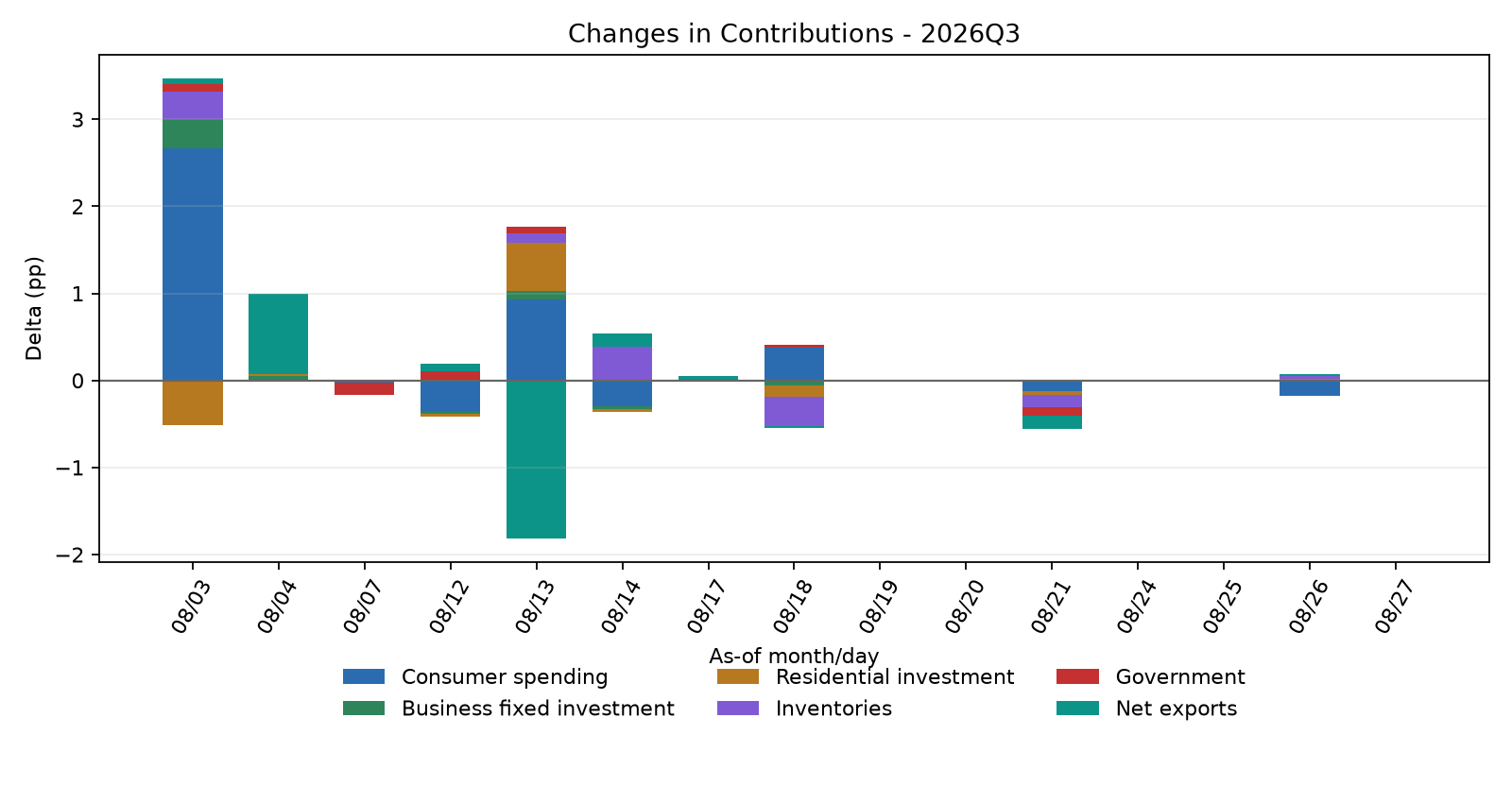
The lack of movement over the last day is useful in its own right. The model absorbed another round of labor-market and interest-rate information without materially changing its estimate of Q3 growth. The question now is whether upcoming releases reinforce that stability or begin shifting the balance between resilient domestic demand and the growing drag from trade.
Nowcast Path
You can follow the Q3 GDP nowcast and future updates at GDPDynamics.com.